
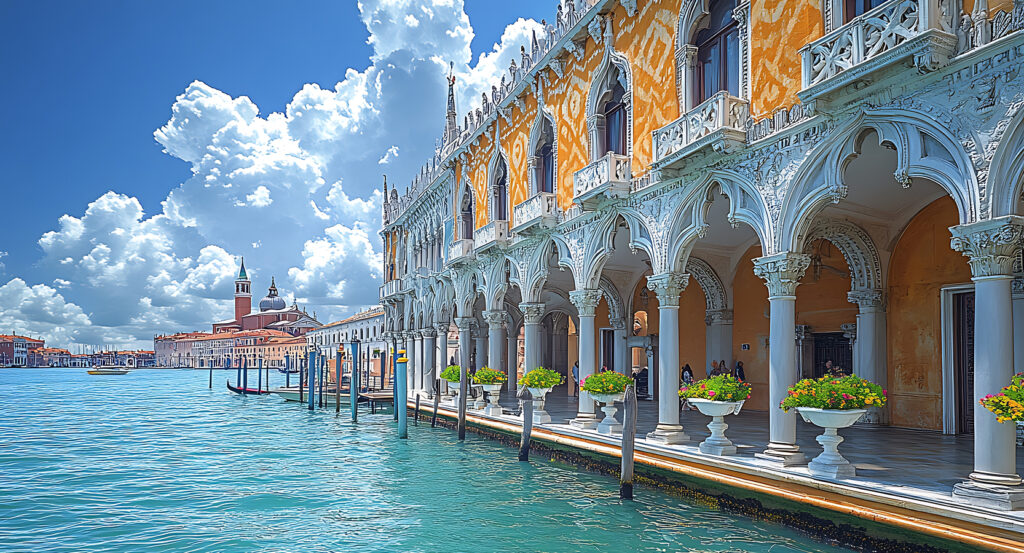
Why you should experience Giants' Staircase at Doge's Palace in Venice, Italy.
Giants' Staircase at Doge's Palace is the ceremonial spine of the Doge's Palace, the ascent where power became performance.
Rising through the palace courtyard in luminous white marble, this grand staircase was more than an architectural feature; it was a stage. Here, beneath the watchful gaze of colossal statues of Mars and Neptune, Venice crowned its Doges, elevating mortal rulers into symbols of divine authority. The symmetry is flawless, the geometry intentional: every line guiding the eye upward, every step a calculated gesture of reverence. The staircase was built to project discipline, grace, and inevitability, a visible declaration that beauty and order were the foundations of Venetian rule. Standing at its base today, the marble gleams like water frozen mid-motion. You can almost hear the echo of trumpets, the rustle of silks, the murmurs of the Senate gathering above. Giants' Staircase is Venice distilled, theatrical, disciplined, and entirely aware of its own majesty.
What you should know about Giants' Staircase at Doge's Palace.
Constructed in the late 15th century by architect Antonio Rizzo, the staircase marked a turning point in Venetian architectural language.
It replaced an earlier Gothic structure with a design that embraced the emerging ideals of the Renaissance, proportion, clarity, and humanism expressed through marble. Yet Venice, ever the contrarian, refused to abandon its drama. The statues of Neptune and Mars that crown the staircase were carved by Jacopo Sansovino a century later, embodying the Republic's twin dominions over sea and land. This pairing wasn't decorative, it was constitutional poetry in stone. The Doge's coronation took place midway up the staircase, beneath those towering figures, before the gathered nobility. The setting was deliberate: power, sanctified by art, visible to all. Hidden in its design are subtle symbols of the Republic's hierarchy, the stair's measured rise, the balustrades' rhythmic repetition, the alternating bands of light and shadow that mirror the duality of justice and grace. Few visitors realize that the staircase also served a practical function, it was the only direct access from the public courtyard to the inner state rooms, a physical and symbolic threshold between the Republic's performance and its secrecy.
How to fold Giants' Staircase at Doge's Palace into your trip.
Giants' Staircase is best experienced slowly, not climbed, but contemplated.
When you step into the courtyard of the Doge's Palace, stand first at a distance to absorb its composition: the delicate arcades framing the grand rise, the statues above catching light like guardians of ceremony. Walk forward and let your eyes trace the marble veins, they ripple softly in the sun, the stone almost translucent where centuries of footsteps have worn it smooth. Pause midway up the steps and turn toward the courtyard, the same view every Doge would have seen during his investiture, the Republic assembled below, the lagoon's light drifting between columns. If you visit in the early morning, the sun illuminates the staircase from the east, casting the statues in relief; in late afternoon, the light falls from the side, turning the marble a deep honeyed gold. After ascending, continue into the interior halls through the Porta della Carta, following the same route once reserved for Venice's rulers. Giants' Staircase at Doge's Palace isn't merely a transition between levels, it's a ritual made permanent in stone, a reminder that in Venice, every ascent was both political and spiritual.
Where your story begins.
Foresyte Travel reveals places that feel extraordinary long before you arrive.
Experience premium editorial crafted for luxury travelers.




















































































































