
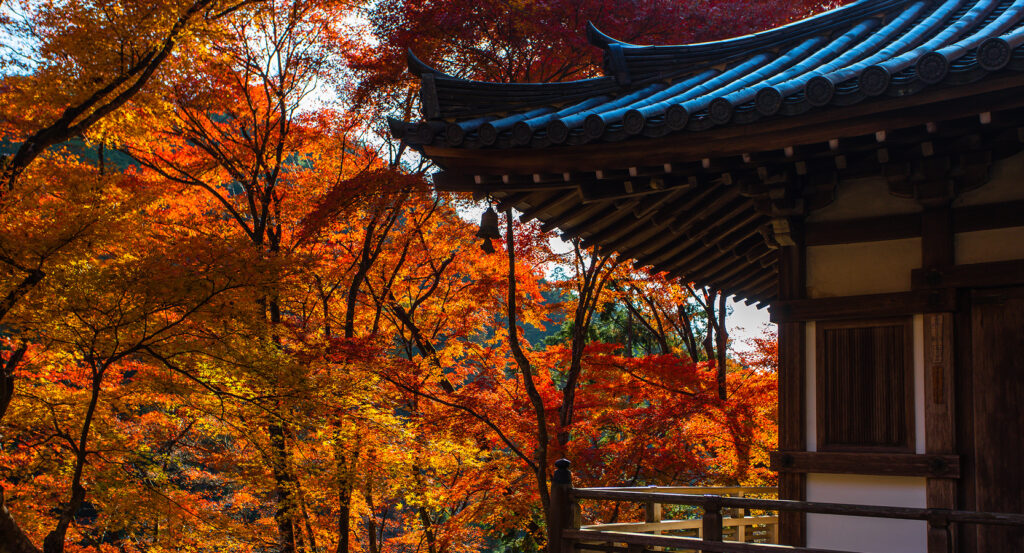
Why Hojo Garden matters.
Hojo Garden is where Eikandō begins to breathe, a living reflection of Kyoto's most meditative truths.
Set at the foot of the temple's hillside complex, it opens like a pause between corridors: water, stone, and silence arranged in perfect rhythm. A pond lies at its center, ringed with stepping stones, crimson maples, and the soft sweep of moss. The reflections here are im clear, so still they seem to hold their own light. Carp drift beneath the surface like brushstrokes, their colors moving through water the way incense moves through air. In autumn, the garden becomes a glowing echo of the hills above; in winter, it fades to silver and shadow. Every curve of the pond, every placement of rock feels deliberate, yet uncontrived, as if nature had composed it over centuries. Hojo Garden doesn't demand reverence; it earns it quietly, one breath at a time.
What defines Hojo Garden.
Hojo Garden was first designed during the late Heian period and later reimagined in the Edo era under the principles of shakkei, “borrowed scenery.”
It was crafted to frame not itself, but everything around it: the reflection of the Tahoto Pagoda above, the faint outline of Higashiyama beyond, and the rhythm of the maple trees that shift color with each season. Its pond, known as Hojo-ike, was engineered in an irregular gourd shape, a classic symbol of good fortune in Buddhist design, and fed by a natural spring that flows down from the mountain behind the temple. The stepping stones trace a subtle asymmetry, encouraging slow movement and mindful balance. Few visitors realize that the layout mirrors the structure of a Buddhist mandala: the central pond represents the pure heart, while the surrounding elements, stone, moss, water, light, symbolize the stages of awakening. The original tea pavilion once stood at the garden's northern edge, offering monks a space for quiet conversation beneath the pines. Even today, when the temple opens the garden for its autumn illuminations, the reflections of lanterns on the water create the illusion of stars drifting through earthbound sky. Every line, every ripple, every echo is an act of translation, turning faith into form.
How Hojo Garden fits.
To visit Hojo Garden is to learn how Kyoto listens.
Begin your journey at the lower courtyard of Eikandō, following the covered walkway that leads toward Hojo Hall. Step down into the garden slowly; the transition from temple to earth is meant to be felt, not rushed. Stand by the edge of the pond and take in the symmetry of reflection, trees above, their twin world below. Visit in early morning when mist lingers on the water, or at sunset when the garden glows amber and the sound of temple bells drifts across the surface. In autumn, arrive near dusk for the illumination; the lanterns transform the scene into pure emotion, the reflections flickering like candlelight beneath the stars. Sit for a moment on one of the stone benches beneath the maple canopy, feel how the air shifts between warm and cool as day gives way to evening. Before leaving, look upward toward the slope: the Tahoto Pagoda peeks faintly through the trees, completing the garden's intended discussion between reflection and ascent. Hojo Garden is not simply a view, it's Kyoto teaching you how to see again.
Where your story begins.
Foresyte Travel reveals places that feel extraordinary long before you arrive.
Enjoy editorial crafted for luxury travelers.
Foresyte may earn a commission when you book.

















































































































