
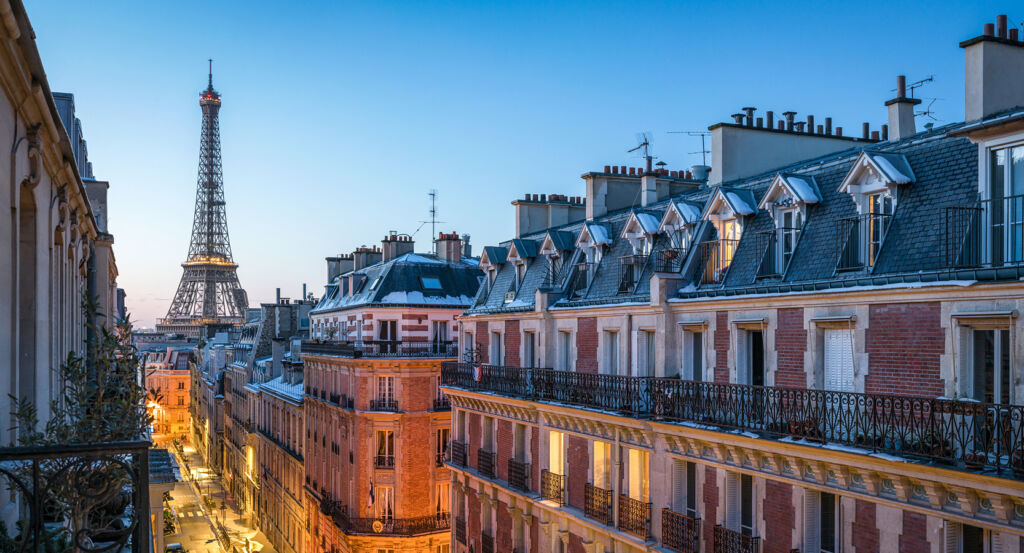
Why you should experience Elysées Bassano Hotel in Paris, France.
Elysées Bassano Hotel is a tailored four-star hotel where Chaillot's diplomatic polish, couture lineage, architectural formality and discreet Right Bank glamour converge within an intimate house shaped by the creative orbit of the Golden Triangle.
Set along Rue Bassano near Avenue Marceau and just steps from Avenue des Champs-Élysées, the 40-room hotel occupies the western edge of a district where nineteenth-century residential architecture later became inseparable from fashion houses, private mansions and international hospitality. Contemporary interiors use deep blue upholstery, graphic carpeting, warm timber and brass accents across a compact accommodation program, giving the property a visual style closer to a private Parisian pied-à-terre than a conventional business hotel. Rue Bassano itself carries the title awarded to French diplomat Hugues-Bernard Maret, Napoleon's secretary of state and later Duke of Bassano, embedding an imperial association within the hotel's address. The result is a hotel where Napoleonic nomenclature, Golden Triangle fashion culture and deliberately restrained interiors give Chaillot's cultivated western edge a hospitality character built around discretion.
What you should know about Elysées Bassano Hotel.
Elysées Bassano Hotel is best known for occupying 24 Rue Bassano, a street renamed in 1867 for Hugues-Bernard Maret, Duke of Bassano, the diplomat and statesman who became Napoleon Bonaparte's secretary of state in 1799, served as minister of foreign affairs from 1811 to 1813 and received his ducal title in 1809 following the French victory at Wagram. The contemporary four-star property contains 40 guestrooms divided among Classic, Superior, Deluxe and connecting configurations, with interiors organized around midnight blue, warm woods, metallic accents and geometric textiles. Elysées Bassano belongs to Hotels Emeraude, the independent French hotel group founded in Brittany in 1986 by Christiane Derory before expanding its collection into Paris, Rennes, Larmor-Plage and Nantes. The property underwent a substantial interior redesign that repositioned its guestrooms and communal spaces around a more contemporary decorative character while preserving the intimate proportions associated with its 40-key inventory. Together, the Duke of Bassano address, an independent French ownership lineage extending back to 1986, a tightly concentrated accommodation program and a location inside the fashion and hospitality geography surrounding Avenue George V give Elysées Bassano Hotel considerably more provenance than its restrained exterior initially reveals.
Hotels Emeraude remains a family hospitality enterprise, with founder Christiane Derory developing the company from its Breton origins into a collection of individually conceived properties rather than imposing a single design template across the portfolio. Elysées Bassano expresses that model through a compact lobby and lounge, breakfast room beneath a glazed ceiling and guestrooms whose blue-dominated palette establishes continuity. The hotel's immediate fashion context deepens the concept through Rue François 1er, Avenue Montaigne and Avenue George V, the three principal axes forming Paris's Golden Triangle and concentrating generations of French and international couture houses within a few blocks of Rue Bassano. Hugues-Bernard Maret supplies the historical counterpoint to that contemporary luxury geography, connecting the hotel's name and address to a statesman who accompanied Napoleon's political ascent from the Consulate through the Empire and briefly served as prime minister during the Hundred Days in 1815.
How to fold Elysées Bassano Hotel into your trip.
Elysées Bassano Hotel works as the anchor for an afternoon tracing how couture authorship, private collecting and modern architecture gave the streets surrounding Avenue Marceau their unusually concentrated creative authority.
Begin at Musée Yves Saint Laurent Paris, where Yves Saint Laurent transferred his couture house to 5 Avenue Marceau in 1974, directing nearly 200 atelier workers there until his retirement in 2002 before the Second Empire mansion reopened as a museum devoted to his work in 2017. Continue to Musée d'Art Moderne de Paris, created within the eastern wing of the Palais de Tokyo built for the 1937 Exposition Internationale and inaugurated as a municipal museum in 1961, with collections extending from Robert Delaunay and Sonia Delaunay to Pierre Bonnard, Henri Matisse and Raoul Dufy. Conclude at Musée Galliera, where the fashion collection of the City of Paris occupies a Renaissance-inspired palace commissioned by the duchesse de Galliera and designed by architect Léon Ginain between 1879 and 1894, placing more than a century of dress and couture history inside one of western Paris's great patronage projects. The progression moves from Saint Laurent's working couture headquarters through twentieth-century artistic experimentation into the institutional preservation of dress, revealing the creative infrastructure behind the polished fashion culture surrounding Elysées Bassano Hotel.
Where your story begins.
Foresyte Travel reveals places that feel extraordinary long before you arrive.
Experience premium editorial crafted for luxury travelers.














































































































