Why Fed Square matters.
Fed Square is a landmark civic and cultural precinct where Melbourne CBD's historic commercial heart meets the architectural experimentation, Indigenous cultural heritage, and public traditions that define Australia's most ambitious contemporary urban gathering place.
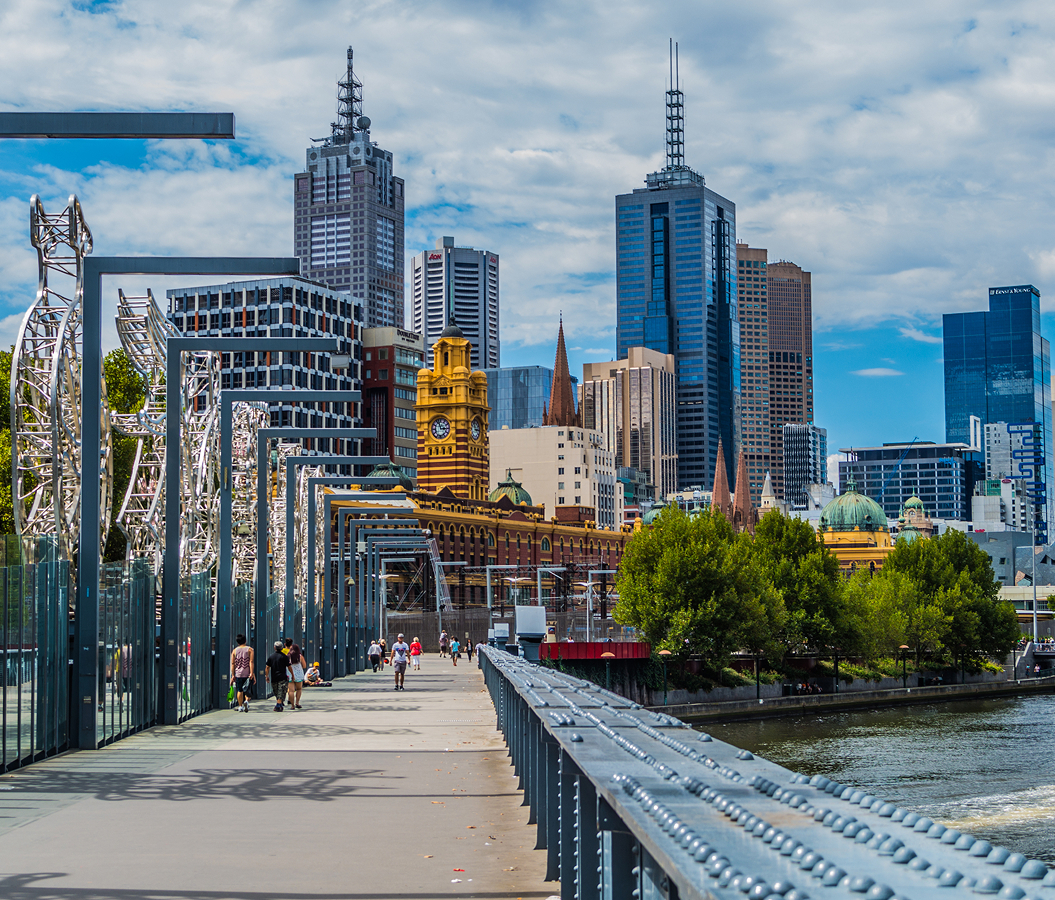
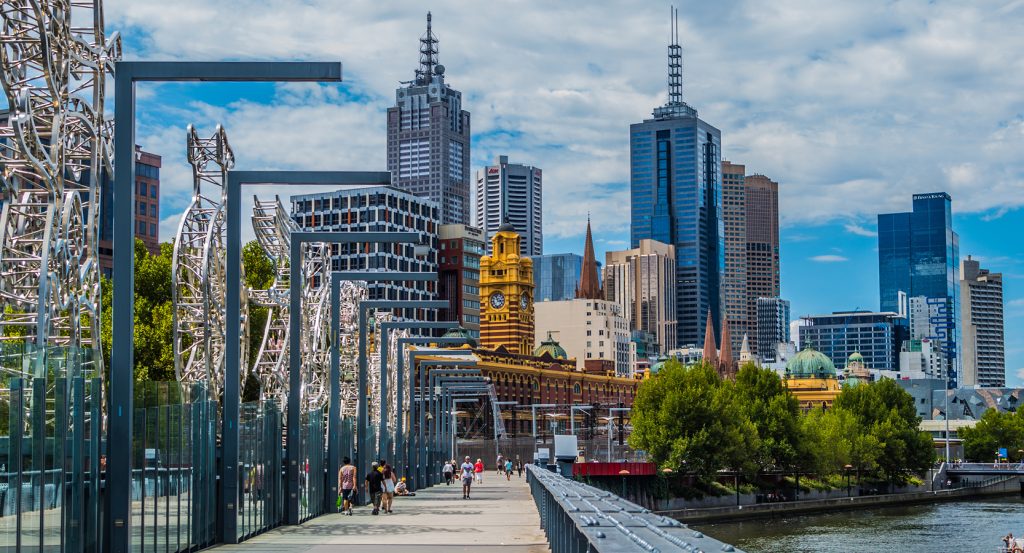
Occupying a prominent position along Flinders Street opposite Flinders Street Station, Fed Square extends across the railway corridor toward the northern bank of the Yarra River, connecting Melbourne's central business district with its southern cultural precinct. Swanston Street approaches from the northwest, St. Kilda Road continues south across Princes Bridge, and the riverfront extends east toward the sporting precinct, placing the square at the intersection of Melbourne's principal transport corridors, pedestrian routes, and cultural institutions. The precinct's striking architectural composition brings together angular buildings, irregular façades, and interlocking public spaces arranged around an expansive sandstone-paved plaza. Fractured surfaces of glass, zinc, and sandstone create a distinctive geometric character, with triangular patterns extending across the building envelopes and establishing visual continuity between separate structures. The main square descends toward an expansive outdoor screen, complemented by sheltered pedestrian passages, elevated terraces, and a glazed atrium connecting the precinct's cultural buildings. The result is an expansive civic landscape whose unconventional architecture, layered circulation, and expansive public spaces establish a powerful physical setting for Melbourne's artistic institutions and collective urban life.
What defines Fed Square.
Fed Square is best known for transforming a fragmented railway and government-office precinct into Melbourne's principal public gathering place through one of Australia's most consequential architectural competitions. The land surrounding Birrarung had served as a meeting place for the Wurundjeri Woi Wurrung people and other members of the Kulin Nations for thousands of years, establishing a cultural significance that preceded the development of the colonial city. European settlement introduced successive changes to the riverfront, including a morgue, fish market, railway infrastructure, and commercial buildings associated with Melbourne's nineteenth-century expansion. The construction of the Princes Gate Towers during the 1960s introduced a substantial modernist office complex beside the railway yards, occupying a prominent position at the southeastern edge of the central business district. Their presence became increasingly controversial as Melbourne's civic ambitions developed around the possibility of creating a major public square. The Victorian Government initiated an international architectural competition in 1996, seeking a new civic destination that would commemorate the centenary of Australian Federation and establish a permanent gathering place for public celebrations, cultural events, and community activities. The competition required a substantial open amphitheatre capable of accommodating 15,000 people alongside cultural institutions and commercial facilities. Its most demanding technical condition involved constructing the precinct above the operating Jolimont railway yards, requiring an extensive structural deck to accommodate buildings and public spaces over active railway infrastructure. London-based LAB Architecture Studio, established by architects Peter Davidson and Donald Bates in 1994, developed a proposal that challenged conventional approaches to civic-square design through fragmented geometry and interconnected spatial arrangements. The practice partnered with Melbourne architectural firm Bates Smart, whose local expertise supported the technical development and construction of the ambitious project. Their collaborative proposal won the international competition in July 1997, introducing an architectural vision grounded in the relationship between individual geometric components and a unified urban composition. Construction began in 1998 with a development budget of $450 million, supported by the Victorian Government, City of Melbourne, Commonwealth Government, and private-sector contributions. The project's complexity generated substantial political and architectural controversy, particularly concerning construction costs, the unconventional appearance of the buildings, and their relationship with the surrounding historic streetscape. Changes to the original architectural proposal intensified public debate, including modifications to the western building envelope intended to preserve important views toward the city's nineteenth-century architecture. Technical challenges associated with the railway deck, specialized cladding, and irregular building geometry contributed to delays that prevented completion for the Federation centenary celebrations on January 1, 2001. Fed Square eventually opened on October 26, 2002, establishing a major public destination at the intersection of Melbourne's central business district and its southern cultural institutions. The completed precinct immediately attracted significant attention for its departure from the rectilinear organization of the city's historic street grid. Its architects developed a complex arrangement of intersecting geometric forms that connected individual buildings through irregular passages, public terraces, and open spaces. The design received five major architectural awards from the Royal Australian Institute of Architects' Victorian chapter in 2003, establishing an extraordinary early recognition of its architectural significance. Public opinion gradually shifted as the square became a familiar setting for major sporting celebrations, political demonstrations, cultural festivals, and collective public events. More than 100,000 people gathered in the precinct during demonstrations opposing the impending invasion of Iraq in February 2003, demonstrating its capacity to accommodate large-scale civic expression. The Melbourne Prize began using the precinct for its exhibitions in 2005, strengthening the square's relationship with the city's literary, artistic, and cultural institutions. The site's growing significance culminated in its inclusion on the Victorian Heritage Register in 2019, making it the youngest building complex in Australia to receive that recognition. Its heritage designation acknowledged the exceptional architectural ambition of the project and its transformation of Melbourne's civic geography. Fed Square's development connects the city's ancient Indigenous gathering traditions with the political ambitions of Federation-era commemoration, the technical challenges of constructing above active railway infrastructure, and the emergence of a nationally significant architectural landmark.
The Ian Potter Centre: NGV Australia establishes one of the precinct's most important cultural foundations through its dedication to Australian art, connecting the public square with a collection encompassing Indigenous artistic traditions, colonial painting, modernism, and contemporary visual culture. Named for Australian businessman and philanthropist Sir Ian Potter, the institution occupies a purpose-designed gallery building whose exhibition spaces accommodate major works from the National Gallery of Victoria's Australian collection. Its galleries trace the development of Australian painting through nineteenth-century landscapes, portraiture, and the emergence of artistic movements shaped by the country's distinctive environment and changing social conditions. The Heidelberg School occupies a particularly consequential position within this history, connecting artists including Tom Roberts, Arthur Streeton, and Frederick McCubbin with the development of Australian Impressionism during the late nineteenth century. Indigenous Australian art introduces a much longer cultural history through works grounded in Country, ancestral knowledge, ceremonial traditions, and the continuing artistic practices of Aboriginal and Torres Strait Islander communities. The gallery's presentation of these traditions establishes a relationship between the surrounding urban landscape and the artistic histories that preceded European settlement. ACMI, Australia's national museum of screen culture, develops another dimension of the precinct's cultural significance through the history and transformation of moving-image technology. The institution originated as the State Film Centre of Victoria in 1946, establishing an archival and educational foundation that subsequently expanded into cinema, television, animation, video games, and digital media. Its permanent exhibition, The Story of the Moving Image, examines the development of screen culture through historical objects, interactive installations, and works associated with international filmmaking and technological innovation. Early optical devices establish the mechanical principles that preceded cinema, connecting experiments in sequential imagery with the later development of photographic motion pictures. The exhibition subsequently explores the emergence of synchronized sound, color cinematography, and the expanding relationship between screen technology and popular entertainment. Australian film history receives particular attention through the country's early contributions to narrative cinema and the development of internationally recognized filmmakers, performers, and production companies. Video games extend the institution's treatment of moving images into interactive digital environments, examining how technological advances transformed audiences into participants within fictional worlds. Koorie Heritage Trust introduces a complementary cultural perspective through its dedication to the histories, artistic practices, and contemporary achievements of Aboriginal communities in southeastern Australia. Established in 1985, the organization developed from an initiative to preserve and promote Koorie cultural heritage through collections, exhibitions, educational programs, and community engagement. Its relocation to the precinct in 2015 strengthened the public visibility of First Peoples' cultural traditions within Melbourne's central civic landscape. The Trust's collections include historical photographs, artworks, cultural objects, and archival holdings that connect Indigenous family histories with the broader development of Victoria. Its exhibitions emphasize the continuing presence of Aboriginal communities through contemporary artistic production and the preservation of cultural knowledge across generations. The precinct's cultural institutions collectively establish a remarkable concentration of Australian artistic history, moving-image innovation, and Indigenous cultural preservation, giving Fed Square an intellectual and creative significance extending far beyond its role as an urban gathering place.
How Fed Square fits.
Fed Square works as the centerpiece of a Melbourne exploration connecting nineteenth-century ecclesiastical architecture, the international development of urban street art, and the transformation of the Yarra riverfront into a landscape of public art and recreation.
Begin at St. Paul's Cathedral, the expansive Anglican church occupying the historic intersection of Flinders Street and Swanston Street. English architect William Butterfield developed the Gothic Revival design, introducing a polychromatic architectural composition that combined sandstone masonry with richly patterned interior surfaces. Construction began in 1880 on a site associated with Melbourne's earliest public Christian worship, and the cathedral was consecrated on January 22, 1891. Butterfield's relationship with the project deteriorated through disagreements with local church authorities, leading to his resignation in 1884 and the appointment of Melbourne architect Joseph Reed to supervise its completion. The cathedral's soaring spires were subsequently completed in 1932 through the work of architect James Barr, establishing the building's distinctive silhouette above the surrounding city streets. Continue to Hosier Lane, the narrow bluestone-paved passage whose transformation into an internationally recognized street-art destination reflects Melbourne's late twentieth-century creative development. The lane originated as a service passage within the city's commercial grid, accommodating deliveries and access to the warehouses and businesses occupying the surrounding blocks. Its artistic transformation accelerated during the 1990s as graffiti writers and street artists began treating its walls as an evolving public canvas. The Citylights initiative contributed to the development of the surrounding street-art culture, connecting artists with unconventional exhibition spaces and encouraging new approaches to public artistic expression. A major intervention arrived in November 2013 through All Your Walls, an ambitious collaborative project involving more than 100 artists who repainted the lane and adjoining Rutledge Lane. The event formed part of the broader Melbourne Now cultural program, strengthening the relationship between independent street art and the city's established artistic institutions. Conclude at Birrarung Marr, the landscaped riverfront park extending eastward along the northern bank of the Yarra. Opened in 2002, the park transformed former transport infrastructure and underused riverside land into a substantial public landscape organized around three descending terraces. Its name derives from Wurundjeri language, combining the terms associated with the river and its banks. Birrarung Wilam introduces an important Indigenous artistic dimension through a sculptural installation featuring a winding pathway associated with the eel and a semicircular arrangement of metal shields representing the five groups of the Kulin Nations. The park also contains Deborah Halpern's two-headed Angel sculpture, a substantial ceramic work whose expressive forms introduce a distinctive element of contemporary Australian public art. The Federation Bells provide another remarkable artistic installation through 39 upturned bronze bells designed by Anton Hasell and Neil McLachlan in collaboration with Swaney Draper Architects. Their electronically controlled compositions connect musical performance with the surrounding landscape, extending the park's cultural character into the acoustic environment of the riverfront. The progression moves from St. Paul's Cathedral's nineteenth-century ecclesiastical architecture through Hosier Lane's transformation of commercial infrastructure into public artistic expression and culminates at Birrarung Marr, where Indigenous cultural heritage, contemporary sculpture, and experimental musical installations shape Melbourne's evolving relationship with its river.
Where your story begins.
Foresyte Travel reveals places that feel extraordinary long before you arrive.
Enjoy editorial crafted for luxury travelers.
Foresyte may earn a commission when you book.