
Why you should experience First Hotel in Paris, France.
First Hotel is a graphic four-star hotel where Cambronne's residential composure, Eiffel Tower mythology and Left Bank geometry are distilled into an unusually disciplined black-and-white interior conceived as a contemporary counterpoint to its Haussmannian shell.
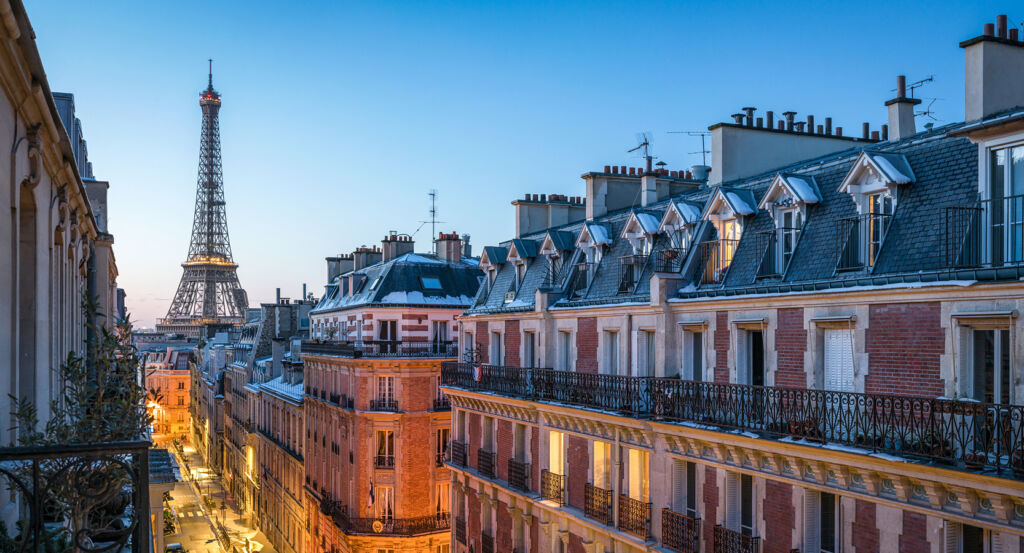
Set along Boulevard Garibaldi at Place Cambronne, the 43-room property uses a restrained monochrome style across guestrooms before introducing gold, ochre and patterned textiles as warmer accents in its larger accommodations. Wrought-iron balconies preserve the building's Parisian street character, while selected upper-level rooms frame direct Eiffel Tower views, turning the monument into part of the interior composition. The room collection progresses from compact 13-square-meter Singles through Classic and Superior categories to suites, with courtyard-facing and skyline-facing orientations creating materially different experiences within the same small property. The result is a hotel where disciplined interiors and carefully framed Paris views give Cambronne's quieter urban character a confident visual identity.
What you should know about First Hotel.
First Hotel is best known for building its character around 43 rooms and suites whose contemporary black-and-white interiors use the Eiffel Tower as both geographical context and recurring visual punctuation, with selected accommodations opening directly toward the monument across the rooftops of the fifteenth Arrondissement. The accommodation sequence begins with 13-square-meter Single rooms and 15-square-meter Classic Doubles before reaching 16-square-meter Superior courtyard rooms, with larger categories adding balconies, expanded living space and increasingly prominent Paris views. First Hotel occupies 2 Boulevard Garibaldi beside Cambronne, placing the property at the intersection of the broad nineteenth-century boulevards created across this portion of the Left Bank and the residential fabric extending south from Champ de Mars. FINOTEL directs the property within a French hospitality portfolio, while First Hotel's independent visual character distinguishes the Cambronne address through its tightly controlled decorative language and compact 43-key scale.
First Hotel develops that character most convincingly through its Eiffel Tower-facing accommodations, where wrought-iron balconies and full-height windows turn Gustave Eiffel's structure into an active element of the guestrooms. FINOTEL maintains the property as an independently presented Paris hotel, allowing the First Hotel name and monochrome design concept to remain more prominent than a standardized international brand vocabulary. Place Cambronne supplies the immediate urban frame, connecting First Hotel with a district named for Pierre Cambronne, the Napoleonic general whose military career stretched from the Revolutionary Wars through Waterloo and whose name remains embedded throughout the surrounding streetscape. First Hotel ultimately derives its strongest character from the convergence of FINOTEL's boutique positioning, Place Cambronne's historical character and guestrooms composed around views of Gustave Eiffel's 1889 iron tower.
How to fold First Hotel into your trip.
First Hotel works as the anchor for an afternoon tracing how military performance, technological invention and international modernism repeatedly reshaped the western Left Bank.
Begin at Musée Bourdelle, where sculptor Antoine Bourdelle worked from 1885 until 1929, preserving studios filled with plaster models, marbles and bronzes including studies for his 1893 Monument aux morts de Montauban and the grand Héraklès archer that established his international reputation. Continue to Maison de l'UNESCO, where Bernard Zehrfuss, Marcel Breuer and Pier Luigi Nervi collaborated on the Y-shaped headquarters inaugurated in 1958, combining modernist architecture with commissions and works by Pablo Picasso, Joan Miró, Alexander Calder, Henry Moore and Isamu Noguchi. Conclude at Hôtel des Invalides, commissioned by Louis XIV in 1670, developed under Libéral Bruant and Jules Hardouin-Mansart, crowned by the gilded Dôme des Invalides and transformed into Napoleon Bonaparte's burial place after his remains returned from Saint Helena in 1840. The progression moves from Bourdelle's intensely physical sculpture through Breuer, Nervi and Zehrfuss's international modernism into Hardouin-Mansart's architecture of royal and Napoleonic memory, revealing the artistic and historical forces surrounding First Hotel.
Where your story begins.
Foresyte Travel reveals places that feel extraordinary long before you arrive.
Experience premium editorial crafted for luxury travelers.














































































































