
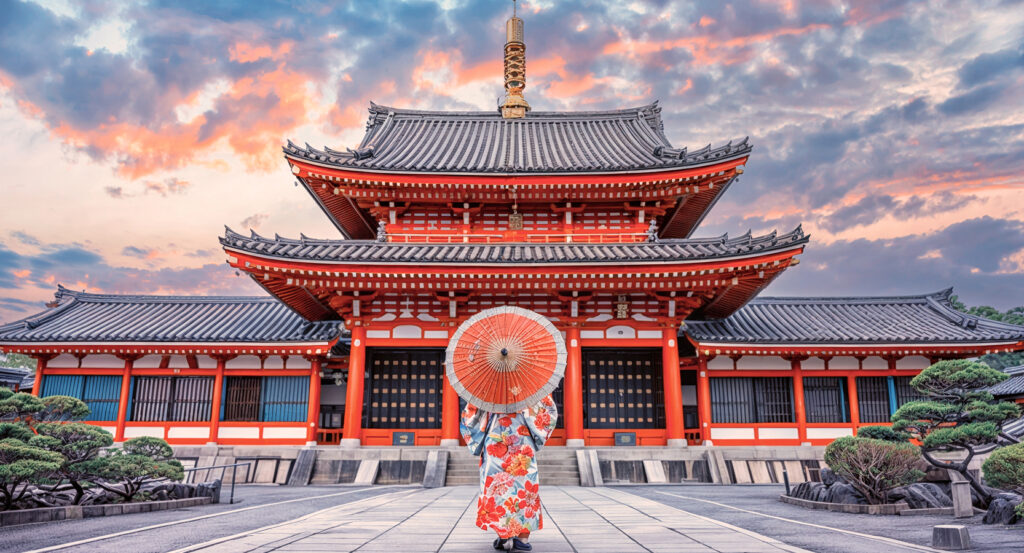
Why you should experience Sensō-ji Five-Storied Pagoda in Tokyo, Japan.
Sensō-ji Five-Storied Pagoda is a soaring Buddhist tower where Asakusa's temple-town character meets centuries of reconstruction, sacred relics and a vermilion silhouette that restores vertical drama to one of Tokyo's oldest religious precincts.
Set within Sensō-ji near Nakamise-dori and just steps from Hozomon Gate, the 53.32-meter pagoda rises southwest of the Main Hall from a broad podium building, giving its five diminishing roofs a far greater visual reach across the precinct than their compact 7.5-meter-square first stage suggests. The steel and reinforced-concrete tower climbs 48.32 meters above its base before a 15.07-meter sorin extends from the upper roof, producing the steep vertical accent visible between the temple's lower halls and gates. Moving around the precinct continually recomposes that profile, with vermilion structural elements, deep eaves and rooflines appearing above Hozomon, beside incense smoke or through openings between surrounding buildings. The tower's elevation above the podium separates its religious interior from the public circulation below, preserving the uppermost fifth storey as the sacred chamber for relics associated with Shakyamuni Buddha. The result is a pagoda whose immense visual presence remains inseparable from its religious purpose, turning a structure reconstructed in the twentieth century into the vertical marker of a Buddhist tradition at Sensō-ji extending more than a millennium.
What you should know about Sensō-ji Five-Storied Pagoda.
Sensō-ji Five-Storied Pagoda is best known for carrying a tower tradition attributed to Taira no Kinmasa in 942 through repeated destruction, Tokugawa reconstruction and the rebuilding of Sensō-ji after the 1945 Tokyo air raid. Kinmasa's original structure was a three-storey pagoda, and Sensō-ji preserves the possibility that two towers once stood symmetrically around the Main Hall in a configuration associated with the Yakushi-ji temple plan. An earthquake destroyed the early tower in 1041, and later structures passed through another sequence of repair, fire and rebuilding during the seventeenth century. Tokugawa Iemitsu commissioned the five-storey pagoda completed in 1648, one year before his reconstruction of the Main Hall and Niomon, embedding the tower within the shogunate's extensive patronage of Sensō-ji. Repairs followed in 1692, 1719 and 1886, and the government designated the structure a National Treasure in 1911. Its engineering survived the Ansei earthquake of 1855 with little more than fallen roof tiles, although the shaking bent the uppermost kurin, an incident preserved in contemporary imagery and remembered through an Edo wordplay linking magatta, or bent, with ma ga totta. Ukiyo-e artists including Utagawa Hiroshige and Utagawa Kuniyoshi repeatedly incorporated the pagoda into views of Asakusa, spreading its profile far beyond the temple precinct. The March 10, 1945 air raid ended that physical lineage when incendiary bombing destroyed the 33-meter Tokugawa tower along with the Main Hall, Niomon and other major structures. Reconstruction of the present pagoda began ceremonially in 1968, construction commenced in 1970 and the tower was completed on November 1, 1973, restoring a vertical element absent from Sensō-ji for 28 years.
The rebuilt tower acquired a new sacred center through relics formally brought to Sensō-ji from Sri Lanka before construction began. On March 18, 1966, Isurumuniya Temple transferred busshari associated with Shakyamuni Buddha to Sensō-ji, linking the future pagoda directly with the Indian stupa tradition from which Buddhist pagodas developed. The relics now occupy the fifth storey at the summit of the tower, placing the structure's most sacred contents above the memorial complex built beneath it. That Lower Five-Storied Pagoda compound surrounds the tower with memorial chambers containing one hundred statues of Sho Kannon, with perpetual memorial tablets placed around them and an Amida triad installed at the front. Close to 30,000 memorial tablets are held within the complex, connecting individual commemoration with the larger Buddhist symbolism of the tower. Sensō-ji also preserves more than 200 votive ema in the Five-Storied Pagoda compound, including works by major artists such as Tani Buncho, Suzuki Kiitsu, Hasegawa Settan, Utagawa Kuniyoshi and Kano Kazunobu. Many survived the 1945 destruction through an extraordinary circumstance: they had been removed from the Main Hall during repairs completed in 1933 and were never returned before the air raid. The present complex consequently joins relic veneration, memorial practice and an important surviving body of Edo-period devotional painting within the reconstructed pagoda precinct.
How to fold Sensō-ji Five-Storied Pagoda into your trip.
Sensō-ji Five-Storied Pagoda works as the anchor for an Asakusa route through three smaller religious sites that uncover surviving Tokugawa architecture, a modern hall built around older devotional objects and the riverside ground tied to Sensō-ji's foundational tradition.
Begin at Yakushido Hall, among the rare Sensō-ji buildings whose physical fabric reaches directly into the Tokugawa reconstruction campaign. Tokugawa Iemitsu built the present three-bay-square hall in 1649 northwest of the Main Hall, and a small neighboring bridge led him to give it the name Hashimoto Yakushido. Its principal seated Yakushi Nyorai is joined by Nikko and Gakko Bosatsu, the Twelve Heavenly Generals and a group of Ten Kings associated with judgment of the dead, concentrating several layers of Buddhist devotion within a comparatively small structure. Precinct reorganization moved the entire hall to its current site south of Yogodo Hall in October 1994 and included restoration work, preserving a seventeenth-century building through physical relocation inside a temple complex repeatedly transformed around it. Continue to Yogodo Hall, completed in 1994 to commemorate the 1,200th anniversary of the birth of Ennin, the Tendai monk revered by Sensō-ji as a major figure in its institutional development. Its altar places Sho Kannon at the center with eight protective Buddhist figures associated with the twelve zodiac birth signs, including Senju Kannon, Kokuzo Bosatsu, Monju Bosatsu, Fugen Bosatsu, Seishi Bosatsu, Dainichi Nyorai, Fudo Myoo and Amida Nyorai. The surrounding ground reaches much further back than the hall itself: a stone bridge erected in 1618 survives nearby as Tokyo's oldest bridge, accompanied by a 1693 bronze Amida and a large 1761 bronze hokyointo funded by close to one thousand worshippers. Yogodo gathers objects separated by centuries around a modern devotional building, exposing how Sensō-ji has repeatedly reorganized older sacred fabric. Conclude at Komagatado Hall beside the Sumida River, where Sensō-ji locates the event from which the entire temple tradition begins. In 628, brothers Hinokuma Hamanari and Takenari are said to have retrieved the image of Sho Kannon from the river near this ground before Haji no Nakatomo enshrined it, and Taira no Kinmasa later established a hall here during his 942 construction campaign. Edo-period worshippers arriving by boat encountered Komagatado before proceeding toward Sensō-ji, making the riverside sanctuary an earlier ceremonial threshold for people approaching Asakusa from the water. A 1693 stone prohibition on killing fish protected a section of the Sumida River near the sacred site, extending Buddhist concern for living creatures into the surrounding waters. The present hall dates to 2003 and houses a 28.8-centimeter wooden Batō Kannon, maintaining worship beside the river more than thirteen centuries after the tradition that established Sensō-ji began there. The progression moves from Yakushido Hall's surviving connection with Iemitsu's seventeenth-century building campaign through Yogodo Hall's concentration of devotional objects from several periods into Komagatado Hall's relationship with the river and the 628 Kannon tradition, carrying Sensō-ji Five-Storied Pagoda backward through the architectural and sacred history surrounding its reconstructed tower.
Where your story begins.
Foresyte Travel reveals places that feel extraordinary long before you arrive.
Experience premium editorial crafted for luxury travelers.

















































































































