Why Fleur de Pavé matters.
Fleur de Pavé is an inventive restaurant where Sentier's mercantile character meets Sylvain Sendra's MICHELIN-starred cooking, Japanese influences and an unusually close relationship with grower Asafumi Yamashita.
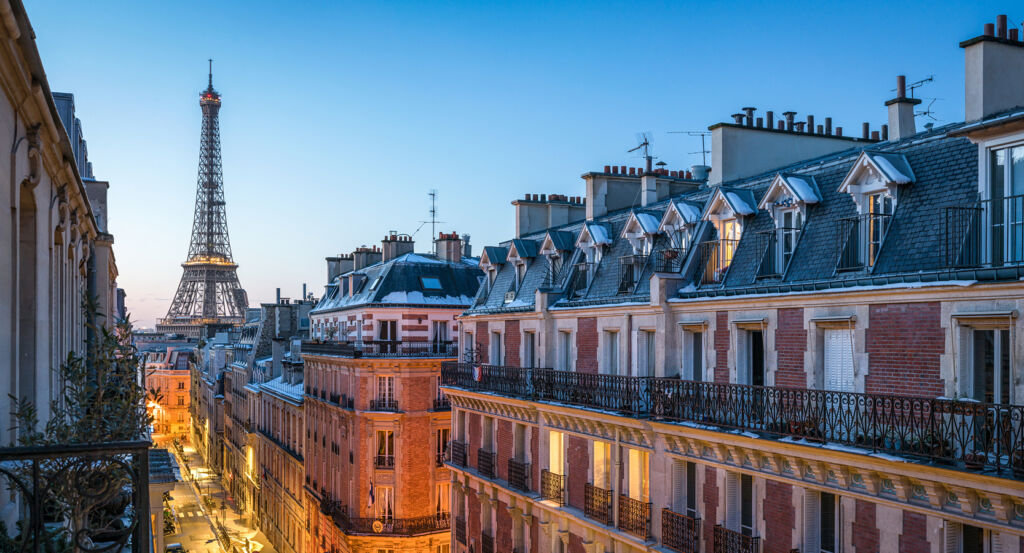
Set along Rue Paul Lelong near Rue Montmartre and just west of Rue d'Aboukir, the restaurant occupies a compact corner of the 2nd Arrondissement between the Bourse, Sentier's former textile streets and the dense commercial passages extending south toward Les Halles. Dark walls, exposed stone and restrained furnishings give the dining room a deliberately intimate scale. Closely spaced tables place the plates and wine service at the visual center of the room. The limited footprint concentrates attention on Sendra's tasting formats. The result is a small Paris restaurant whose physical restraint gives unusually concentrated attention to the kitchen, cellar and ingredients.
What defines Fleur de Pavé.
Fleur de Pavé is best known as chef Sylvain Sendra's return to Paris after a career that moved through Lyon, the Côte d'Azur, London, the Latin Quarter and extensive international travel. Born in Lyon in 1977 to a family of bakers and pastry chefs, Sendra trained at Vatel before working at La Chèvre d'Or in Èze. A move to London brought him into Alexis Gauthier's kitchen at Roussillon, adding a British chapter to his early French training. He opened Le Temps au Temps in Paris at 23 and later moved into a larger kitchen with Itinéraires in the 5th Arrondissement. Itinéraires earned Sendra his first MICHELIN star and became the principal setting for cooking increasingly shaped by his travels through Asia and his growing interest in Japan and Japanese green tea. Bocca Rossa and the wine bar 58 Qualité Street extended his Paris portfolio into different formats. Sendra eventually sold Itinéraires and spent a year traveling and consulting before returning to Paris in 2019 to open Fleur de Pavé. Gault&Millau awarded the new restaurant two toques immediately after its debut, and MICHELIN subsequently awarded Fleur de Pavé a star. The restaurant remains under Sendra's direction in 2026, completing an arc in which successive businesses, international kitchens and extended travel were consolidated into his most personal Paris restaurant.
Asafumi Yamashita's vegetables provide one of the kitchen's most distinctive foundations. The Japanese grower cultivates produce in the Yvelines outside Paris and supplies Sendra with vegetables selected for flavor, maturity and culinary purpose. Sendra's cooking places that produce within compositions influenced particularly by encounters with Japan and Peru, using acidity, controlled cooking and textural contrast to sharpen individual ingredients. Japanese green tea supplies another strand carried forward from his years at Itinéraires, giving bitterness and vegetal depth a place beside classical French technique. The kitchen favors concise compositions whose apparent simplicity depends on exact cooking and calibrated contrasts. Vegetable courses receive the same structural importance as fish and meat, allowing Yamashita's harvests to determine portions of the menu as seasons change. Tasting formats extend that approach across several services, creating space for shifts between raw and cooked preparations, concentrated sauces, crisp elements and softer textures. The wine cellar carries enough depth to function as a parallel component of the meal, with bottles selected beyond the scale normally associated with such a compact dining room. Fleur de Pavé consequently places Sendra's international influences inside a highly disciplined French structure, with exceptional produce supplying the central point of departure.
How Fleur de Pavé fits.
Fleur de Pavé works as the anchor for a Sentier outing connecting nineteenth-century library engineering, Paris's former commodities exchange and one of the capital's surviving covered passages.
Begin at BnF Richelieu, the historic Bibliothèque nationale complex whose architecture accumulated through successive campaigns responding to the enormous growth of France's collections. Henri Labrouste transformed the institution during the nineteenth century and completed his celebrated reading room between 1861 and 1868, suspending nine ceramic-clad cupolas on open iron arches carried by sixteen slender cast-iron columns. Jean-Louis Pascal began the Salle Ovale in 1897; Alfred Recoura completed it in 1932, and President Albert Lebrun inaugurated the room in 1936. Its 43.7-meter-long interior reopened to the public in 2022 after the wider Richelieu restoration. Continue to Bourse de Commerce, whose circular form preserves layers extending from Catherine de Médicis's residence to an eighteenth-century grain hall. The former Halle aux blés acquired an innovative iron dome in 1812, was reconstructed as the commodities exchange in 1889 and later entered another architectural chapter when François Pinault selected it for his contemporary-art collection. Tadao Ando inserted a cylindrical concrete volume inside the rotunda, working with NeM / Niney et Marca Architectes and Pierre-Antoine Gatier before the museum opened in 2021. Conclude at Passage des Panoramas, opened in 1799 and among the earliest surviving covered passages in Paris. American inventor Robert Fulton presented his panoramic paintings in rotundas associated with the site, supplying the passage with its enduring name, and its glazed commercial interior became part of a nineteenth-century building type that concentrated shops, pedestrians and illumination beneath a protected roof. The progression moves from industrial-age library engineering through the repeated reinvention of a circular commercial building and culminates in an early covered passage that helped redefine pedestrian commerce in Paris.
Where your story begins.
Foresyte Travel reveals places that feel extraordinary long before you arrive.
Experience premium editorial crafted for luxury travelers.
Foresyte Travel may earn a commission when you book through the link on this page.