
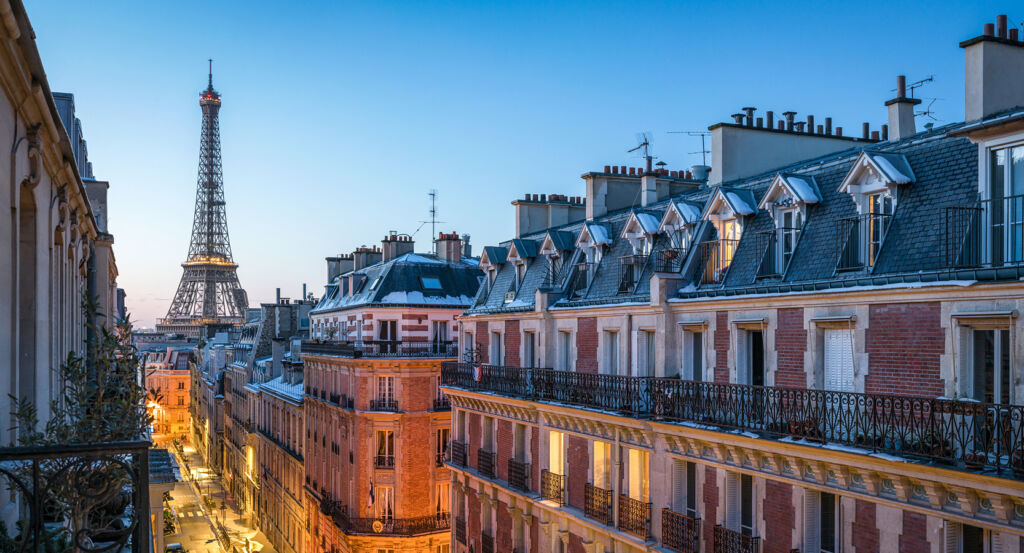
Why 5th Arrondissement matters.
5th Arrondissement is an intellectually charged enclave where the ancient Left Bank meets modern Paris through steep historic streets, university buildings, bookshops and riverfront institutions layered across the ground of Roman Lutetia.
Positioned between Saint-Germain-des-Prés, the 13th Arrondissement, and the Seine, the neighborhood occupies a broad Left Bank territory rising from the river through the Quartier Latin toward the Montagne Sainte-Geneviève before descending south through Val-de-Grâce and the old Bièvre corridor. Rue Saint-Jacques and Boulevard Saint-Michel establish strong north-south lines across the slope, yet smaller streets around Maubert, Mouffetard and the upper hill repeatedly break that order through bends, changing widths and inherited alignments that expose the district's exceptional chronological depth. The ascent toward the Montagne Sainte-Geneviève supplies the primary encounter as stone facades, academic institutions and compressed side streets turn elevation into a sequence of changing perspectives between the Seine and the southern Left Bank. Rue Mouffetard supplies a distinct secondary mechanism through a long descending corridor where narrow building plots and dense commercial frontage carry the scale of pre-Haussmann Paris deep into the Arrondissement. The eastern edge opens again toward planted institutional ground and the Seine, allowing enclosed medieval streets, formal nineteenth-century axes and broad riverfront space to coexist within a short walk. The result is an Arrondissement whose physical variety exposes successive layers of Paris with unusual clarity, preparing a history shaped by the concentration of teaching, scholarship and intellectual exchange on the Left Bank.
What you should know 5th Arrondissement.
5th Arrondissement is best known for containing the historic core of the Quartier Latin, where schools established around the Montagne Sainte-Geneviève developed into the intellectual concentration associated with the medieval University of Paris. Teaching expanded across the Left Bank during the twelfth century as masters and students gathered around cathedral and monastic schools, and royal recognition in 1200 helped establish the corporate privileges of the emerging university. Instruction organized around four faculties, Arts, Medicine, Canon Law and Theology, drawing scholars into colleges created to house and educate students arriving from beyond Paris. Robert de Sorbon, confessor to Louis IX, founded a theological college for poor students in 1253, and its reputation eventually made the Sorbonne name synonymous with the university itself. The use of Latin among masters and students supplied the Quartier Latin designation that became attached to the surrounding district. Sainte-Geneviève developed into another scholarly center through its abbey library, whose collections expanded under Cardinal de La Rochefoucauld during the seventeenth century and later passed into public institutional life. The Revolution dissolved the old university in 1793, but higher education returned under new structures during the nineteenth century, preserving the Montagne Sainte-Geneviève as one of France's densest concentrations of scholarship. Schools, libraries and faculties subsequently accumulated around the hill, carrying an educational geography created in the Middle Ages into the modern Arrondissement.
The southern 5th developed through another historical mechanism along the Bièvre, the small river that entered Paris from the southeast before joining the Seine near the Jardin des Plantes. Its banks supported dyers, tanners and other trades whose work depended on abundant water, concentrating workshops through the territory around present-day Rue Censier, Rue de la Clef and the lower reaches of Rue Mouffetard. Jean Gobelin established a dyeing operation beside the river during the fifteenth century, and the family's success attached the Gobelins name first to the watercourse and surrounding district before its association with royal textile production became internationally familiar. Industrial use intensified as Paris expanded, turning sections of the Bièvre into one of the city's most heavily worked waterways. Sanitary concerns and urban growth drove its gradual enclosure beneath streets during the nineteenth and early twentieth centuries, removing the visible river from the Arrondissement. Rue Mouffetard survived above this altered geography as one of the principal inherited routes across the southern hill, carrying a much older street pattern through the modern city. The disappearance of the Bièvre left an unusual historical inversion across the 5th: a waterway central to centuries of production vanished underground as the streets and commercial corridors around it endured.
How 5th Arrondissement fits.
5th Arrondissement works as the anchor for a day tracing Paris from Roman public performance through an eighteenth-century royal church recast as a national mausoleum into the medieval educational culture that connected the Left Bank with scholars arriving from across Europe.
Begin at Arènes de Lutèce, the surviving amphitheater complex whose ancient configuration combined an arena with a theatrical stage and placed large-scale entertainment inside the Roman city. Built during the Roman period and partly destroyed in 285, the structure later disappeared beneath successive occupation before Théodore Vacquer began excavating remains during construction of Rue Monge in 1869 and 1870; another campaign followed in 1883, and Victor Hugo, historian Victor Duruy and preservation advocates helped secure the surviving section before Louis Capitan directed restoration continuing through 1918. Continue to Panthéon, where Louis XV's recovery from grave illness at Metz in 1744 produced a royal vow to rebuild the ancient church of Sainte-Geneviève and ultimately one of eighteenth-century France's most ambitious architectural commissions. Jacques-Germain Soufflot developed a Greek-cross plan crowned by a triple dome, Louis XV laid the first stone in 1764, and Maximilien Brébion and Jean-Baptiste Rondelet completed the project after Soufflot's death; the Revolution converted the church into a secular national pantheon, beginning a nineteenth-century sequence in which political regimes repeatedly shifted the building between religious and commemorative functions. Conclude at Collège des Bernardins, founded in 1245 by Étienne de Lexington, abbot of Clairvaux, after Pope Innocent IV encouraged Cistercians to pursue advanced study in Paris. The complex grew around a vast Cistercian nave, residences, gardens and a church completed in 1360, receiving monks from across Europe before the Revolution ended its educational function and the property was sold in 1791; subsequent use included a prison, warehouse, school and fire station before a six-year restoration led by Hervé Baptiste with Jean-Michel Wilmotte prepared its 2008 reopening as a center for scholarship and cultural exchange. The progression moves from Roman entertainment recovered beneath nineteenth-century Paris through Soufflot's royal church repeatedly redefined by national politics into a Cistercian college created for the international circulation of medieval scholarship, compressing nearly two millennia of institutional and architectural history into the 5th Arrondissement.
Where your story begins.
Foresyte Travel reveals places that feel extraordinary long before you arrive.
Enjoy editorial crafted for luxury travelers.
Foresyte may earn a commission when you book.














































































































