
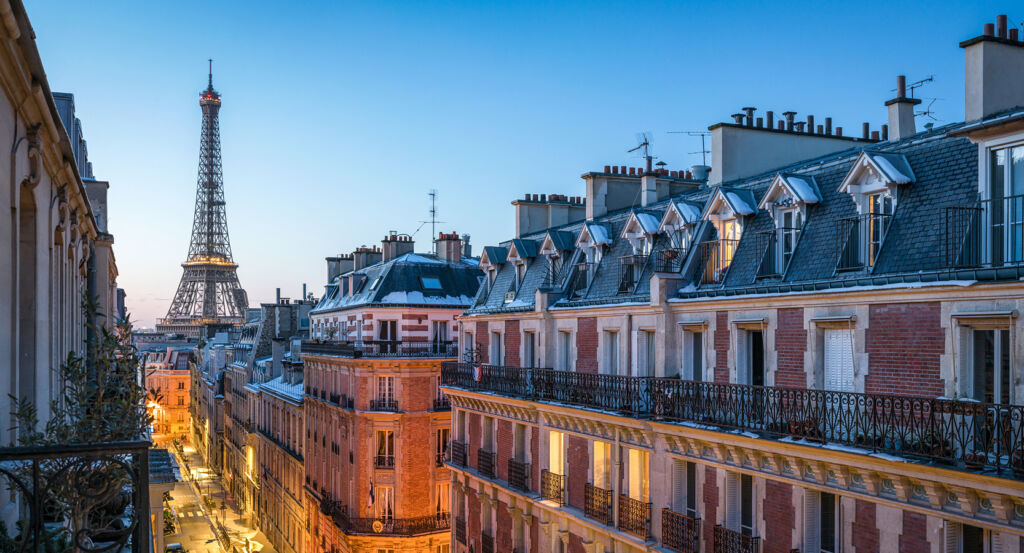
Why you should experience Foch Hotel in Paris, France.
Foch Hotel is a whimsical four-star hotel where Porte-Dauphine's patrician discretion, garden-city calm, diplomatic polish and proximity to the Bois de Boulogne are filtered through an intimate house devoted to the decorative imagination of Marie-Antoinette.
Set along Rue Marbeau near Rue Pergolèse and just steps from Avenue Foch, the 25-room hotel occupies a Haussmannian building whose seven accommodation levels unfold as a visual journey through Versailles, Petit Trianon, the Queen's Hamlet and the Tuileries. Marie-Antoinette provides the connective thread through decorative references that move between eighteenth-century motifs, patterned textiles and individually composed rooms, while balconies, terraces and courtyard-facing accommodations reinforce the private-house character of the property. The surrounding Rue Marbeau adds unusual seclusion, extending only 203 meters through a pocket of the sixteenth Arrondissement originally assembled from land connected with the former Petit-Parc of Château de la Muette. The result is a hotel where Marie-Antoinette's decorative universe and Rue Marbeau's tucked-away geography give Porte-Dauphine's polished restraint an eccentric streak of historical fantasy.
What you should know about Foch Hotel.
Foch Hotel is best known for translating the world of Marie-Antoinette across 25 individually decorated rooms, with successive floors referencing Versailles, Petit Trianon, the Queen's Hamlet and the Tuileries inside a seven-level Haussmannian property at 10 Rue Marbeau. The accommodation collection includes Standard, Traditional, Superior and Elegance Terrasse configurations, with selected rooms opening onto balconies or terraces and others facing the interior courtyard, allowing the eighteenth-century decorative premise to develop across materially different spaces. Maison Eric Kayser supplies the breads and pastries for the breakfast program, while Ferme d'Alexandre provides cheeses and yogurts, connecting the intimate hotel with two named French producers through a dining room supplemented by organic coffee and teas. Rue Marbeau itself occupies land whose modern history began after M. Marbeau acquired part of the former Casimir Périer property in 1851, terrain descended from the Petit-Parc or faisanderie attached to Château de la Muette before its sale as national property in 1796 to Comte de Saint-Simon.
Casimir Périer introduces another consequential strand to the hotel's immediate geography because the future minister of Louis-Philippe acquired the former Petit-Parc terrain from Comte de Saint-Simon before the Marbeau family's 1851 purchase helped shape the streets around the present property. M. Marbeau subsequently gave his family name to Rue Marbeau, preserving that nineteenth-century landholding history within the address of Foch Hotel more than 170 years later. Château de la Muette provides the deeper geographical origin, since the former faisanderie stretched between the principal château grounds and what became Avenue de la Grande-Armée, placing the hotel within territory transformed from royal peripheral landscape into one of western Paris's most exclusive urban districts. Together, Marie-Antoinette, Comte de Saint-Simon, Casimir Périer and the Marbeau family give Foch Hotel an unusually coherent historical frame, connecting its deliberately royal decorative character with land whose passage from château dependency to private estate and Parisian street can still be read in the address.
How to fold Foch Hotel into your trip.
Foch Hotel works as the anchor for an afternoon tracing private collecting, the strange economics of imitation and twenty-first-century architectural ambition through the unusually cerebral cultural world of western Paris.
Begin at Musée d'Ennery, where Clémence d'Ennery began collecting Asian art in 1859, commissioned Pierre-Joseph Olive to build her Avenue Foch mansion in 1875 and assembled 7,000 Chinese and Japanese objects before the collection became a public museum in 1908. Continue to Musée de la Contrefaçon, born from Unifab's 1872 campaign for industrial-property protection, developed from original-and-copy evidence pairs collected from 1884, formally inaugurated in 1922 and transferred in 1951 to Rue de la Faisanderie after its archives exceeded 1,600 linear meters. Conclude at Fondation Louis Vuitton, where Bernard Arnault and Frank Gehry's collaboration produced a building opened in 2014 whose twelve sails required 3,600 individually curved glass panels while 19,000 unique Ductal panels form the white volumes containing its contemporary-art galleries. The progression moves from d'Ennery converting private obsession into a national collection through Unifab turning commercial deception into material evidence and finally to Gehry pushing glass and concrete into new technical territory, revealing western Paris as a district shaped by collecting, invention and exacting craftsmanship.
Where your story begins.
Foresyte Travel reveals places that feel extraordinary long before you arrive.
Experience premium editorial crafted for luxury travelers.














































































































