Why Forest Park matters.
Forest Park isn't just a park, it's Portland's untamed heart, where the city exhales and the wild begins.
Stretching over 5,200 acres along the city's northwest hills, it's one of the largest urban forests in the United States, a place where moss carpets every trunk, mist curls through the canopy, and silence hums beneath the sound of distant rain. Only minutes from downtown, it feels worlds away: 80 miles of trails wind through Douglas firs, western red cedars, and bigleaf maples, their branches knitting together to form an emerald cathedral. The air smells of pine and earth, and every step feels like rediscovery, a reminder that wilderness can thrive even inside a metropolis. Whether you're hiking the iconic Wildwood Trail, crossing century-old bridges, or standing still as sunlight flickers through ferns, Forest Park feels less like an escape and more like a return, a communion between human rhythm and nature's quiet pulse. It's the kind of place that doesn't demand attention; it rewards awareness.
What defines Forest Park.
Behind its tranquil expanse lies a story of preservation, resilience, and visionary city planning.
Forest Park was officially dedicated in 1948, the result of decades of advocacy by conservationists who saw the need to protect Portland's western hills from encroaching development. Yet its roots reach even deeper, shaped by the original Tualatin Kalapuya and Multnomah peoples, who lived in harmony with this landscape long before the city rose. Today, the park shelters more than 100 species of birds and 60 species of mammals, including black-tailed deer, owls, and even the occasional coyote. Its dense canopy serves as a vital carbon sink and watershed, cooling the city and filtering rain before it reaches the Willamette River. The park's extensive trail network, from Leif Erikson Drive's sweeping gravel stretches to the rugged switchbacks of Lower Macleay, connects neighborhoods, creeks, and scenic overlooks across the city's northwest corner. Though wild in appearance, Forest Park is actively managed and monitored by the Forest Park Conservancy, which works to protect native species and restore ecological balance against the threats of invasive plants and urban sprawl. What began as a visionary idea of urban coexistence has grown into Portland's greatest symbol of sustainability, a forest that belongs not to the wilderness, but to everyone.
How Forest Park fits.
To truly experience Forest Park, slow down and let the forest decide your pace.
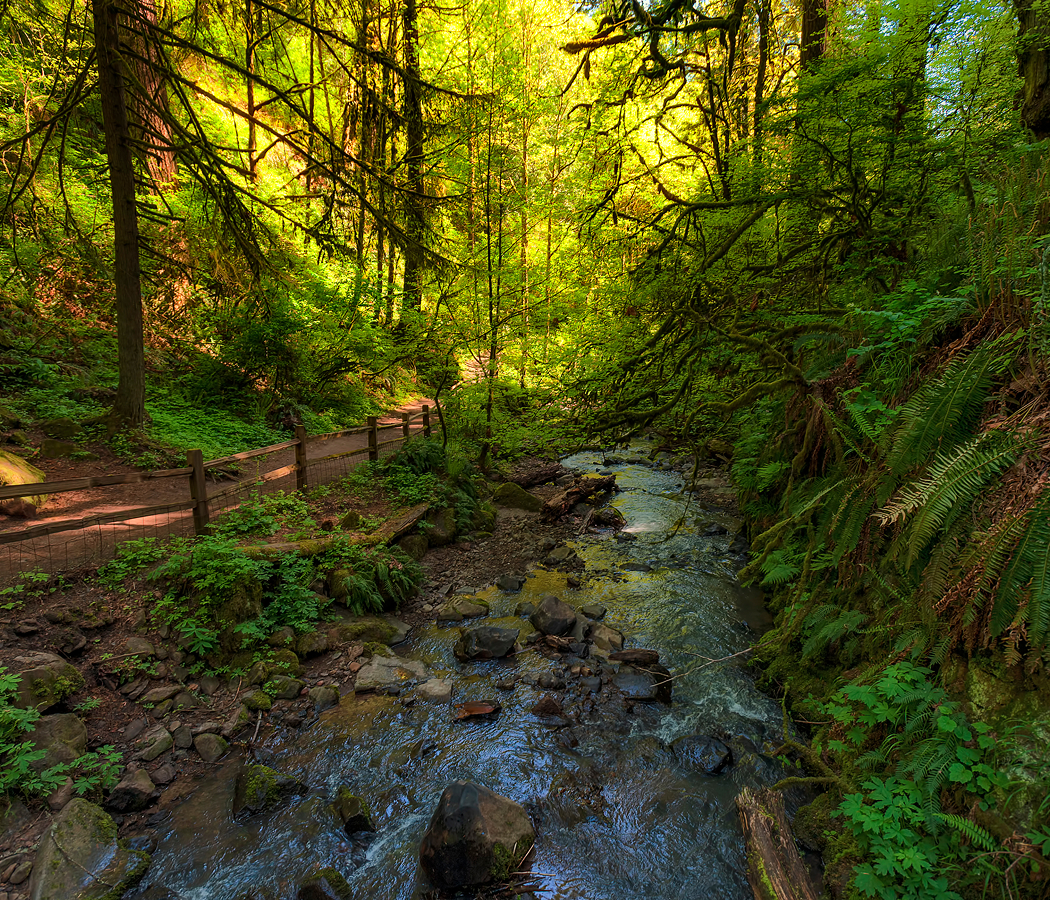
Start at the Lower Macleay Trailhead near NW Thurman Street, where the hum of the city fades beneath the sound of Balch Creek's steady flow. Follow the trail through moss-draped trees to the ruins of the Witch's Castle, a mossy stone structure that looks lifted from a fairy tale. Continue along the Wildwood Trail - Portland's renowned 30-mile backbone through the park, where elevation rises and falls through deep green stillness and glimpses of the skyline appear between branches. For shorter hikes, explore the Maple or Ridge trails, or take Leif Erikson Drive for a gentle stroll ideal for biking and running. In spring, trilliums blanket the forest floor; in autumn, golden leaves scatter the trails like confetti. Pack water, layers, and time, this is a park meant to be felt, not rushed. When you emerge back into the city, stop in nearby Northwest Portland or the Pearl District for a post-hike coffee or local craft beer. Forest Park isn't just Portland's backyard, it's its soul made tangible, a reminder that even in the heart of a city, the wilderness still speaks softly and endlessly.
Where your story begins.
Foresyte Travel reveals places that feel extraordinary long before you arrive.
Enjoy editorial crafted for luxury travelers.
Foresyte may earn a commission when you book.