
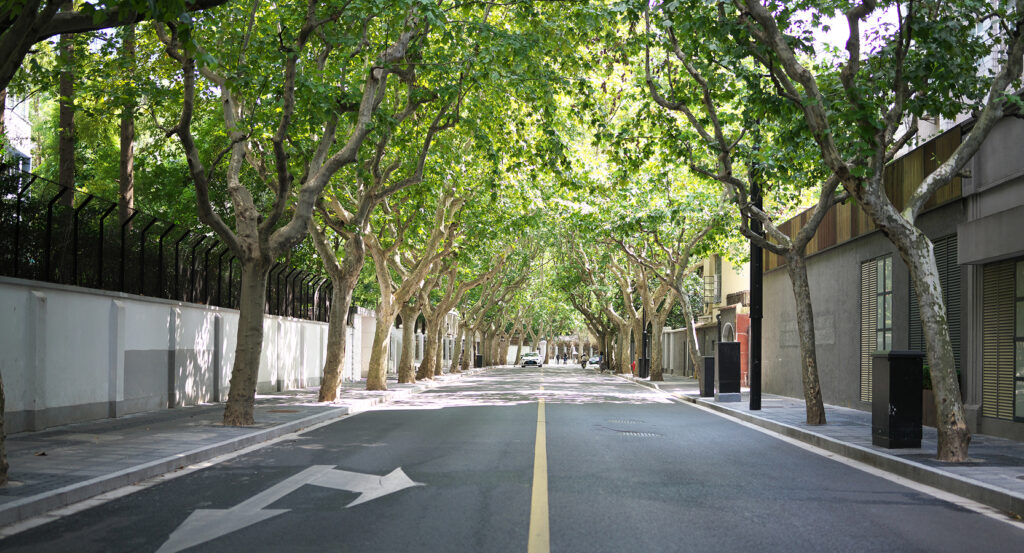
Why Wukang Road matters.
Wukang Road is where Shanghai's story takes human form, a quiet, tree-lined street that whispers of writers, architects, and dreamers who shaped the city's soul.
Beneath its arched plane trees, you'll find ivy-clad villas, wrought-iron balconies, and art deco façades that seem to glow with memory. Every corner feels cinematic, a mix of faded grandeur and modern pulse, where cyclists glide past cafés, and the scent of fresh pastries mingles with magnolia blooms. The rhythm is slow, confident, and self-assured, inviting you to stroll. Once known as Route Ferguson, this street captures the essence of Shanghai's Former French Concession: cosmopolitan yet intimate, refined yet alive. To walk Wukang Road is to trace a living museum, one lined not with artifacts, but with stories still unfolding in real time.
What defines Wukang Road.
Wukang Road was originally laid out in 1907, designed by Scottish missionary John Ferguson, and quickly became the residential artery of the French Concession's intellectual and artistic elite.
It runs for just over 1.1 kilometers, but along that short stretch stand over 30 protected heritage buildings, each a different architectural style, Spanish Revival, Art Deco, Neo-Renaissance, and Tudor among them. The road's most famous landmark, the Wukang Mansion (formerly the Normandie Apartments), was designed in 1924 by Hungarian architect László Hudec, whose work defined much of Shanghai's interwar skyline. Once home to prominent writers and film stars, including Eileen Chang, the building's curved prow and ochre stone façade have become an icon of old Shanghai elegance. During the Republican era, Wukang Road's villas hosted salons, poetry readings, and political debates, gatherings that shaped modern Chinese literature and culture. The street's transformation after 1949 was quieter but no less significant; many villas became communal residences, layering everyday life over architectural splendor. In the early 2000s, a preservation effort restored the façades, gardens, and cobbled sidewalks, while protecting the tree canopy that gives the street its distinctive filtered light. Hidden behind certain gates are small courtyards where vines climb century-old walls and wooden shutters creak in the breeze, remnants of a Shanghai that never stopped breathing beneath modernization. Few know that the underground wiring system here was reengineered to prevent disruption to the tree roots, a feat of urban planning that symbolizes the city's delicate balance between progress and preservation.
How Wukang Road fits.
Wukang Road is best experienced slowly, on foot, with time to linger and listen.
Start the walk at the Wukang Mansion intersection (Huaihai Middle Road) and head north, following the gentle curve beneath the plane trees. Plan for 1-1.5 hours, ideally in late morning or late afternoon, when the light slants across the façades. Pause at No. 390, home to the Former Residence of Soong Ching-ling, and continue past restored villas now housing galleries, cafés, and boutiques. Stop for coffee at Pain Chaud or Grains, both local favorites, or step into Wukang Road Café, which overlooks the street's most photogenic bend. If you're drawn to architecture, look for plaques identifying heritage buildings, many are accessible for short tours or exhibits. For photography, the best vantage is from the opposite corner of Wukang Mansion, capturing its iconic wedge-shaped façade against the tree canopy. Access the area via Shanghai Library Station (Line 10) or Hengshan Road Station (Line 1), both within a ten-minute walk. Combine your visit with nearby Fuxing Park or Sinan Mansions for a perfect day immersed in the French Concession's charm. Above all, take your time, Wukang Road rewards slowness, revealing its beauty in details: a balcony shadow, a doorway mosaic, a lingering note of jazz spilling from a second-story window.
Where your story begins.
Foresyte Travel reveals places that feel extraordinary long before you arrive.
Enjoy editorial crafted for luxury travelers.
Foresyte may earn a commission when you book.

















































































































