
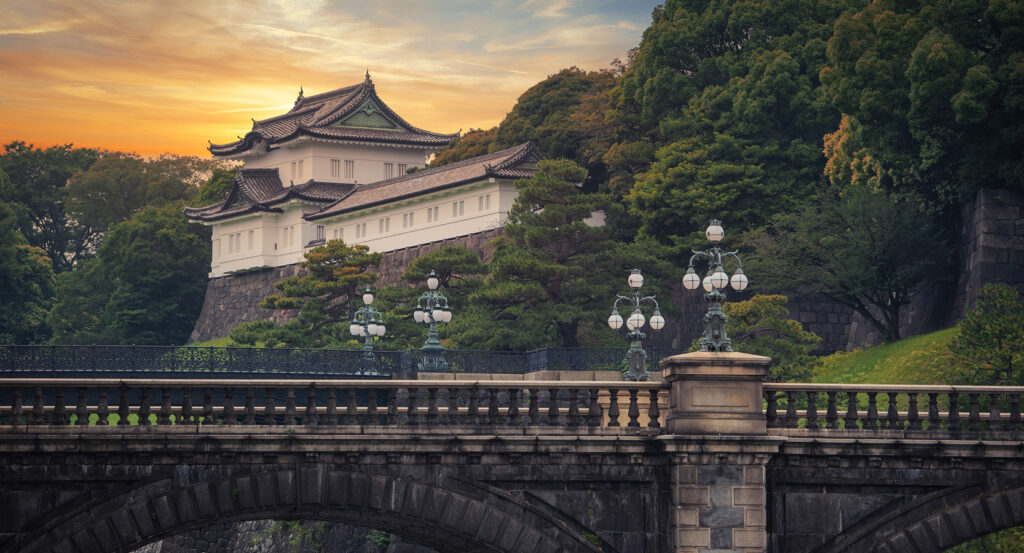
Why you should experience Fushimi-yagura in Tokyo, Japan.
Fushimi-yagura is a distinguished castle landmark where Marunouchi's imperial heritage, feudal architecture, military engineering, and centuries of history preserve one of the Imperial Palace's most significant surviving watchtowers.
Set along the western edge of the Imperial Palace near Sakuradamon Gate and just steps from Nijubashi Bridge, this elegant three-story turret combines white plaster walls, black-tiled roofs, massive granite stone foundations, narrow defensive openings, and beautifully proportioned Edo-period architecture overlooking the palace moats and gardens. Carefully preserved defensive features and commanding views reveal the remarkable craftsmanship that once protected the seat of Japan's shogunate. The result is a landmark defined by architectural authenticity, military ingenuity, and exceptional historical significance.
What you should know about Fushimi-yagura.
Fushimi-yagura is best known for being among the oldest surviving structures within the Imperial Palace, relocated from Kyoto's Fushimi Castle shortly after the Siege of Osaka in 1615 and reconstructed at Edo Castle during Tokugawa Ieyasu's massive expansion of the shogunal capital, preserving a rare surviving example of early Edo-period military architecture. According to long-standing historical tradition, the three-story watchtower originally stood at Fushimi Castle, the retirement residence built by Toyotomi Hideyoshi south of Kyoto during the 1590s before the castle suffered repeated destruction during the Battle of Sekigahara and subsequent conflicts. Following Tokugawa victory and the establishment of the Edo shogunate, major sections of Fushimi Castle were dismantled and transported to Edo, where valuable gates and turrets were incorporated into the expanding defenses of Edo Castle. Constructed atop immense granite ramparts overlooking the palace moat, Fushimi-yagura functioned both as a defensive observation tower and as a symbol of Tokugawa authority, commanding strategic approaches to the western side of the castle complex. Remarkably, the structure survived the Meireki Fire of 1657, the collapse of the Tokugawa shogunate, the Great Kantō Earthquake of 1923, wartime bombing during World War II, and the extensive demolition that claimed most of Edo Castle's original buildings, leaving it among only a handful of authentic Edo-period castle structures remaining within today's Imperial Palace. Together, with the Fujimi-yagura and Sakurada-mon Gate, it represents one of the finest surviving examples of seventeenth-century Japanese castle engineering within the former seat of the Tokugawa shoguns.
Elegant timber framing, white plaster fire-resistant walls, layered tiled roofs, massive cyclopean stone foundations, and restrained military design continue illustrating the sophistication of early Edo-period fortress construction. Its exceptional survival through centuries of fires, earthquakes, political transformation, and war provides invaluable insight into the original appearance of Edo Castle while reinforcing the Imperial Palace's status as Japan's most historically significant castle site. Architectural preservation, feudal history, and extraordinary rarity collectively establish Fushimi-yagura among Tokyo's most important historic structures.
How to fold Fushimi-yagura into your trip.
Fushimi-yagura works as part of an exploration through the Imperial Palace's celebrated historic landmarks.
Begin at Nijubashi Bridge, where the iconic entrance introduces the grandeur of the Imperial Palace before viewing Fushimi-yagura across the surrounding moats. Continue to Fujimi-yagura, another surviving Edo Castle watchtower that further demonstrates the defensive sophistication of the Tokugawa capital. Conclude at Sakurada-mon Gate, whose grand architecture preserves one of the Imperial Palace's finest original entrance gates. The progression moves naturally from the palace's most celebrated entrance to one of its oldest surviving watchtowers before concluding at a grand Edo-period gate, revealing why Fushimi-yagura remains one of Tokyo's most treasured architectural survivors.
Where your story begins.
Foresyte Travel reveals places that feel extraordinary long before you arrive.
Experience premium editorial crafted for luxury travelers.

















































































































