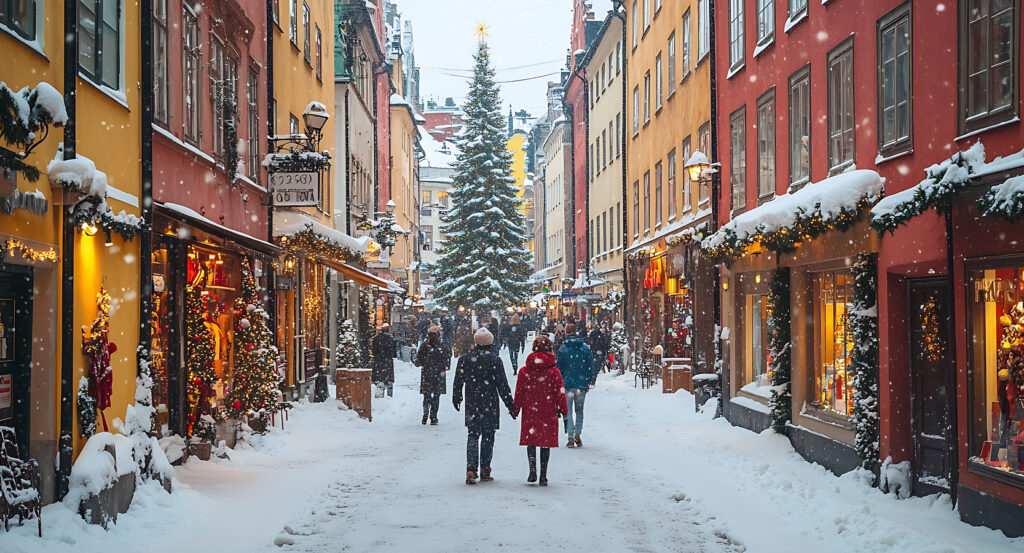
Why Mårten Trotzigs Gränd matters.
Hidden within the winding alleys of Gamla Stan, Mårten Trotzigs Gränd feels like a secret, a whisper of Stockholm's medieval past preserved in stone and shadow.
It's the narrowest street in the city, barely 90 centimeters wide at its tightest point, yet it holds more character than boulevards ten times its size. Walking down its steep steps feels like slipping into another dimension, one where lanterns flicker above rain-darkened walls, where whispers echo between façades, and where history presses close enough to touch. The walls seem to lean inward, as if conspiring to keep their centuries-old stories hidden from the outside world. Locals pass quietly, their footsteps muffled against the worn stone, while travelers pause to trace the grooves etched by time. Mårten Trotzigs Gränd isn't just a passageway; it's an experience of compression, of space, sound, and time collapsing into a single, intimate encounter with Stockholm's soul.
What defines Mårten Trotzigs Gränd.
The alley is named after Mårten Trotzig, a German merchant who settled in Stockholm in the late 1500s and became one of the city's wealthiest tradesmen.
He dealt in copper and iron, the lifeblood of Sweden's early economy, and owned several properties along this passage. Over the centuries, the alley fell into neglect, even sealed off for a time in the 19th century before being restored to its present form. Its twenty-six steps descend from Västerlånggatan to Prästgatan, two of Old Town's most storied streets. The walls, rough and mottled with limewash, are original to the medieval foundations, giving visitors a tactile link to the city's earliest centuries. At twilight, when shadows settle deep between the stones, the alley takes on an almost cinematic quality, like a film still from a forgotten era. Few realize that it once served as a discreet shortcut for merchants and priests between the markets and the cathedral above. Today, photographers and wanderers alike are drawn here not just for the novelty of its size but for the atmosphere, that rare, quiet pulse of authenticity that modern cities too often erase.
How Mårten Trotzigs Gränd fits.
To find it, wander through Gamla Stan without a map, let the city lead you.
Approach from Västerlånggatan, the lively main street lined with cafés and artisan shops, and look for the small bronze plaque marking the entrance. Step between the walls, and feel the world narrow around you. Move slowly, the air grows cooler, the light dimmer, and each footstep seems to echo twice. Halfway down, pause to look upward; the thin slice of sky between the rooftops appears almost liquid, shifting with the clouds above. Continue downward until the passage opens onto Prästgatan, where pastel facades and cobbles greet you again like daylight after a dream. Visit in early morning or late evening for the fullest sense of solitude, when you can hear your own breath mingle with the faint hum of the city beyond. If you linger a moment at the base, you'll notice how the alley perfectly frames the spire of Storkyrkan in the distance, a glimpse of divine symmetry amid the chaos of medieval design. Mårten Trotzigs Gränd isn't a tourist stop to check off; it's a moment of compression, a meditation in stone, a reminder that even the narrowest paths can lead to the heart of history.
Where your story begins.
Foresyte Travel reveals places that feel extraordinary long before you arrive.
Experience premium editorial crafted for luxury travelers.