
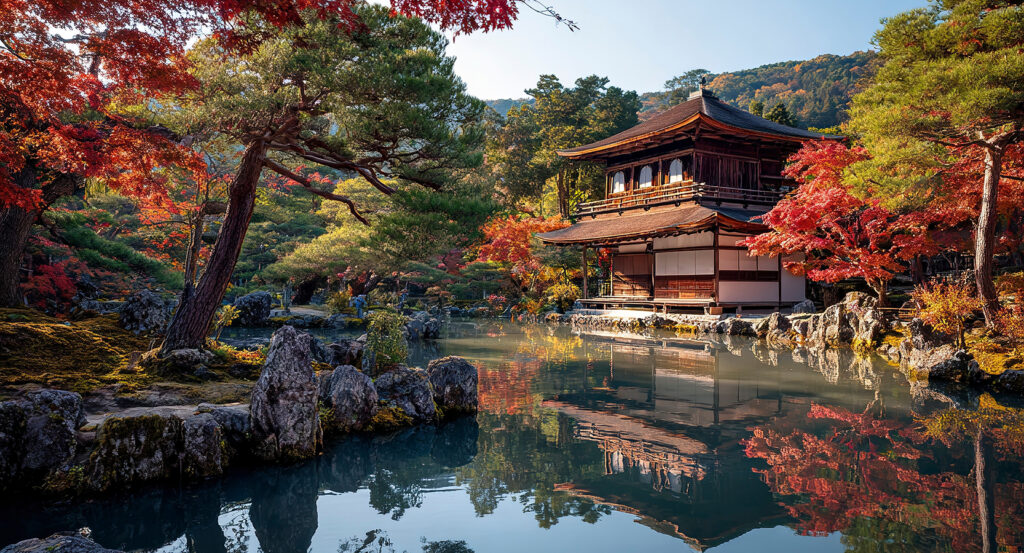
Why you should experience The Sand Garden at Ginkaku-ji in Kyoto, Japan.
The Sand Garden at Ginkaku-ji is Kyoto's moonlit stillness, a landscape of light and geometry that transforms simplicity into transcendence.
Stretching before the Silver Pavilion, its white gravel glows softly beneath the sun, as if storing the memory of moonlight. Every grain has purpose. The raked patterns ripple outward like frozen waves, embodying both movement and pause. At its center rises the sculpted cone of Kōgetsudai, the “Moon-Viewing Platform,” a perfect mound of silvered sand that mirrors Mount Fuji and symbolizes enlightenment. Together, these elements create a scene of profound equilibrium, light against shadow, form against void. Standing at its edge, you feel the garden breathing, its silence humming like music just beyond hearing. The sand garden is not meant to be walked; it is meant to be witnessed. It's Kyoto's invitation to stop seeking and simply see.
What you should know about The Sand Garden at Ginkaku-ji.
The sand garden, or Ginshadan, was created in the late 15th century by Sōami, the artist and Zen practitioner who also designed Ginkaku-ji's moss gardens.
Unlike the abstract austerity of Ryōan-ji's rock garden, Ginkaku-ji's composition is luminous, built to reflect and amplify moonlight at night. The Kōgetsudai mound was carefully proportioned to catch the moon's glow, its peak aligning visually with the Silver Pavilion when viewed from the temple veranda. The raked ripples surrounding it represent ocean waves, a metaphor for the eternal flow of time and the mind's attempt to still it. During Ashikaga Yoshimasa's lifetime, this sand garden was the stage for moon-viewing ceremonies, poetry readings, and tea gatherings, all centered on the harmony of light and silence. The garden's white quartz sand was sourced from Kyoto's northern riverbeds, chosen for its reflective purity, and monks still rake it daily in a precise meditative rhythm passed down for centuries. Few visitors realize that this act of raking, erasing and recreating the garden's surface, is itself a Zen exercise in impermanence. The lines fade with rain and wind, only to be drawn again, teaching that perfection is not permanence but practice. Over the centuries, the sand garden became not just the soul of Ginkaku-ji, but the visual example of the wabi-sabi ideal, beauty shaped by time, not in spite of it.
How to fold The Sand Garden at Ginkaku-ji into your trip.
The Sand Garden at Ginkaku-ji should be experienced as a pause, a moment of suspension between thought and breath.
Arrive early or near closing, when crowds thin and the air turns golden. Enter the temple grounds and follow the stone path until the sand garden reveals itself beside the Silver Pavilion. Stand quietly along the wooden veranda and observe the patterns: the ripples, the precision, the stillness that somehow moves. Let your eyes travel from the flat expanse of raked lines to the towering Kōgetsudai, its perfect slope catching light like porcelain. Visit during a full moon if you can, the sand glows with an otherworldly brilliance that transforms the garden into a sea of light. In autumn, fallen maple leaves scatter across the surface, punctuating white with bursts of crimson. In winter, snow erases the patterns completely, and when monks redraw them at dawn, it feels like watching time begin again. Before leaving, walk the hillside path that overlooks the entire garden from above; from there, you'll see the Silver Pavilion and sand composition aligned like heaven and earth. This view, simple, silent, eternal, captures Kyoto's essence more clearly than any monument. The Sand Garden at Ginkaku-ji isn't a place you visit. It's a moment you inhabit, and one that stays with you long after you've left.
Where your story begins.
Foresyte Travel reveals places that feel extraordinary long before you arrive.
Experience premium editorial crafted for luxury travelers.

















































































































