
Why Shirakawa Canal matters.
Shirakawa Canal is Gion's quiet reflection, a thread of water that carries the district's soul beneath the hum of the city.
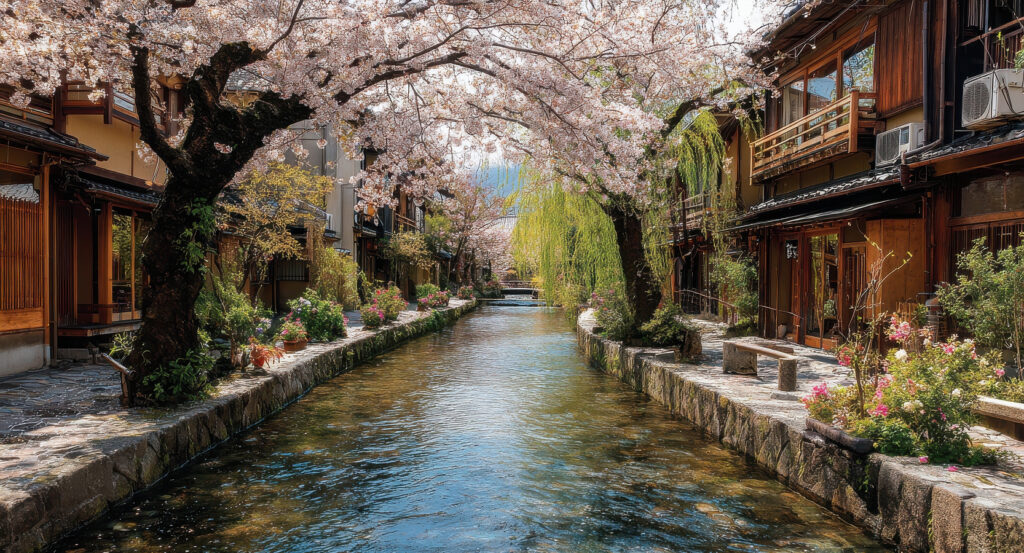
Lined with willows, stone bridges, and softly glowing lanterns, it winds through the northern edge of Gion like a whispered memory. The air along the canal feels different, cooler, gentler, touched with the faint scent of water and pine. Wooden machiya houses lean toward the banks, their windows catching fragments of moonlight, while small restaurants spill golden light onto the cobblestones. In spring, the cherry blossoms lean so close to the water that their petals seem to float in two worlds, one above, one below. You can hear the quiet trickle of the current beneath the murmur of footsteps, the laughter from distant teahouses, and the occasional ring of a bicycle bell fading into the dusk. Shirakawa Canal doesn't demand attention. It rewards stillness, an unspoken invitation to slow your breath and let Kyoto's beauty find you.
What defines Shirakawa Canal.
Shirakawa Canal predates Gion's fame, it's one of Kyoto's oldest waterways, once carved to channel life into the city's heart.
Its name means “White River,” a nod to the clarity of its flow and the pale stones lining its bed. During the Heian period, the canal carried fresh water from the eastern mountains into Kyoto, sustaining the temples, gardens, and households that gave the capital its rhythm. Over time, it became a symbol of refinement, a natural companion to the teahouses and ryotei that flourished along its banks. The district's geiko and maiko often walked this path between engagements, their reflections gliding across the water under lantern light. Many of Gion's most exclusive teahouses, such as the famed Ichiriki Chaya, sit only steps away from its edge, their presence a reminder that art and nature in Kyoto are inseparable. The bridges that cross the canal each have their own personality: narrow stone spans where lovers pause in spring, arched crossings framed by weeping willows that sway like calligraphy strokes. Few visitors realize that Shirakawa Canal has survived every major fire and flood since the Edo period, protected by the collective care of Kyoto's residents who regard it not as infrastructure, but as inheritance. It remains one of the city's most enduring metaphors, beauty that flows.
How Shirakawa Canal fits.
To walk Shirakawa Canal is to experience Kyoto in its quietest register.
Begin your stroll in the early evening, when the lanterns flicker to life and the air cools against the stone. Start near Shinbashi-dori, often called one of Japan's most beautiful streets, where the canal runs parallel to wooden façades draped in ivy. Move slowly, the entire path feels suspended in another time. Stop on one of the small bridges and watch the water catch the light; if you're lucky, a few petals or maple leaves will drift by like tiny messengers of the season. Visit again at dawn when the district is empty, and the water mirrors the pale sky, you'll hear nothing but the soft rhythm of the current and the distant toll of temple bells. If you come during cherry blossom season, visit after dark: the trees form an illuminated tunnel, their reflections doubling the world beneath your feet. There's no need for agenda or expectation here. Shirakawa Canal isn't about spectacle; it's about surrender. To stand beside it is to see Kyoto the way its poets and artists always have, as a place where beauty moves quietly, like water, carrying centuries of grace toward eternity.
Where your story begins.
Foresyte Travel reveals places that feel extraordinary long before you arrive.
Enjoy editorial crafted for luxury travelers.
Foresyte may earn a commission when you book.

















































































































