
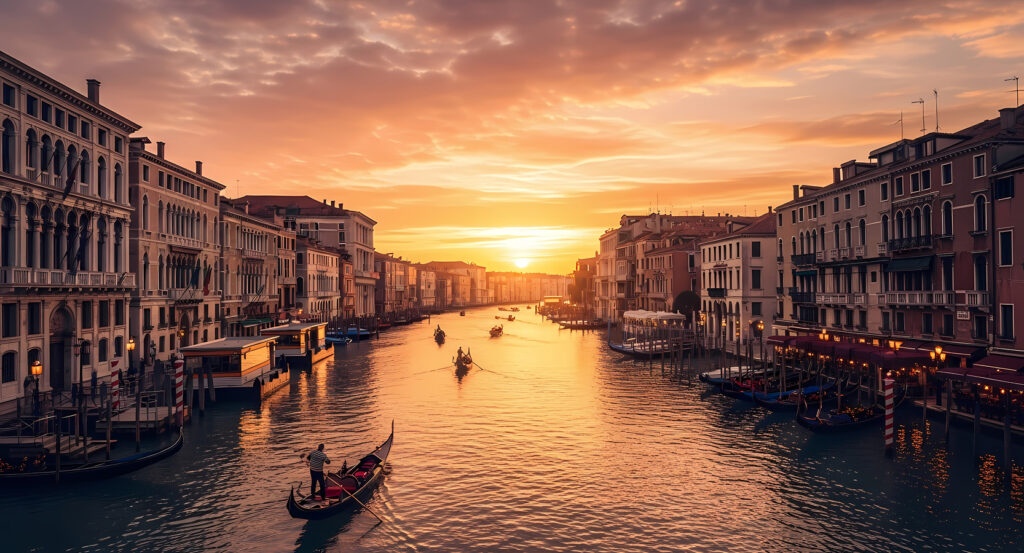
Why you should experience Palazzo Barbaro in Venice, Italy.
Palazzo Barbaro is where Venice's grandeur turns intimate, a palazzo that feels more like a living soul than a structure.
Set along one of the most elegant bends of the Grand Canal, its twin façades shimmer with age-old dignity: one Gothic, one Baroque, both reflecting centuries of taste and transformation. The building doesn't just face the canal, it converses with it. Every ripple of light across the marble feels deliberate, every shadow deliberate poetry. Step near its mooring and you can almost hear the echo of salons that once defined Venetian intellect, rooms where artists, poets, and exiled dreamers gathered under painted ceilings to debate the divine. Palazzo Barbaro captures the beauty of continuity: a home that outlasted empire, still holding the hum of civilization in its walls.
What you should know about Palazzo Barbaro.
Palazzo Barbaro is actually two palaces joined through lineage and vision, the Gothic Palazzo Barbaro Curtis, built in the 15th century, and its Baroque counterpart from the 17th.
Together, they form one of the most complete portraits of Venetian aristocracy, layered in art and memory. The Barbaro family, among the city's oldest patricians, filled the interiors with masterpieces by Tiepolo, Tintoretto, and Carpaccio, each room a curated reflection of power softened by grace. But the building's modern legacy belongs to the expatriate world of the 19th and early 20th centuries. Henry James stayed here, writing The Aspern Papers and describing the palace as “a house of haunting harmonies.” John Singer Sargent painted here, capturing the play of light on silk and marble. Even Cole Porter played the piano in these gilded halls. Palazzo Barbaro became a symbol of Venice as muse, not a ruin of the past, but a living stage for art, intellect, and belonging. Few realize that its terrace once served as the vantage point for one of the earliest plein-air studies of the Grand Canal, painted before the age of cameras, when light itself was the subject.
How to fold Palazzo Barbaro into your trip.
Palazzo Barbaro remains a private residence, but its aura spills into the street, the canal, and the air.
You can admire its twin façades from a vaporetto or gondola, the pointed Gothic windows on one side, the baroque undulations on the other, both unified by time's patina. The most striking view comes just before sunset, when the façade glows rose-gold and the water mirrors every curve like molten glass. If you're exploring nearby, stop by the Gallerie dell'Accademia, only steps away, to see the very paintings that once hung in similar palazzi, a reminder that the bridge between art and architecture here is seamless. For the most cinematic experience, pass by Palazzo Barbaro at twilight aboard Vaporetto Line 1; the lights from its windows cast golden ripples across the canal, and for a brief moment, you can almost feel the presence of Henry James gazing out from within, still observing Venice through the eyes of a poet. Palazzo Barbaro isn't open to visitors, but that's part of its mystery, it exists to be seen, not entered. To look upon it is to understand Venice's secret: that true beauty doesn't need to be accessible to be felt.
Where your story begins.
Foresyte Travel reveals places that feel extraordinary long before you arrive.
Experience premium editorial crafted for luxury travelers.




















































































































