
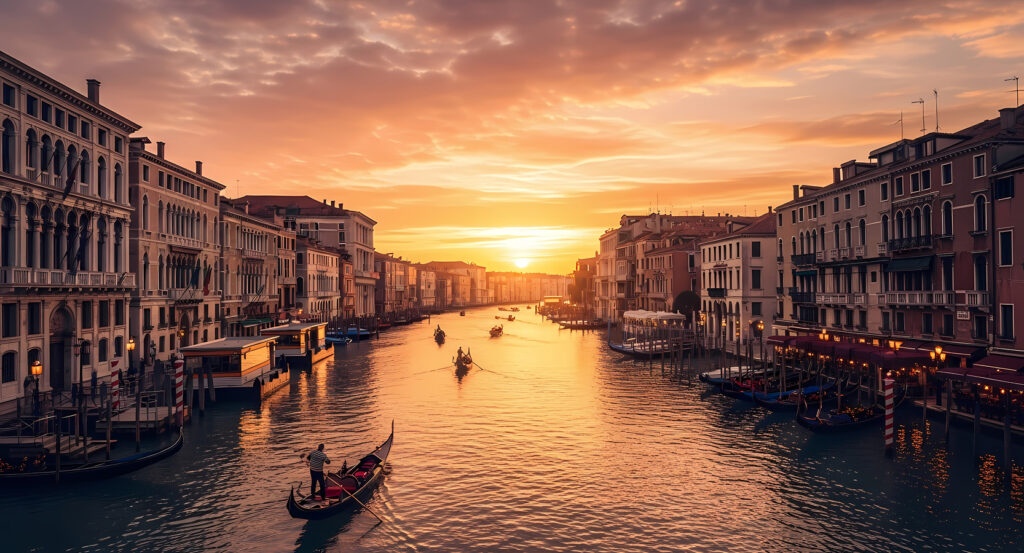
Why you should experience Palazzo Grimani in Venice, Italy.
Palazzo Grimani is where Venice dared to dream in marble, a palace that redefined what elegance meant in a city already obsessed with beauty.
Hidden just off Campo Santa Maria Formosa, its façade stands apart from the gothic lacework and Byzantine mosaics of its neighbors. Here, geometry reigns. Light pours through perfect symmetry. Inside, the air shifts, cooler, quieter, reverent. This is the house of a collector, a philosopher, a family that believed art was not just decoration but devotion. Every corridor feels composed; every wall, a discussion between myth and reason. To step into Palazzo Grimani is to walk into a Renaissance mind, rational, radiant, and restless for meaning.
What you should know about Palazzo Grimani.
Palazzo Grimani tells the story of a family that turned intellect into architecture.
Built in the 16th century for Antonio Grimani, a patriarch who rose to the rank of Doge, the palace was later expanded by his descendants, men who studied humanism, collected antiquities, and surrounded themselves with ideas as much as art. Unlike most Venetian palaces that faced the Grand Canal, Palazzo Grimani turns inward, its grandeur hidden from casual view. The interior, restored to its original brilliance, reveals why: the family wanted a temple, not a trophy. Its central courtyard rises in tiers of classical order, Doric, Ionic, Corinthian, a living homage to ancient Rome. The Sala di Psiche, with frescoes attributed to Giovanni da Udine, celebrates love and the divine in color that still glows like dawn. The ceiling of the Tribuna room, coffered and painted with mythic scenes, once framed the Grimani collection, fragments of Greece and Rome meticulously arranged to teach beauty through proportion. Few realize that this was the first Venetian home designed according to the principles of Vitruvius, its architecture itself an act of scholarship. The palace became a laboratory for Renaissance thought, where every sculpture, fresco, and frieze spoke to a unified vision of art as harmony.
How to fold Palazzo Grimani into your trip.
Palazzo Grimani rewards the traveler who lingers.
Step through its unassuming entrance on Ruga Giuffa, and you'll find yourself in a world suspended between museum and memory. The ground floor opens into the courtyard, sunlight spilling through arcades of stone, the quiet echo of footsteps like a metronome for reflection. Move upward, floor by floor, through rooms restored with reverent restraint. The Tribuna, with its soaring ceiling and marbled walls, remains one of Venice's most breathtaking interiors, a space that feels both sacred and intellectual. Visit the Sala di Psiche when light filters from the high windows, the frescoes seem to breathe in rhythm with the day. Pause at the upper loggia and look out across the rooftops of Castello, where the sea breeze carries the scent of salt and bells. The palace's current life as a museum preserves not only art but atmosphere; its rooms whisper of evenings filled with debate, poetry, and philosophy. Before leaving, step into the courtyard one last time, the tiers of columns rising like thought itself, ordered and eternal. Palazzo Grimani isn't just an architectural masterpiece; it's a mind made of stone, the rare Venetian palace that teaches you how to see.
Where your story begins.
Foresyte Travel reveals places that feel extraordinary long before you arrive.
Experience premium editorial crafted for luxury travelers.




















































































































