
Why Grillmarkaðurinn matters.
Grillmarkaðurinn is a contemporary Icelandic grill restaurant where Kvosin's historic commercial culture meets the country's volcanic landscape, its agricultural traditions and a pioneering Reykjavík restaurant partnership that brought Icelandic ingredients into an ambitious new era of live-fire cooking.
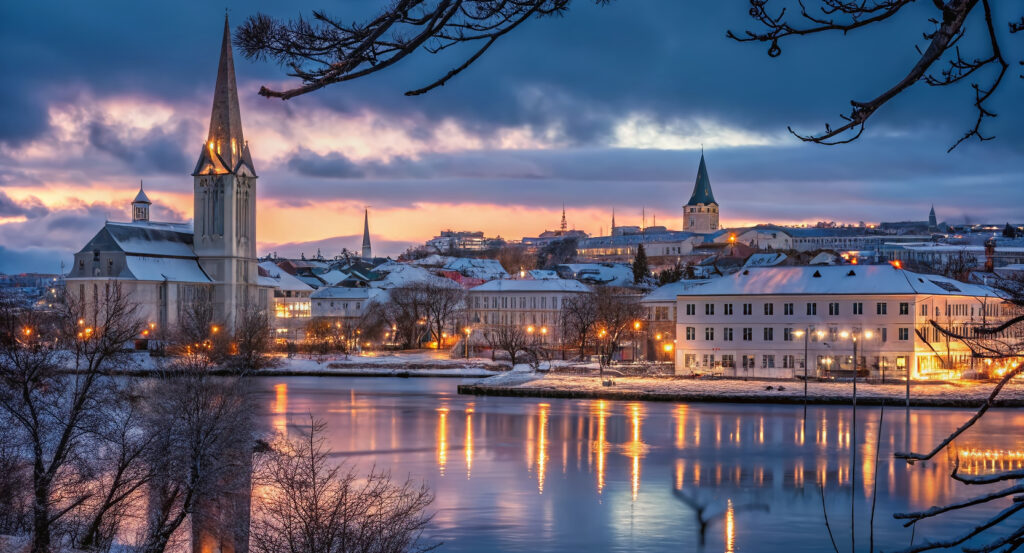
Occupying a prominent corner at the intersection of Lækjargata and Austurstræti, the restaurant stands within Reykjavík's historic commercial center, a short distance from the waterfront and the pedestrian streets extending toward the capital's principal shopping district. Its reconstructed street frontage incorporates broad windows and a substantial masonry exterior, giving the building a commanding presence within the surrounding urban fabric. Inside, columnar basalt, driftwood, fish leather and Icelandic stone create a distinctive architectural composition drawn directly from the country's geological formations and traditional industries. A dark, warmly illuminated dining room surrounds an open kitchen and charcoal grill, allowing the fire and its preparations to become visible elements of the interior. The result is a restaurant whose volcanic textures, natural Icelandic furnishings and theatrical cooking environment establish an unusually direct connection between the country's physical landscape and its contemporary dining culture.
What defines Grillmarkaðurinn.
Hrefna Rósa Sætran, Ágúst Reynisson and Guðlaugur Pakpum Frímannsson established Grillmarkaðurinn in 2011, bringing together three established culinary professionals whose collaboration had developed through Reykjavík's increasingly ambitious restaurant sector. Sætran began her professional training at Apótekið before joining Sjávarkjallarinn, where she developed her expertise in Icelandic ingredients and contemporary cooking techniques. She met Reynisson during this period, establishing a professional partnership that led to the opening of Fiskmarkaðurinn in August 2007. The restaurant combined Icelandic seafood with international culinary influences and became an important platform for Sætran's growing public reputation. Her subsequent work included cookbooks and television cooking programs, extending her contribution to Icelandic food culture beyond professional restaurant kitchens. Frímannsson had worked alongside the pair and shared their involvement in the Icelandic Culinary Team, whose international competitions encouraged technical development and professional exchange among Icelandic chefs. He developed the original Grillmarkaðurinn concept through an extensive proposal addressing its menu, interior architecture and culinary direction, subsequently refining the project with Sætran and Reynisson. The partners selected a historically significant commercial site associated with Nýja Bíó, a cinema established in 1920 that operated until 1987. Following its conversion into a nightclub, the former cinema suffered a destructive fire in 1988, and the building was subsequently demolished. The restaurant project became part of the redevelopment of this prominent corner property, creating an opportunity to establish a substantial new dining destination within the capital's historic center. Reykjavík mayor Jón Gnarr participated in the ceremonial opening of the redeveloped site in June 2011, marking the return of commercial activity to a property associated with decades of urban change. Grillmarkaðurinn opened shortly afterward, developing a reputation for its emphasis on premium Icelandic meat, relationships with farmers and preparations shaped by open-fire cooking. Its establishment coincided with a period of renewed international interest in Nordic gastronomy, during which Icelandic chefs increasingly emphasized regional agriculture, traditional preservation methods and the exceptional quality of domestic ingredients. The partnership developed a restaurant that connected those ambitions with the accessibility and sociability of a contemporary grill house. Sætran subsequently expanded her professional activities through additional hospitality ventures, maintaining a prominent position within Iceland's restaurant industry. In March 2025, she sold her one-third ownership interest in Grillmarkaðurinn, Trattoria and Rauttvín, concentrating her business activities on Fiskmarkaðurinn, Uppi Bar, Skúli Craft Bar and Kampavínsfjélagið. The ownership transition concluded her direct involvement in the restaurant she had helped establish, leaving Grillmarkaðurinn's culinary reputation grounded in the original partnership's sustained development of Icelandic live-fire dining.
Guðlaugur Pakpum Frímannsson's original culinary concept established fire, smoke and carefully sourced Icelandic ingredients as the defining elements of Grillmarkaðurinn's cooking, creating a direct relationship between traditional methods and contemporary restaurant technique. The kitchen works extensively with domestic farmers, selecting meat and agricultural produce through relationships that connect the restaurant with Iceland's regional food producers. Charcoal grilling and Japanese-inspired robata preparation provide complementary methods for developing concentrated flavor, allowing the controlled application of heat to influence caramelization, tenderness and aromatic depth. Icelandic beef receives particular attention, including ale-fed cattle raised at Hvammur, whose limited production contributes distinctive cuts selected according to daily availability. The kitchen's signature GM Steak combines fillet and sirloin on the bone, developing the natural qualities of both cuts through carefully controlled grilling and shared presentation. Lamb contributes another important expression of Icelandic agriculture, with garlic glaze, grilled baby gem lettuce and cucumber kimchi combining familiar regional meat with complementary acidity and fermented flavors. Wild game extends the menu into Iceland's distinctive culinary heritage, incorporating seasonal reindeer and puffin into preparations developed through direct heat and carefully balanced accompaniments. Grilled reindeer pairs the meat's lean, concentrated flavor with creamed white cabbage, portobello mushrooms and blueberry sauce, connecting the preparation with ingredients associated with northern landscapes. Puffin receives a light smoking treatment before being served rare with blueberries and wild thyme, preserving its distinctive flavor through restrained cooking and aromatic accompaniments. The seafood repertoire draws upon Iceland's extensive marine resources, incorporating Arctic char, cod and farm-raised salmon into compositions adapted to the grill. Lightly smoked Arctic char develops through the contrast between delicate fish, crisp rye crumbs, pickled fennel and dill mustard sauce, connecting traditional Nordic ingredients with precise contemporary preparation. Seasonal vegetables and cultivated herbs provide complementary textures and acidity, balancing the richness of grilled meats and the concentrated flavors produced by smoke. The tasting menu assembles a changing sequence of the kitchen's principal preparations, allowing the relationship between individual ingredients and different applications of fire to develop across successive courses. A separate three-course menu, Sveitaferð, takes its name from the Icelandic expression for a countryside excursion and connects shared starters with beef tenderloin and a concluding chocolate dessert. The kitchen's chocolate sphere combines mascarpone mousse, hot caramel and coffee ice cream, creating a carefully controlled contrast between temperature, texture and sweetness. Grillmarkaðurinn's cooking achieves its distinctive character through the sustained development of Icelandic agricultural products under fire, connecting regional ingredients with an ambitious contemporary interpretation of the country's culinary heritage.
How Grillmarkaðurinn fits.
Grillmarkaðurinn works as the evening culmination of an outing connecting Reykjavík's earliest settlement, the development of its national religious institutions and the emergence of modern Icelandic parliamentary government.
Begin at The Settlement Exhibition, the archaeological museum preserving the remains of a Viking Age longhouse discovered during excavations in Reykjavík's historic center. The dwelling was occupied between 930 and 1000, establishing a direct physical connection with the Norse families who developed Iceland's earliest permanent settlements. Archaeologists also uncovered a fragment of an earlier wall dating to the settlement period 871, providing one of the oldest surviving traces of human habitation in the country. The museum opened in 2006 around the preserved foundations, allowing the original archaeological structure to remain visible within a purpose-built underground exhibition space. An expansion completed in 2022 incorporated the adjoining historic property at Aðalstræti 10, whose eighteenth-century construction was associated with the Innréttingar industrial enterprise that contributed to Reykjavík's early urban development. Continue to Reykjavík Cathedral, the Neoclassical church whose construction accompanied the emergence of Reykjavík as Iceland's administrative center during the late eighteenth century. Danish court architect Andreas Kirkerup designed the original building, constructed between 1787 and 1796 as ecclesiastical responsibilities shifted toward the growing settlement. Its consecration in 1796 established a permanent religious institution within the developing capital, and architect Laurits Albert Winstrup directed substantial enlargement and alterations during 1847 and 1848. The cathedral became closely associated with Iceland's parliamentary ceremonies, hosting religious services connected with the opening of legislative sessions and the inauguration of presidents. A major restoration completed in 2000 under architect Þorsteinn Gunnarsson preserved the building's historical character and its enduring relationship with Icelandic public life. Conclude at Alþingishúsið, the historic Parliament House constructed during Iceland's nineteenth-century movement toward greater political representation and national self-government. Danish architect Ferdinand Meldahl designed the building, erected between 1880 and 1881 from Icelandic basalt quarried at Skólavörðuholt, establishing a permanent architectural setting for the Alþingi in Central Reykjavík. Its exterior incorporates sculpted representations of Iceland's four traditional guardian spirits, connecting the parliamentary institution with the country's medieval literary heritage and national symbolism. The adjoining parliamentary garden was developed between 1893 and 1895 through the efforts of politician and banker Tryggvi Gunnarsson, becoming Iceland's oldest public garden. Subsequent additions included the Kringlan annex in 1908 and Skálinn in 2002, accommodating the changing requirements of parliamentary administration within the historic government complex. The progression moves from the archaeological foundations of Norse settlement through Reykjavík's emergence as an ecclesiastical and administrative center and culminates in the basalt Parliament House, connecting the origins of Icelandic habitation with the institutions that shaped the development of its modern capital.
Where your story begins.
Foresyte Travel reveals places that feel extraordinary long before you arrive.
Enjoy editorial crafted for luxury travelers.
Foresyte may earn a commission when you book.

















































































































