
Why Gucci Osteria da Massimo Bottura matters.
Gucci Osteria da Massimo Bottura is a celebrated contemporary Italian restaurant where Centro Storico's Renaissance grandeur meets Gucci's Florentine fashion heritage, Massimo Bottura's revolutionary culinary creativity and the international cooking traditions that have established a new expression of Italian fine dining.
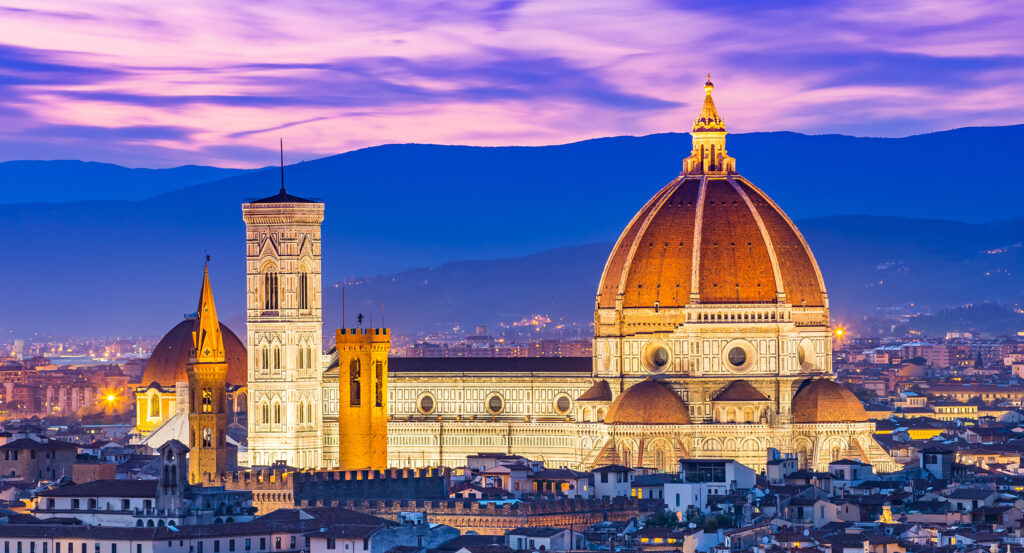
Set directly on Piazza della Signoria near Via dei Calzaiuoli and a short walk from Piazza della Repubblica, the restaurant occupies the historic center's expansive civic square, where medieval palaces, Renaissance façades and narrow commercial streets converge around Florence's architectural heart. Its entrance forms part of Palazzo della Mercanzia, a historic building whose restrained stone exterior conceals an intimate dining room developed around the decorative language of contemporary Italian fashion. Hand-painted parquet flooring, green velvet banquettes and richly patterned surfaces establish a theatrical interior whose colors and materials reflect the imaginative visual character of the Gucci house. The carefully composed dining room combines ornamental details, intimate seating and refined table settings within an architectural environment that retains the proportions of its historic surroundings. The result is a restaurant whose expansive setting, fashion-inspired interiors and carefully orchestrated intimacy establish an extraordinary physical connection between Florentine craftsmanship and contemporary hospitality.
What defines Gucci Osteria da Massimo Bottura.
Gucci Osteria da Massimo Bottura is best known for bringing together the Florentine fashion house Gucci and three-MICHELIN-starred chef Massimo Bottura in a restaurant that transformed a historic commercial building into an international destination for contemporary Italian cuisine. The collaboration emerged during the creative leadership of Alessandro Michele, whose appointment as Gucci's creative director in 2015 introduced an ambitious period of artistic experimentation across the fashion house. Michele's relationship with Gucci president and chief executive Marco Bizzarri helped establish a broader cultural direction in which fashion, contemporary art and hospitality became interconnected expressions of the brand. Bottura brought an equally consequential culinary inheritance through Osteria Francescana in Modena, the restaurant he founded in 1995 and developed into one of the most influential establishments in modern Italian gastronomy. His reinterpretations of traditional Emilia-Romagna cooking had earned three MICHELIN stars by 2012 and first place on The World's 50 Best Restaurants list in 2016, establishing an international reputation for transforming familiar Italian ingredients into intellectually ambitious compositions. Gucci Osteria opened on January 9, 2018, as part of the inauguration of Gucci Garden, a cultural complex developed within the historic Palazzo della Mercanzia. The project transformed the earlier Gucci Museo, established in 2011 to commemorate the fashion house's ninetieth anniversary, into a broader environment combining exhibitions, exclusive retail and a restaurant. Michele collaborated with curator Maria Luisa Frisa on the renewed exhibition spaces, establishing a cultural setting in which the house's archival collections and contemporary visual language could develop together. Bottura selected Mexican-born chef Karime López to lead the restaurant's kitchen, drawing upon her professional experience at Pujol in Mexico City, Central in Lima and Osteria Francescana. López had developed a particularly international culinary perspective through work in Latin America and Europe, bringing Mexican ingredients and techniques into conversation with the traditions of Italian fine dining. The MICHELIN Guide awarded Gucci Osteria its first star in the 2020 edition, making López the first Mexican woman chef to receive that distinction. The achievement established the restaurant's culinary reputation independently of the international recognition already associated with its founding partners. The enterprise subsequently expanded beyond Florence, opening Gucci Osteria locations in Beverly Hills in 2020, Tokyo in 2021 and Seoul in 2022, each developed around a distinct interpretation of the original collaboration. A significant leadership transition followed in March 2022 when Japanese chef Takahiko Kondo joined López as co-executive chef, bringing seventeen years of experience at Osteria Francescana into the Florentine kitchen. Kondo had arrived in Italy in 2000 and subsequently joined Bottura's brigade in Modena, becoming head pastry chef in 2010 and head sous-chef in 2014. His marriage to López brought an additional personal dimension to the collaboration, connecting two culinary careers shaped by international travel and their shared experience within Bottura's restaurant organization. Kondo assumed sole leadership of the Florentine kitchen in 2025, establishing a new chapter in the restaurant's development under a chef whose Japanese upbringing and long professional association with Italian cooking inform its contemporary direction. Gucci Osteria's evolution connects the transformation of an internationally influential fashion house, Bottura's reimagining of Italian gastronomy and the careers of two chefs whose professional journeys have helped redefine the boundaries of contemporary Italian cuisine.
Takahiko Kondo's cooking develops through a deeply personal relationship between Japanese culinary discipline, Italian regional ingredients and the imaginative reinterpretation of familiar dishes. His approach begins with the conviction that a recognizable culinary tradition provides the foundation for creative experimentation, allowing individual preparations to retain a meaningful connection to their geographical and cultural origins. The kitchen's treatment of Tuscan produce emphasizes seasonal availability and the natural character of carefully selected ingredients, establishing a distinctly Italian foundation for compositions shaped by international influences. Japanese techniques introduce another dimension through precise knife work, delicate treatment of seafood and a particular sensitivity to the balance between acidity, sweetness, salinity and umami. The relationship between these traditions becomes especially apparent in preparations inspired by coastal Italian cooking, where raw seafood and carefully developed broths create a discussion between Mediterranean ingredients and Japanese culinary methods. Kondo's interpretation of cacciucco, the celebrated fish stew associated with Livorno, demonstrates this approach through a progression that moves between delicate seafood preparations and the concentrated flavors of the traditional Tuscan dish. Scallops, almonds and raw tuna belly introduce contrasting textures and aromatic qualities before the preparation develops toward the deeper character of a carefully constructed seafood broth. The sequence preserves the recognizable culinary inheritance of the Tuscan coast through a composition whose techniques and presentation reflect the chef's international background. Pasta provides another important connection to Italian culinary tradition, with carefully developed doughs, fillings and sauces allowing regional ingredients to acquire new expressive possibilities through contemporary technique. Kondo's professional experience in pastry contributes a particularly refined understanding of texture and temperature, extending the kitchen's attention to technical precision across both savory preparations and desserts. The tasting menu develops these ideas through a succession of courses whose individual compositions contribute to a coherent culinary narrative, allowing familiar flavors to reappear through unexpected combinations and carefully controlled contrasts. The restaurant's wine program complements that progression through selections from distinguished Italian regions and international producers, establishing relationships between individual courses and the acidity, structure and aromatic development of carefully chosen wines. Service follows a measured rhythm that gives the kitchen's more intricate preparations sufficient space to develop, creating an intimate dining occasion shaped by the relationship between culinary technique and presentation. Gucci Osteria's distinctive achievement lies in this integration of regional Italian cooking, Japanese precision and contemporary creativity, establishing a restaurant whose international perspective deepens its connection to the culinary inheritance of Florence and Tuscany.
How Gucci Osteria da Massimo Bottura fits.
Gucci Osteria da Massimo Bottura works as the anchor for an outing connecting Florence's medieval commercial institutions, the domestic culture of its merchant elite and the extraordinary evolution of Italian fashion design into an internationally influential creative industry.
Begin at Orsanmichele, the remarkable medieval building whose transformation from grain market into church and sculptural monument reveals the economic power of Florence's historic merchant guilds. A commercial loggia occupied the site during the thirteenth century, and construction of the surviving structure began in 1337 after an earlier building was destroyed by fire. The ground-floor arcades originally accommodated grain trading, with the upper levels functioning as storage spaces for a commodity essential to the city's commercial and social stability. During the fourteenth century, the market gradually acquired a religious function, culminating in the enclosure of its arcades and the development of a church dedicated to the Virgin Mary. Florence's powerful guilds subsequently commissioned statues of their patron saints for the building's exterior niches, creating an extraordinary public program of Renaissance sculpture. Donatello, Lorenzo Ghiberti, Nanni di Banco and Andrea del Verrocchio contributed works whose artistic ambition reflected the wealth and competitive prestige of the city's professional corporations. The surviving original sculptures occupy the upper-level museum, preserving a remarkable account of the relationship between commercial organization, religious patronage and artistic innovation. Continue to Museo di Palazzo Davanzati, the fourteenth-century merchant residence whose preserved interiors reveal the domestic world created by Florence's expanding commercial prosperity. The Davizzi family commissioned the palace during the middle of the fourteenth century, combining several medieval tower houses into a substantial residence organized around a central courtyard. The Davanzati family acquired the property in 1578, introducing subsequent modifications that reflected changing expectations of comfort and aristocratic presentation. Its interiors preserve elaborate wall paintings, historic furnishings and architectural arrangements that reveal the relationship between family life, commercial wealth and domestic craftsmanship. The Sala dei Pappagalli and Sala dei Pavoni contain extraordinary painted decorations imitating textiles and decorative hangings, illustrating the importance of expensive fabrics within the visual culture of wealthy Florentine households. Antiquarian Elia Volpi acquired the deteriorating property in 1904 and undertook an ambitious restoration, transforming the residence into an influential exhibition space for historic furnishings. The Italian state purchased the palace in 1951, securing its future as a museum devoted to the material culture of the medieval and Renaissance home. Conclude at Museo Salvatore Ferragamo, the fashion museum occupying Palazzo Spini Feroni and preserving the extraordinary achievements of one of Italy's most influential footwear designers. The palace was constructed beginning in 1289 for Geri Spini, a wealthy banker whose international financial relationships included the papacy and the royal courts of France and England. Salvatore Ferragamo established his Florentine headquarters within the building in 1938, bringing his internationally recognized footwear business into one of the city's most distinguished medieval residences. His career had developed through work in California during the early years of Hollywood, where he created shoes for film productions and prominent performers before returning to Italy in 1927. Ferragamo's technical innovations included the development of the cork wedge in 1936, a response to wartime restrictions on conventional shoe materials that became one of the defining forms of twentieth-century footwear design. The museum opened in 1995 following a successful international exhibition program devoted to the designer's work, establishing one of Italy's pioneering corporate museums. Its collections preserve thousands of footwear designs, drawings, photographs and technical materials, including creations associated with Judy Garland, Marilyn Monroe and Audrey Hepburn. The progression moves from the merchant guilds that organized Florence's medieval economy through the richly decorated domestic world of its commercial elite and culminates in Ferragamo's transformation of traditional craftsmanship into internationally influential fashion design, revealing the artistic and entrepreneurial inheritance that gives Gucci Osteria its distinctly Florentine cultural setting.
Where your story begins.
Foresyte Travel reveals places that feel extraordinary long before you arrive.
Enjoy editorial crafted for luxury travelers.
Foresyte may earn a commission when you book.




















































































































