
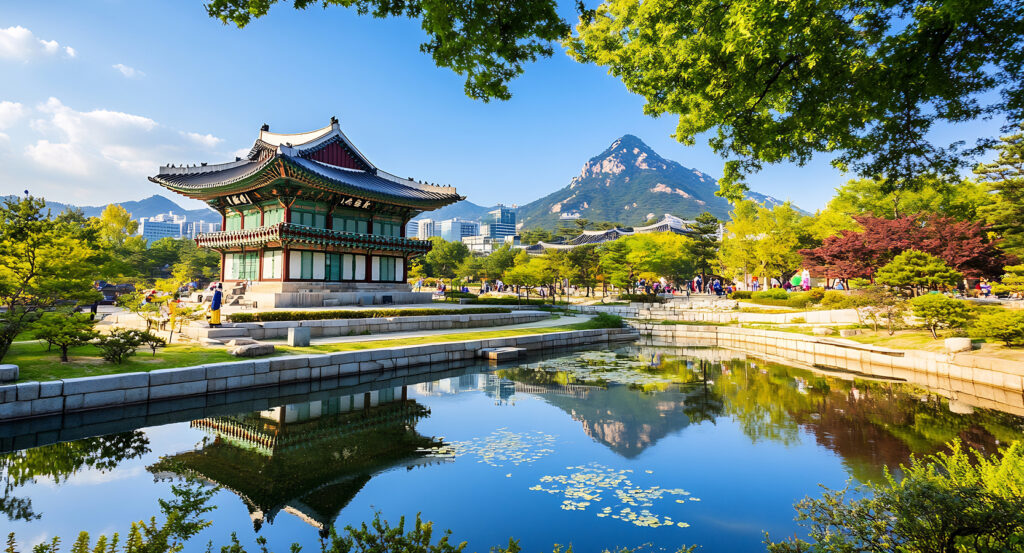
Why Gwanghwamun Gate matters.
Gwanghwamun Gate is more than an entrance, it's a national heartbeat, the threshold where Korea's story begins anew each day.
Standing sentinel at the southern edge of Gyeongbokgung Palace, the gate rises in stoic majesty, its three arched portals perfectly aligned with the palace's central axis and the mountains beyond. The moment you approach, you feel scale and symbolism converge: beneath its tiered roof of jade tiles and red-painted beams, past and present meet like the joining of breath. The capital's rhythm hums behind you, cars, conversation, neon, yet as you pass through Gwanghwamun's stone arches, that sound fades into echo, replaced by the hush of courtyards and the steady beat of history. Each tile, each carving, each guardian lion standing at its base carries the same message: endurance. Gwanghwamun isn't merely a gate; it's the living face of Korea's identity, rebuilt, revered, and resolute through every chapter of its past.
What defines Gwanghwamun Gate.
Gwanghwamun, meaning “Gate of Radiant Harmony,” was first completed in 1395 as the grand southern gate of Gyeongbokgung Palace, the symbolic mouth through which royal processions entered the world.
Its architecture followed Confucian principles of order and symmetry: three portals for the triad of heaven, earth, and humankind, and a two-story pavilion above for archers and guards to watch over the capital. Yet its beauty belies a story of survival. The gate was destroyed during the Imjin War in the 16th century, rebuilt in the 19th, and again dismantled during Japanese occupation in the early 20th, when it was relocated to the eastern corner of the palace grounds to make way for colonial headquarters. For decades, Gwanghwamun stood displaced, its wooden frame stripped, its stones scattered. Only after the 1990s did the painstaking process of restoration begin, culminating in its full return to its original location in 2010. Every piece of granite in its foundation was cataloged and reassembled using traditional joinery without steel or concrete, honoring the methods of Joseon-era craftsmen. The calligraphy on the signboard, three bold Chinese characters for “Gwanghwamun”, was written by King Jeongjo himself and restored in his original brush style. Few visitors realize that inside the gate's upper pavilion, known as Gwanghwamunru, lies a time capsule placed during the 2010 reopening ceremony, containing wishes and messages for Korea's next century.
How Gwanghwamun Gate fits.
Gwanghwamun Gate is best experienced at the edges of day, when the city's pulse softens and the gate's silhouette glows against the sky.
Arrive in the early morning to watch the Changing of the Guard ceremony, a vivid reenactment of royal tradition complete with banners, drums, and guards in crimson and blue. Stand at the front of the plaza for the best perspective: the gate framed by Mount Bugaksan behind it, symbolizing Korea's eternal guardianship. Walk slowly through the central arch reserved for royalty, an act once forbidden to all but the king, and feel the quiet dignity of passing where history once moved. In the evening, return to see it illuminated, its curved eaves glowing gold above the stone walls, lantern light flickering along the moat. From the plaza, look outward down Sejong-ro toward the statue of King Sejong the Great; it's the perfect alignment of Korea's intellectual and spiritual lineage. Pair your visit with a walk through Gyeongbokgung Palace itself, beginning at Gwanghwamun and ending at Geunjeongjeon Hall to experience the full ceremonial axis. Gwanghwamun Gate at Gyeongbokgung Palace in Seoul isn't just a doorway, it's a resurrection in stone, a promise that harmony, once lost, can always be rebuilt.
Where your story begins.
Foresyte Travel reveals places that feel extraordinary long before you arrive.
Enjoy editorial crafted for luxury travelers.
Foresyte may earn a commission when you book.

















































































































