
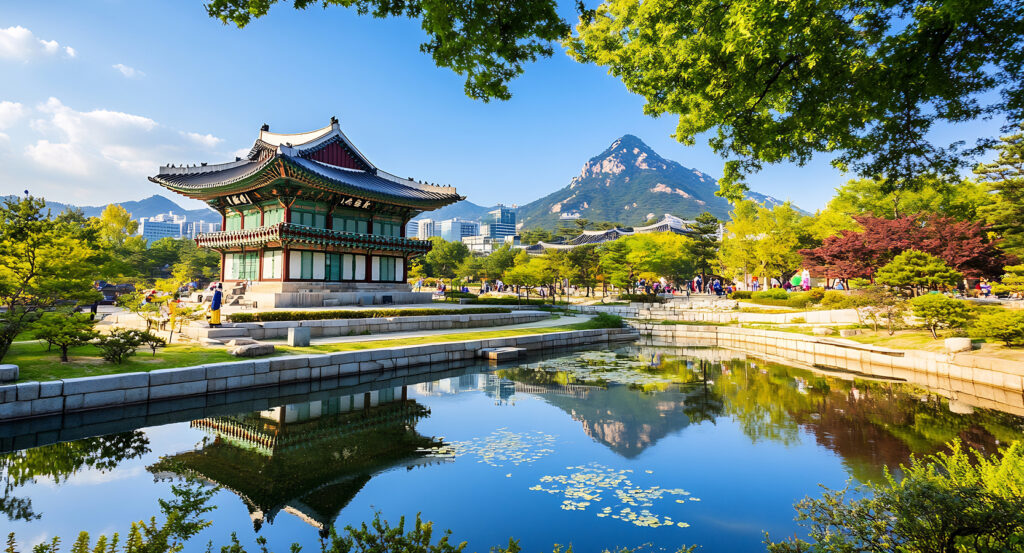
Why Hyangwonjeong Pavilion matters.
Hyangwonjeong Pavilion is the palace's heartbeat of tranquility, a floating poem in wood and water.
Set on a small, lotus-shaped island in the northern gardens of Gyeongbokgung, it feels like a dream suspended in stillness. A delicate wooden bridge, Chwihyanggyo, the “Bridge of Fragrance”, stretches across the pond toward the hexagonal pavilion, its reflection shimmering on the surface like a watercolor come to life. Each season transforms the scene entirely: in spring, the air hums with cherry blossoms drifting like snow; in summer, lotus flowers bloom around the base; in autumn, crimson maples turn the water to fire; and in winter, snow blankets the roofs in white silence. The pavilion's name translates to “Pavilion of Far-Reaching Fragrance,” and true to it, the air seems perfumed with calm. Standing there, surrounded by water and light, you can almost hear the quiet breaths of kings who once sought peace away from courtly duty.
What defines Hyangwonjeong Pavilion.
Hyangwonjeong was commissioned in 1873 by King Gojong, during one of the few peaceful intervals in Korea's turbulent 19th century.
Built as a royal retreat for contemplation and rest, it represents the softer, human side of monarchy, a sanctuary from the weight of governance that dominated Geunjeongjeon Hall to the south. The pavilion's hexagonal shape carries deep symbolism: the number six signifying harmony between heaven and earth in Korean geomancy. Its architectural proportions were inspired by Chinese garden pavilions, yet its materials, pine and clay tile, are purely Korean, embodying the simplicity and balance prized during the late Joseon era. The pond encircling the pavilion was excavated by hand, lined with stones arranged in natural irregularity to mirror the randomness of nature. During the Japanese occupation, the bridge was dismantled and later rebuilt using photographs and royal blueprints discovered in the archives of the National Palace Museum. Few visitors realize that Hyangwonjeong and its bridge form a perfect compass alignment, north to south, symbolizing passage from contemplation (the pavilion) to action (the palace). Even the surrounding flora was chosen with intent: willows for humility, lotuses for purity, and maples for wisdom in maturity.
How Hyangwonjeong Pavilion fits.
Hyangwonjeong Pavilion works as a meditation, a slow walk through stillness that deepens with every step.
Approach from the northern end of Gyeongbokgung, where the pond first comes into view between the trees. Pause on Chwihyanggyo Bridge midway across, and let your gaze rest on the pavilion's reflection, the rippling symmetry that captures the essence of Korean aesthetics: beauty through impermanence. Visit in the morning for soft light and solitude, or late afternoon when the sun dips behind Bugaksan Mountain and the water mirrors its golden hue. Sit quietly on one of the benches nearby and listen, to the rustling reeds, the occasional bird call, the distant footsteps echoing from the palace. Bring a notebook or a camera if you wish, but most visitors find that stillness is enough. For a fuller experience, pair your visit with Gyeonghoeru Pavilion to compare the intimate and the grand, private reflection versus royal ceremony. Before leaving, circle the pond to see the pavilion from every angle; its beauty lies in movement as much as form. Hyangwonjeong Pavilion at Gyeongbokgung Palace in Seoul isn't simply a structure, it's a breath made visible, the quiet soul of a kingdom that once ruled through grace.
Where your story begins.
Foresyte Travel reveals places that feel extraordinary long before you arrive.
Enjoy editorial crafted for luxury travelers.
Foresyte may earn a commission when you book.

















































































































