Why HA' matters.
HA' is a MICHELIN-starred contemporary Mexican restaurant where Riviera Maya's coastal hospitality heritage meets Carlos Gaytán's French culinary training, the ingredients of regional Mexican cooking and a tasting-menu tradition shaped by his pioneering career in Chicago.
Set within Hotel Xcaret México along the Chetumal-Puerto Juárez highway south of Central Playa del Carmen, the restaurant occupies a secluded position within the resort's landscaped coastal grounds, between tropical vegetation, natural limestone formations and the Caribbean shoreline. A sculptural water installation introduces the entrance, establishing a physical connection with the restaurant's Maya-derived name, meaning water. The dining room incorporates contemporary furnishings, subdued lighting and carefully arranged tables within an intimate architectural composition. Decorative elements and tableware extend the aquatic theme through organic forms and controlled illumination, creating a setting designed for an extended evening meal. The result is a restaurant whose sheltered interior, distinctive entrance and surrounding tropical landscape connect contemporary fine dining with the natural environment of the eastern Yucatán Peninsula.
What defines HA'.
HA' is best known for bringing Carlos Gaytán's Mexican-French cooking to Hotel Xcaret México in 2018 and becoming the first restaurant within Grupo Xcaret's hospitality collection to receive a MICHELIN star in 2024. Gaytán was born in Huitzuco, Guerrero, where his early familiarity with Mexican household cooking developed before he emigrated to the United States. He arrived in Chicago as a young man and began working in professional kitchens, gradually advancing through positions that introduced him to the demanding techniques of classical French cuisine. His career included work at the Union League Club of Chicago under chef Dominique Tougne, whose mentorship contributed to his technical development. In 2008, Gaytán opened Mexique in Chicago, combining French preparations with ingredients and seasonings associated with his Mexican upbringing. The restaurant earned a MICHELIN star in the 2013 Chicago guide, making Gaytán the first Mexican-born chef to receive the distinction. His appearance as a contestant on Bravo's Top Chef in 2013 extended his recognition beyond Chicago's restaurant community. After a decade operating Mexique, he closed the establishment in 2018 and returned to Mexico to develop HA' within Grupo Xcaret's newly opened resort. The project connected his international culinary career with the Caribbean region's expanding fine-dining industry and the hospitality group's emphasis on Mexican food traditions. Chef Cristian Castillo Sánchez joined Gaytán in directing the restaurant's culinary operations, contributing to the development of its contemporary tasting-menu format. Their kitchen cultivated relationships with Mexican producers, integrating carefully selected regional ingredients into preparations informed by French techniques. HA' received the AAA Five Diamond distinction, adding an established international hospitality recognition to its professional standing. Mexico's inaugural MICHELIN Guide awarded the restaurant one star in May 2024, marking Gaytán's return to MICHELIN recognition in his country of birth. The restaurant retained its star in 2025, confirming the continuity of its culinary program across the guide's first two Mexican editions. Its participation in Grupo Xcaret's Apapaxoa gastronomic festival subsequently connected the kitchen with a wider gathering of Mexican and international chefs, extending its role within the region's professional culinary community. MICHELIN's restaurant listing subsequently carried a temporary-closure notice, making confirmation of operating status necessary before planning a visit.
Carlos Gaytán's cooking develops Mexican ingredients through classical French sauces, carefully controlled temperatures and unexpected combinations of savory richness, acidity and sweetness. The nine-course tasting menu begins with wagyu tartare accompanied by avocado, house-made jocoque, hoja santa oil and a delicate fried pastry, establishing the relationship between rich beef, cultured dairy and the aromatic character of a traditional Mexican herb. A tetela introduces the corn-based cooking of Central Mexico through a folded masa preparation containing escamoles, accompanied by avocado purée, cauliflower, fresh cheese and hoja santa. The corn provides an earthy foundation, and the escamoles contribute a delicate nuttiness that complements the richness of the accompanying ingredients. King crab develops a contrasting treatment of seafood through brown-butter ice cream, cucumber, mandarin gel and caviar, balancing the shellfish's sweetness against cold dairy richness and citrus acidity. Lobster tail receives a vanilla beurre blanc, bringing the aromatic warmth of the spice into a classical butter sauce alongside apple, fennel and dill. House-cured ikura introduces salinity and a concentrated marine finish, sharpening the relationship between the shellfish and its creamy accompaniment. Mushroom beignet demonstrates the kitchen's technical precision through a crisp fried preparation accompanied by truffle sauce, morels and mint. The pastry's delicate exterior contrasts with the mushrooms' earthy concentration, and the mint introduces freshness to the rich sauce. Pink mole develops a distinctly Mexican preparation around roasted beetroot, pistachio, horseradish and Greek yogurt, allowing the vegetable's sweetness to interact with nutty richness and sharp seasoning. Wagyu cheek extends the menu into slow-cooked meat, accompanied by smoked eggplant purée, mushroom demi-glace and crisp potato. Rosemary ice cream with yuzu gel and melon provides an aromatic transition toward dessert, introducing herbal fragrance and citrus acidity after the savory courses. A final panna cotta combines white chocolate, vanilla, coconut, cauliflower and cajeta, connecting classical European confectionery with Mexican caramelized milk. Mexican wines accompany the sequence, with pairings selected to address the changing acidity, aromatic intensity and richness of individual preparations. HA's culinary character develops through this precise integration of French technical foundations and Mexican ingredients, allowing familiar regional flavors to acquire new textures and carefully structured combinations.
How HA' fits.
HA' works as the culinary centerpiece for a Riviera Maya itinerary connecting the archaeological foundations of Maya coastal commerce, the subterranean freshwater systems that sustained settlement and the Caribbean shoreline that shaped the peninsula's maritime history.
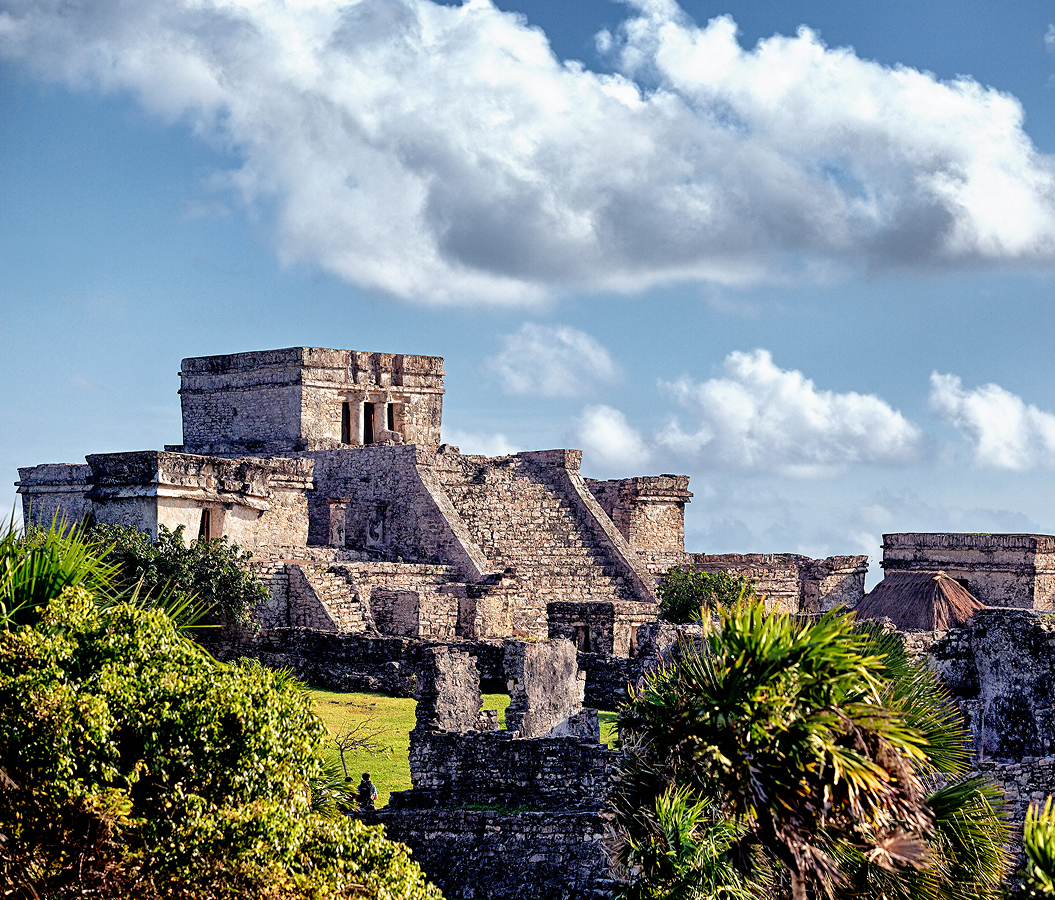
Begin at Xcaret Archaeological Site, the remains of the Maya settlement historically associated with the name Polé. Its position near a sheltered Caribbean inlet supported commercial exchange along the eastern Yucatán Peninsula during the Postclassic period. Surviving masonry structures, ceremonial platforms and plazas preserve elements of the settlement's religious and commercial organization. The coastal community also served as a departure point for pilgrimages to Cozumel, where sanctuaries associated with the goddess Ixchel attracted worshippers from surrounding regions. Its archaeological remains connect the peninsula's maritime geography with the religious institutions and trading networks of the ancient Maya. Continue to Río Secreto, the extensive underground cave system south of Playa del Carmen whose partially flooded limestone passages contain stalactites, stalagmites and mineral columns. Rainwater gradually dissolved the peninsula's carbonate bedrock, creating chambers and drainage routes through which freshwater moved beneath the tropical forest. Mineral deposits accumulated over thousands of years, producing formations that preserve successive stages of geological development. Guided routes combine walking, wading and floating through clear underground pools, revealing the relationship between the peninsula's geology and the aquifer that supplied freshwater to its inhabitants. Conclude at Xaman-Há Archaeological Site, the remains of a Maya coastal settlement within Playa del Carmen's Playacar district. Its location facing the Cozumel Channel connected the community with maritime trade and religious pilgrimage routes during the Postclassic period. Surviving stone platforms and building foundations preserve evidence of occupation along the Caribbean shoreline. The settlement's position near coastal navigation routes demonstrates the importance of small ports within the commercial organization of the eastern Yucatán Peninsula. Its archaeological remains place modern Playa del Carmen within a longer history of Maya settlement and movement across the western Caribbean. The progression moves from the ceremonial and commercial institutions of a Maya coastal port through the underground freshwater system that sustained regional settlement and culminates in the archaeological remains preserving Playa del Carmen's maritime foundations.
Where your story begins.
Foresyte Travel reveals places that feel extraordinary long before you arrive.
Enjoy editorial crafted for luxury travelers.
Foresyte may earn a commission when you book.