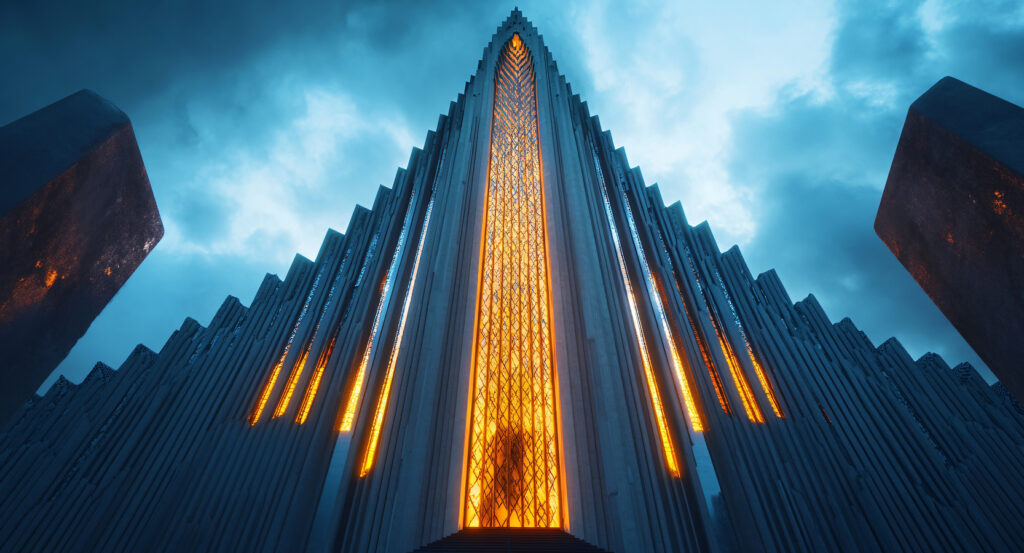
Why you should experience Skólavörðustígur in Iceland.
The Skólavörðustígur Street is Reykjavík's grand promenade in miniature, a gently sloping avenue that leads straight to the soaring spire of Hallgrímskirkja, where art, design, and daily life converge in perfect rhythm.
From the base of the hill, the street rises like a visual crescendo, framing the church at its summit against Iceland's ever-shifting sky. Every step along this stretch feels alive with personality: colorful tin-roofed houses lean toward the sunlight, shopfronts burst with handcrafted jewelry, wool sweaters, and modern Nordic design, while the air fills with the scent of roasted coffee and sea breeze. Street musicians strum softly outside cafés, blending folk melodies with the chatter of locals and travelers. It's the kind of place where time slows, where a simple walk becomes a physical experience that captures Reykjavík's essence: creative, grounded, and quietly proud. And then, as you near the top, the view opens, Hallgrímskirkja rising like a sculpted glacier at the end of your path, calling you forward with its grand grace.
What you should know about Skólavörðustígur.
Though now one of Reykjavík's most photogenic streets, Skólavörðustígur has humble beginnings.
Its name, meaning “School Cairn Path,” dates back to the 19th century, when students would trek up this route to the hilltop to build small stone cairns as part of outdoor exercises from the Latin School. Over time, the street evolved from a quiet residential lane into a creative artery, the soul of Reykjavík's artisan culture. Many of the boutiques and galleries here are family-run, carrying on traditions that trace back generations, from hand-knit Icelandic wool to volcanic-glass jewelry forged by local designers. The murals and art installations you see along the façades aren't random either, they're part of a rotating initiative called Listahátíð í Reykjavík (Reykjavík Arts Festival), where local artists reimagine public space every few years. The street's alignment was intentionally preserved during modern urban planning to maintain the dramatic sightline toward Hallgrímskirkja, a decision that makes Skólavörðustígur both a thoroughfare and a pilgrimage route. Every paving stone, every color choice, and every storefront along it contributes to that quiet crescendo leading to Iceland's most iconic silhouette.
How to fold Skólavörðustígur into your trip.
Start the exploration of Reykjavík here, walking from the thriving intersection of Bankastræti toward the summit of Skólavörðuholt Hill.
The walk itself takes less than ten minutes, but give yourself an hour; this is not a street to rush. Pause at Gallery Fold to see Icelandic contemporary art, duck into Orrifinn Jewels for handmade silverwork inspired by Nordic mythology, and grab a cinnamon bun from Braud & Co, whose scent will guide you long before you see the door. As you climb, look back often, the view of the city descending toward the sea is among the most beautiful in Reykjavík. Near the top, street performers often gather, and on weekends, pop-up markets line the sidewalks with local crafts and pastries. End your walk in the Church Plaza, where Hallgrímskirkja's shadow stretches across the pavement like an invitation. This approach captures everything Reykjavík stands for, creativity rooted in community, beauty in simplicity, and the unspoken joy of a city always looking toward the horizon.
Where your story begins.
Foresyte Travel reveals places that feel extraordinary long before you arrive.
Experience premium editorial crafted for luxury travelers.