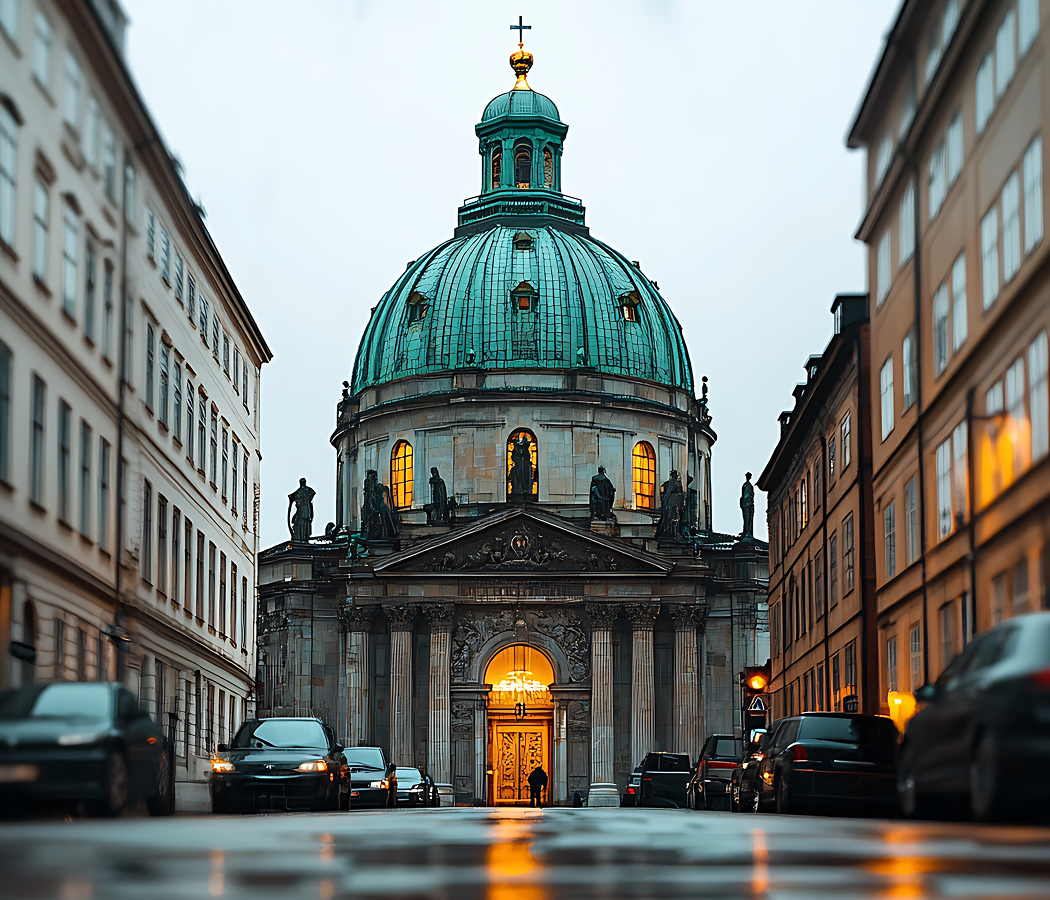
Why Harpa Concert Hall and Conference Centre matters.
Harpa Concert Hall and Conference Centre is a twenty-first-century waterfront performance complex where Miðborg's maritime heritage meets Iceland's orchestral tradition, the geometric architecture of Ólafur Elíasson and the redevelopment of Reykjavík's former harbor district.
Standing on Austurbakki beside Reykjavík's Old Harbour, the concert hall occupies a reclaimed waterfront site between Kalkofnsvegur and the harbor basin, where its faceted glass exterior faces Faxaflói Bay and the surrounding streets connect the historic city center with the northern shoreline. The building rises above a broad public entrance plaza overlooking the water. Its steel-and-glass enclosure incorporates repeated geometric cells that change appearance with daylight and viewing angle. Interior circulation spaces extend along the waterfront façade, connecting multiple performance halls through staircases, balconies and open gathering areas. The result is a cultural complex whose architecture joins Iceland's maritime setting with the technical requirements of orchestral performance and international conferences.
What defines Harpa Concert Hall and Conference Centre.
Harpa Concert Hall and Conference Centre is best known for its geometric glass façade, acoustically specialized performance halls and role as the principal home of the Iceland Symphony Orchestra. Reykjavík's expanding musical institutions created demand for a dedicated concert facility capable of accommodating orchestral performances and large cultural events. The Iceland Symphony Orchestra, founded in 1950, performed for decades in venues whose architectural arrangements had not been developed specifically for symphonic music. Plans for a purpose-built concert hall gained momentum during the early twenty-first century as Reykjavík pursued substantial waterfront redevelopment. The project became part of a broader scheme intended to introduce cultural, commercial and civic facilities along the former harbor frontage. Danish architectural firm Henning Larsen Architects developed the principal building design in collaboration with Icelandic architectural practice Batteríið Architects. Icelandic-Danish artist Ólafur Elíasson contributed the geometric façade concept, drawing upon crystalline formations and the structural patterns associated with Icelandic basalt. Construction began in 2007, bringing together architectural, engineering and acoustic specialists from several countries. The Icelandic financial crisis of 2008 disrupted the original development arrangements and placed the partially completed building's future in doubt. Public authorities subsequently supported the continuation of construction, recognizing the project's importance to Reykjavík's cultural infrastructure. The completed building opened in May 2011, establishing a permanent home for the Iceland Symphony Orchestra and the Icelandic Opera. Its opening introduced a major performance venue at a time when Iceland was recovering from the economic crisis. Harpa received the European Union Prize for Contemporary Architecture, the Mies van der Rohe Award, in 2013. The recognition placed the building within an international discussion of architectural innovation and the relationship between public institutions and urban redevelopment. The concert hall subsequently became a central venue for orchestral music, opera, conferences and cultural festivals in Reykjavík.
Ólafur Elíasson's façade design employs a modular system of steel and glass elements developed from geometric forms associated with Icelandic volcanic landscapes. The southern elevation incorporates three-dimensional crystalline units that create a layered surface of transparent, reflective and colored glass. Changes in sunlight alter the appearance of the façade throughout the day, producing different visual relationships between the building and the surrounding harbor. The northern elevation incorporates a more regular arrangement of glass panels, providing views toward the waterfront and the mountains beyond Faxaflói Bay. The main entrance leads into a substantial foyer containing interconnected staircases, balconies and circulation platforms. These spaces permit movement between the performance halls and provide elevated views across the harbor. Eldborg, the principal concert hall, accommodates 1,800 people and takes its name from an Icelandic volcanic crater. Its interior contains red-toned surfaces and a carefully designed acoustic enclosure suited to symphonic performance. Acoustic specialists Artec Consultants contributed to the development of the hall's sound characteristics, including reverberation and the distribution of orchestral sound. Adjustable acoustic elements support performances requiring different musical conditions. Norðurljós provides a smaller performance setting distinguished by blue-toned decorative surfaces and flexible seating arrangements. Silfurberg accommodates conferences, amplified performances and events requiring adaptable floor configurations. Kaldalón serves chamber music and smaller gatherings through an intimate auditorium arrangement. The Iceland Symphony Orchestra performs its principal concert programs in Eldborg, maintaining a repertory that includes European symphonic works and compositions by Icelandic musicians. The Icelandic Opera contributes staged musical productions to the institution's artistic program. Harpa's combination of specialized halls, waterfront public spaces and geometric glass architecture connects the technical demands of musical performance with the cultural development of Reykjavík's harbor district.
How Harpa Concert Hall and Conference Centre fits.
Harpa Concert Hall and Conference Centre works as the contemporary cultural centerpiece for a Reykjavík outing connecting Iceland's maritime history, sculptural traditions and the civic institutions surrounding the city's northern waterfront.
Begin at the Reykjavík Maritime Museum, housed in a former fish-freezing facility near the Old Harbour. The museum examines Iceland's relationship with fishing, seafaring and maritime trade, industries that shaped Reykjavík's economic development. Its exhibitions include objects associated with fishing vessels, navigation, processing equipment and the working conditions of maritime communities. The former industrial building preserves the architectural character of the harbor's commercial infrastructure. The museum's interpretation of fishing technology connects the expansion of Reykjavík's waterfront with Iceland's transition toward mechanized commercial fishing during the twentieth century. Continue to the Sun Voyager, the stainless-steel sculpture created by Icelandic artist Jón Gunnar Árnason. Installed along Sæbraut in 1990, the work takes the form of an abstracted vessel with curved metal ribs rising from a narrow base. Its design was developed as a representation of discovery, freedom and the promise of new territory. The sculpture stands beside the shoreline, where its polished surfaces interact with changing daylight and the surrounding seascape. Its position overlooking Faxaflói Bay connects Reykjavík's public art with the maritime geography of the Icelandic capital. Conclude at the National Theatre of Iceland, the principal national theater institution situated near Hverfisgata. The building opened in 1950 following a prolonged construction period that began during the early twentieth century. Architect Guðjón Samúelsson designed the structure using forms associated with Icelandic architectural nationalism and the country's volcanic geology. Its dark exterior surfaces and stepped composition distinguish the building from the surrounding streetscape. The theater developed as a central institution for Icelandic-language drama, supporting productions by national playwrights alongside international theatrical works. Its performance spaces preserve the development of professional theater within Iceland's cultural institutions. The progression moves from Reykjavík's fishing economy through twentieth-century public sculpture and culminates at the national theater, connecting Harpa with the maritime and performing-arts history of Iceland's capital.
Where your story begins.
Foresyte Travel reveals places that feel extraordinary long before you arrive.
Enjoy editorial crafted for luxury travelers.
Foresyte may earn a commission when you book.