
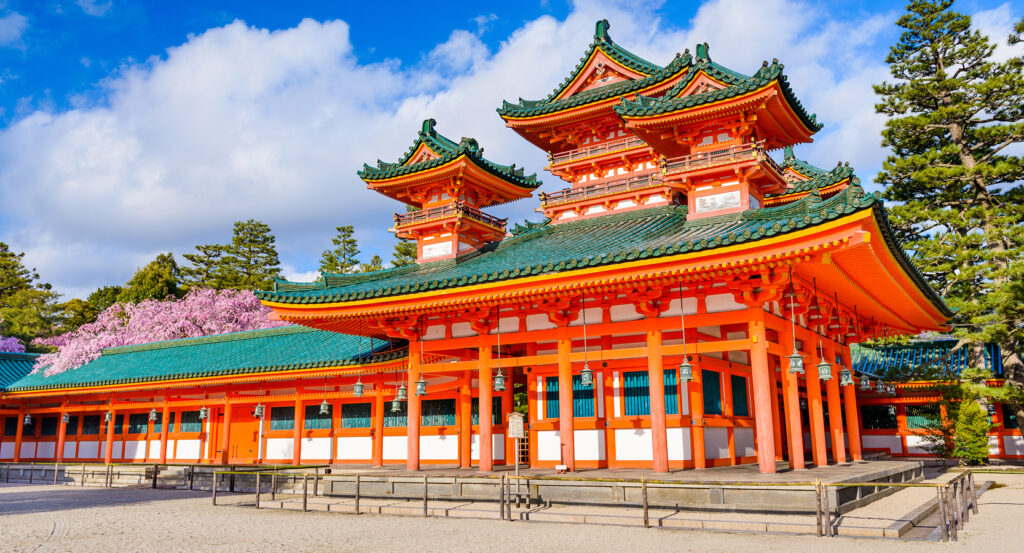
Why you should experience Daigokuden Hall in Kyoto, Japan.
Daigokuden Hall, or Great Audience Hall, at Heian Shrine is Kyoto's imperial echo, a hall where ceremony becomes silence and symmetry becomes spirit.
Standing at the far end of the great courtyard, it radiates power through calmness. Its sweeping green-tiled roof gleams in the sun like polished jade, while its vermilion pillars rise in rhythmic perfection against the pale gravel below. Step into its presence and you feel the gravity of balance, the precision of a city that once ruled an empire through elegance, not noise. The air vibrates faintly with history, though the structure itself is young, a recreation of the grand audience hall that once anchored the ancient Heian Palace. Yet within its geometry, Kyoto's character still beats: disciplined, luminous, timeless. Daigokuden doesn't overwhelm with scale; it invites surrender to stillness, asking nothing but quiet attention.
What you should know about Daigokuden Hall.
Daigokuden was the ceremonial center of the original Heian Palace, where emperors conducted court rituals, welcomed envoys, and proclaimed edicts that shaped the Japanese realm.
When the Heian Shrine was commissioned in 1895 to celebrate Kyoto's 1,100th anniversary, architect Itō Chūta designed Daigokuden as the shrine's focal reconstruction, a two-thirds scale revival of the palace's lost glory. The hall's proportions mirror the ancient layout precisely, from the curvature of its double roof to the spatial rhythm of its 18 vermilion columns. Each beam and bracket was built using traditional kirizuma-zukuri carpentry, assembled without nails, and painted in cinnabar lacquer to reflect sunlight and repel impurities. The hall enshrines the spirits of Emperor Kanmu, Kyoto's founder, and Emperor Kōmei, its last imperial resident before the capital moved to Tokyo, bridging a millennium of history within a single breath. Few visitors realize that the hall's open floor plan was designed to mimic the emperor's dais of the 8th century, where no walls separated ruler from sky, a symbol of harmony between heaven and man. Its vast courtyard, stretching before Daigokuden like a sea of white gravel, amplifies this illusion of endlessness. During festivals, priests in crimson robes cross that expanse in deliberate, floating motion, an echo of processions that once filled the imperial court.
How to fold Daigokuden Hall into your trip.
Daigokuden Hall is best approached slowly, not as a destination, but as a culmination.
Enter Heian Shrine through the Ōtenmon Gate and walk straight across the expansive courtyard. The hall rises before you, serene and commanding, framed perfectly by the symmetrical wings of the compound. Pause midway to take in the scale, the long sweep of rooflines, the rhythm of pillars, the gravel glinting like powdered pearl beneath your feet. As you draw closer, the sound of the city fades into the hush of open air. Visit early in the morning or near sunset, when the light catches the edges of the roof and the colors deepen from vermilion to rusted gold. Step up to the threshold, but do not cross, the inner sanctum remains sacred. From this vantage point, you'll see Kyoto's soul reflected in wood and sky: order, humility, endurance. During the Jidai Matsuri each October, the grand procession culminates here, with thousands of participants bowing before the hall in silent homage to the city's eternal reign. And when you leave, turn back once more, Daigokuden will seem to hover above the courtyard like a memory you've just stepped out of. Kyoto builds its beauty to last beyond time. This hall, reborn from loss, proves it.
Where your story begins.
Foresyte Travel reveals places that feel extraordinary long before you arrive.
Experience premium editorial crafted for luxury travelers.

















































































































