
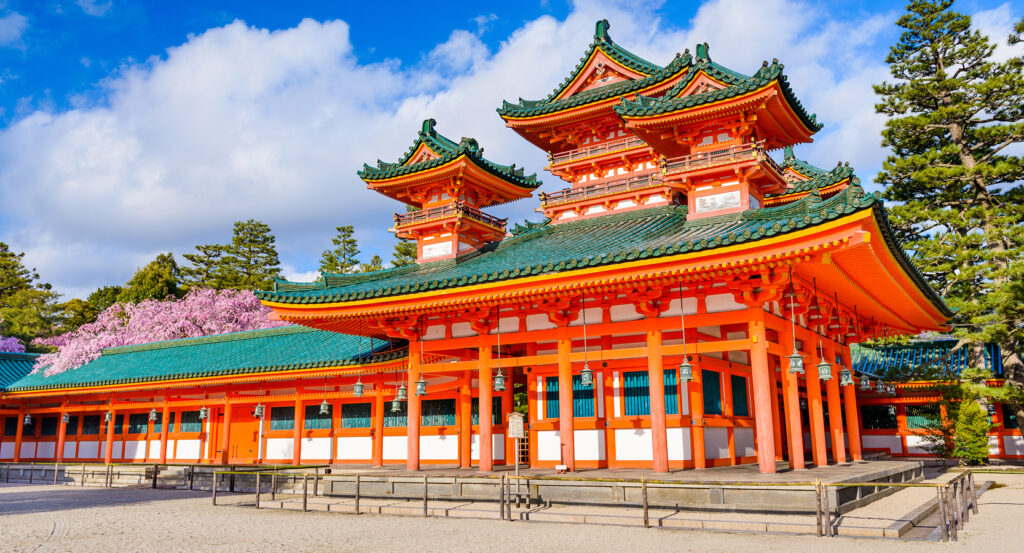
Why you should experience Heian-jingū Shrine in Kyoto, Japan.
Heian-jingū Shrine, or Heian Shrine, is Kyoto's symphony of color, culture, and calm, a world where the grandeur of Japan's imperial past meets the timeless serenity of Shinto tradition.
Set against the city's eastern hills, this shrine feels like a portal to another age. As you pass through the towering torii gate, among the largest in Japan, the modern world melts away, replaced by vast courtyards of white gravel, vermilion columns, and sweeping green roofs that gleam beneath the sun. The air smells faintly of pine and incense, carried by a gentle breeze that stirs the paper streamers of omikuji (fortune slips) tied to sacred trees. Every corner of the shrine seems to breathe harmony, from the curved bridge over still waters to the rhythmic chants of priests echoing softly through the main hall. The Daigokuden, or main building, was modeled after Kyoto's original Imperial Palace from the Heian period, a deliberate homage to an era when art, literature, and ceremony defined Japanese identity. Standing in the courtyard, surrounded by brilliant vermilion and jade-green tiles, you feel both the weight and grace of centuries, a living reminder of Kyoto's role as the spiritual heart of Japan.
What you should know about Heian-jingū Shrine.
Heian-jingū isn't an ancient relic but a modern masterpiece built to honor a thousand years of Kyoto's imperial legacy.
Constructed in 1895 to commemorate the 1,100th anniversary of Kyoto's founding, the shrine was dedicated to Emperor Kanmu, who first established the city as Japan's capital in 794, and later to Emperor Komei, the last to rule before the Meiji Restoration moved the capital to Tokyo. Its architecture intentionally revives the splendor of the Heian period, that golden age when Kyoto flourished as the cultural and political center of Japan. The scale is majestic yet balanced, embodying the principles of Shinbutsu Bunri, the Shinto separation from Buddhism that defined Japan's modernization. Despite being relatively young compared to other Kyoto landmarks, Heian-jingū exudes deep historical soul, partly because of the care given to its details: the precise curvature of the eaves, the soft clatter of wooden clogs on stone, the way the sunlight glances off lacquered red beams. The shrine's Shin-en Gardens, spanning nearly ten acres, are a masterpiece in themselves, divided into four sections, each reflecting a different phase of the day and a direction of the compass. Cherry blossoms burst to life in spring, irises bloom in summer, and maples ignite in autumn, making it one of Kyoto's most photographed sanctuaries. The annual Jidai Matsuri, or Festival of the Ages, begins here every October, featuring hundreds of participants in historical costumes who parade through the city, a living timeline that starts at Heian Jingu and ends at Kyoto's heart.
How to fold Heian-jingū Shrine into your trip.
To experience Heian-jingū is to walk through a story that bridges Kyoto's imperial dawn and modern grace.
Start the visit at the Otorii, the immense vermilion gate that marks the entrance to the shrine's outer approach, its scale alone is breathtaking, framing Kyoto's skyline like a painting. As you pass beneath it, stroll the wide gravel paths leading to the main courtyard, where vermilion columns line your view in perfect symmetry. Visit the offering hall to observe the quiet rituals of worship, a bow, a clap, and a prayer, or purchase a small wooden ema plaque to write your own wish for prosperity or love. Take time to explore the Shin-en Gardens, entering from the east gate, where koi drift through still ponds beneath the Taiheikaku Bridge, a covered walkway so picturesque it has inspired painters and poets alike. Arrive in late afternoon to see the sunlight spill over the shrine's red pavilions and reflect off the water, a scene of fleeting perfection that defines Kyoto's essence. If your timing allows, visit during cherry blossom season in April or the Jidai Matsuri in October, when the shrine transforms into a stage of living history. Before leaving, step back beneath the torii and glance once more at the contrast behind you, Kyoto's modern skyline rising beyond an eternal frame of vermilion and green. Heian-jingū Shrine is Kyoto distilled, elegant, spiritual, and alive with memory. It reminds you that beauty in Japan has always been more than aesthetic; it's a ritual of reverence, a way of honoring time itself.
Where your story begins.
Foresyte Travel reveals places that feel extraordinary long before you arrive.
Experience premium editorial crafted for luxury travelers.

















































































































