
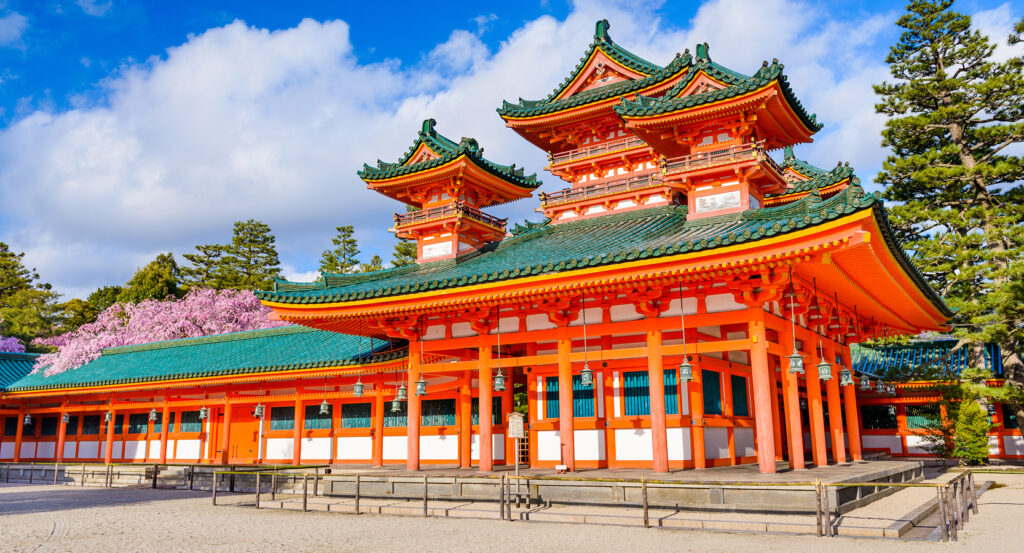
Why you should experience Ōtenmon Gate in Kyoto, Japan.
Ōtenmon Gate at Heian Shrine is Kyoto's grand threshold, a bridge between presence and reverence, form and memory.
Its vast vermilion frame rises at the approach to the main courtyard, sunlight pouring across its lacquered beams like molten gold. Every line of the gate is measured for balance, a geometry that holds the silence of centuries. Step beneath it, and the air itself changes. The gravel crunches softer underfoot, and the noise of the city fades into distant hum. The gate's towering columns, rooted in stone and painted in the same energetic orange as the shrine beyond, feel both ancient and newly awakened. It is the ceremonial pause before entry, the point where the world outside gives way to the world within. More than architecture, Ōtenmon is movement frozen mid-breath, a gate that doesn't separate, but transforms.
What you should know about Ōtenmon Gate.
Ōtenmon Gate is a meticulous reconstruction of the southern gate to the original Heian Palace, the imperial heart of Kyoto during Japan's classical age.
When the Heian Shrine was conceived in 1895 to commemorate the city's 1,100th anniversary, the gate became its most symbolically loaded feature. Architect Itō Chūta designed it as a faithful revival of the 8th-century original, replicating the double-roofed form and distinctive green tiles of the ancient capital's ceremonial entrance. Its proportions are deliberate, smaller than the mythic Daidairi Palace yet expansive enough to evoke awe, its structure calculated to draw the eye upward in stages, as if ascending toward the heavens. The gate's upper roof shelters a narrow balcony where imperial guards once stood watch in ritual re-enactments during the shrine's early ceremonies. The color, a deep, almost living vermilion, is not merely decorative; in Shinto tradition, it repels evil spirits and purifies all who pass beneath it. Few realize that every section of the gate was rebuilt by Kyoto craftsmen following the devastating fire of 1976, using original blueprints preserved in imperial archives. The reconstruction itself became a spiritual act, a continuation of the same craftsmanship that defined the city's ancient palaces. Ōtenmon Gate, in this sense, is Kyoto's architectural echo, a memory made tangible through faith and precision.
How to fold Ōtenmon Gate into your trip.
Ōtenmon Gate works as both entrance and meditation, a pause before immersion.
Approach along the stone avenue that stretches beneath the colossal torii on Okazaki Street. As the gate comes into view, let your pace slow; it is designed to command stillness as much as admiration. Step beneath its twin roofs and look up, the wooden rafters interlock in a perfect rhythm of light and shadow, their lacquered surfaces glowing with centuries of craft. Visit in the morning when the light slants across the gravel courtyard, or near sunset when the orange pillars blaze against the fading sky. The gate frames the main hall of Heian Shrine like a living picture, each step forward turning architecture into ritual. During the annual Jidai Matsuri, the procession of historical figures passes directly beneath the gate's arch, symbolizing Kyoto's passage through time itself. On quiet days, stand at the threshold and listen: the wind moves through the beams like a soft chant, the gravel beneath your feet whispering a steady rhythm. When you finally pass through to the courtyard beyond, you'll understand why Kyoto builds gates not to keep people out, but to remind them to arrive.
Where your story begins.
Foresyte Travel reveals places that feel extraordinary long before you arrive.
Experience premium editorial crafted for luxury travelers.

















































































































