
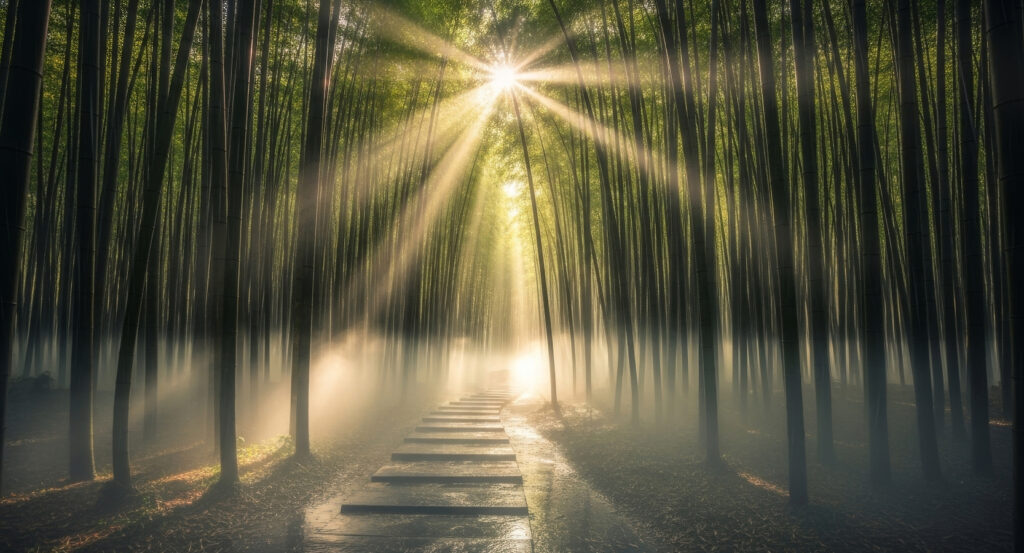
Why you should experience Hoshinoya Kyoto in Kyoto, Japan.
Hoshinoya Kyoto is Kyoto removed from the city entirely, a place where arrival itself rewires your perception of time and where the boundary between destination and refuge disappears the moment you leave the road behind.
Reaching Hoshinoya Kyoto is not incidental. You do not walk to it, and you do not stumble upon it. You arrive by boat, drifting along the Katsura River as the city recedes and the Arashiyama hills slowly enclose you. This approach is not a novelty; it is the first act of separation. By the time you step onto the landing, the pace of Kyoto has already been dismantled. Sound thins out. Movement becomes deliberate. The property sits low and quiet along the riverbank, intentionally obscured by trees and terrain, giving the impression that it has been absorbed into the landscape. Architecture here does not assert dominance. It follows the river's curve, the slope of the land, and the logic of concealment. Public spaces feel hushed, almost monastic, shaped by stone, wood, and filtered light. There is no lobby in the conventional sense, no moment of presentation. Instead, you are guided inward gradually, through layered thresholds that signal retreat. Guest rooms extend this sense of detachment with rare discipline. They are designed not as accommodations, but as private viewing chambers for the surrounding environment. Windows frame the river, mossy banks, and overhanging branches in compositions that change yet never demand attention. Beds are placed low and wide, encouraging rest. Seating is minimal, arranged to face outward. Storage is discreet, allowing you to disappear into the space. Lighting is exceptionally restrained. Natural light governs the day, while evening illumination remains soft, indirect, and intentionally limited, reinforcing circadian rhythm. Bathrooms function as places of purification. Deep tubs, quiet water flow, and controlled temperature turn bathing into a grounding ritual that feels inseparable from the setting. Dining at Hoshinoya Kyoto is inseparable from season and silence. Meals are paced slowly, presented with clarity rather than ceremony, and designed to be consumed without distraction. The experience does not perform Kyoto cuisine; it inhabits it. Shared spaces throughout the property feel like extensions of the landscape. Pathways, terraces, and river-facing platforms encourage stillness. Nothing tells you to slow down. The environment simply leaves no alternative. Service at Hoshinoya Kyoto is almost invisible. Interactions are sparse, precise, and deeply respectful of solitude. Staff appear when needed and dissolve when not, operating with an acute awareness of timing and resonant space. The property attracts travelers who are willing to surrender control: repeat visitors to Japan, couples seeking withdrawal rather than romance-as-display, creatives, thinkers, and anyone who understands that true luxury sometimes means being unreachable. Hoshinoya Kyoto does not offer access to the city. It offers removal from it, and in doing so, reveals a different Kyoto entirely.
What you should know about Hoshinoya Kyoto.
Hoshinoya Kyoto was conceived as a deliberate counterpoint to urban hospitality, built around the belief that retreat is not an amenity but a condition that must be architected from the ground up.
The site was selected not for convenience, but for isolation within reach. Designers prioritized concealment, water access, and topography over visibility. The river approach is essential to the experience, functioning as both literal and psychological separation. Architectural choices emphasize horizontality, enclosure, and material continuity with the environment. Structures sit low, avoiding skyline interruption and visual dominance. Materials were chosen for their ability to weather quietly: wood that darkens, stone that mosses, surfaces that absorb sound and soften reflection. Guest rooms were designed with extreme restraint, informed by observation of how solitude alters behavior. Furniture was reduced to essentials, storage concealed, and visual stimuli minimized to allow external focus. Lighting design intentionally avoids brightness, supporting a gradual descent into evening. Bathing culture at Hoshinoya Kyoto emphasizes stillness and repetition, with water temperature and acoustics calibrated to promote deep physical calm. Dining spaces were planned to limit distraction, with seating orientations that preserve privacy and acoustic separation. Operational philosophy mirrors the architecture. Staff training emphasizes timing, distance, and sensitivity to silence. Service is not personalized through interaction, but through anticipation. Over time, Hoshinoya Kyoto has become a reference point for travelers seeking retreat without austerity, proving that removal can feel deeply nurturing rather than isolating. In a city saturated with heritage and movement, the property stands apart by refusing participation altogether.
How to fold Hoshinoya Kyoto into your trip.
Hoshinoya Kyoto works best when you allow it to function as a complete interruption, not as a base for sightseeing or a reward after exhaustion.
Plan the stay here either at the beginning or end of your trip, when you are willing to disengage from schedules and objectives. Arrive with minimal plans. Let mornings unfold naturally with the river's movement and filtered light. Spend time sitting, bathing, reading, or doing nothing. If you leave the property, do so intentionally and briefly, treating excursions into Arashiyama as optional. Return early. Afternoons are best spent on the grounds, allowing the environment to recalibrate you. Evenings belong to quiet meals and early rest, guided by darkness. Hoshinoya Kyoto pairs best with shorter stays that prioritize depth over activity, or longer stays where withdrawal itself is the purpose. By the time you depart by boat, the city will feel distant, and your reentry into Kyoto will be softened, slowed, and strangely clarified. In a destination defined by density, history, and repetition, Hoshinoya Kyoto offers something almost radical: a version of Kyoto that exists without audience, schedule, or demand, and a stay that asks nothing of you except presence.
Where your story begins.
Foresyte Travel reveals places that feel extraordinary long before you arrive.
Experience premium editorial crafted for luxury travelers.

















































































































