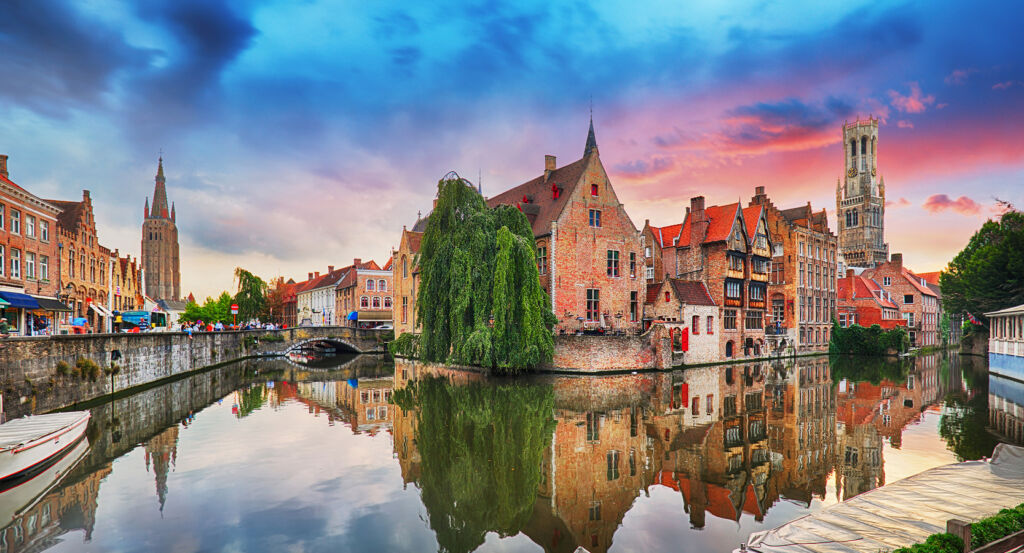
Why you should experience Hotel Albert I, Bruges in in Brugge, Belgium.
Hotel Albert I is where Bruges feels observational rather than immersive, a stay designed for travelers who want to see the city clearly, move through it efficiently, and maintain a sense of independence rather than resonant absorption.
Bruges often encourages surrender. Its density, beauty, and narrative weight can quickly pull visitors into a fully enclosed experience where days blur together and orientation becomes secondary to atmosphere. Hotel Albert I offers an alternative posture. Located directly opposite the main railway station, the hotel places you at a literal and psychological edge of the historic center, creating a relationship with Bruges defined by perspective. Arrival is immediate and pragmatic. There is no procession through medieval lanes or staged reveal. Instead, you step directly from transit into accommodation, a transition that establishes the hotel's defining value: clarity. Inside, the environment is straightforward, calm, and purpose-built. Interiors favor order, legibility, and restraint, allowing guests to orient themselves quickly and move with intention. Public spaces are minimal and functional, designed to support arrival, rest, and departure. This simplicity is deliberate. By refusing to compete with Bruges' aesthetic density, the hotel allows the city itself to remain the primary subject of attention. Guest rooms reinforce this orientation. Spaces are clean, well-organized, and efficiently proportioned, offering comfort. Beds are supportive and reliable, positioned to facilitate genuine rest. Lighting is practical and adjustable, accommodating early departures, midday returns, and evening downtime with equal ease. Furnishings prioritize utility, providing sufficient storage, seating, and workspace to support travelers who value readiness and order. Windows often look toward the station area or surrounding streets, offering a view of Bruges as a functioning city. Bathrooms are simple and efficient, emphasizing cleanliness, water pressure, and layout over indulgence. Throughout the hotel, sound management is pragmatic. The surrounding area carries movement and activity, but interior spaces are insulated enough to maintain calm, creating an environment that feels alert. Service at Hotel Albert I reflects this same sensibility. Interactions are polite, direct, and efficient, guided by clarity. Assistance focuses on logistics, timing, and navigation, making the hotel especially well-suited for travelers who prioritize movement and planning. The location completes the experience. From Hotel Albert I, Bruges becomes something you enter intentionally. The historic center is a short walk away, but returning to the hotel always feels like stepping back into a neutral zone, one that allows the day's impressions to settle. Hotel Albert I does not attempt to romanticize Bruges or draw you inward. It offers a vantage point, making it ideal for travelers who value perspective, autonomy, and control over immersion.
What you should know about Hotel Albert I.
Hotel Albert I reflects a layer of Bruges shaped by mobility, transition, and modern circulation rather than medieval enclosure, a context that quietly defines its role in the city's hospitality landscape.
The area surrounding the railway station developed later than Bruges' historic core, responding to the city's integration into national and international transport networks. This zone was designed for flow rather than preservation, supporting arrival, departure, and exchange rather than ritual or display. Hotel Albert I inherits this logic. Its positioning aligns with Bruges as a connected city rather than an isolated relic, emphasizing accessibility and movement. One lesser-known aspect of the hotel is how intentionally it supports travelers with changing itineraries. Bruges is often part of a broader route through Belgium or Europe, and Hotel Albert I functions particularly well for guests who are navigating multiple cities, schedules, or modes of transport. Early trains, late arrivals, and short stays are accommodated without friction, making the hotel a reliable anchor rather than a destination in itself. The building's design reinforces this operational clarity. Layouts are straightforward, signage is legible, and circulation is efficient, reducing cognitive load for guests who may be arriving tired or departing early. This emphasis on clarity creates a subtle psychological benefit. Rather than feeling absorbed into a new environment that demands orientation, guests can maintain continuity with their broader journey. Another defining element is the hotel's relationship with neutrality. In a city where many properties assert character through heritage, narrative, or atmosphere, Hotel Albert I remains intentionally neutral. This allows guests to project their own purpose onto the stay, whether that is sightseeing, transit, or short-term rest. Over time, this neutrality has attracted a specific clientele: independent travelers, planners, and repeat visitors who value predictability and efficiency over novelty. The service culture supports this orientation. Staff engagement is focused on accuracy and reliability. Directions, schedules, and local logistics are communicated clearly, reinforcing the hotel's role as an operational base. The hotel's name itself reflects a modern, civic era rather than medieval romance, aligning more closely with infrastructure and governance than legend. In a city where history is often framed inwardly, Hotel Albert I preserves a forward-facing identity. It does not attempt to situate you inside Bruges' past. It positions you at its edge, allowing you to approach the city with awareness, intention, and control.
How to fold Hotel Albert I into your trip.
Hotel Albert I works as a strategic base, allowing Bruges to be explored deliberately.
Begin your mornings with structure. The hotel's proximity to transit and its calm interior make it easy to plan the day clearly, whether that means heading directly into the historic center or using Bruges as one stop among many. Walk into the city with intention, crossing from the station area into medieval Bruges as a conscious transition. This shift sharpens perception, making the city's density feel intentional. Visit major landmarks with focus. Because your base remains slightly removed, you are less to drift aimlessly and more to engage selectively. Midday returns to the hotel are particularly effective. A brief pause outside the historic core allows physical reset, making afternoon exploration feel renewed. Use this time to rest, reorganize, or recalibrate plans without the pressure of remaining “inside” the city. In the afternoon, re-enter Bruges for targeted exploration. Museums, churches, or specific neighborhoods feel more distinct when approached in segments rather than as part of an uninterrupted flow. The walk back to the hotel reinforces this rhythm, creating a clear boundary between engagement and rest. Evenings benefit from intentional choice. Dine in the historic center or closer to the station area depending on mood, knowing that your return will be straightforward and calm. On longer stays, this separation becomes increasingly valuable. Bruges' beauty remains vivid rather than numbing, and each visit into the city feels purposeful rather than habitual. For travelers continuing onward, the hotel's location simplifies departure, eliminating the compression often felt on final days. Leaving Hotel Albert I feels efficient rather than abrupt, reinforcing the sense that the hotel has supported movement rather than interrupted it. The hotel does not attempt to deepen your resonant relationship with Bruges. It provides clarity, access, and perspective, allowing the city to be experienced with intention and remembered distinctly.
Where your story begins.
Foresyte Travel reveals places that feel extraordinary long before you arrive.
Experience premium editorial crafted for luxury travelers.