Why you should experience Hotel Bourgoensch Hof in Brugge, Belgium.
Hotel Bourgoensch Hof is where Brugge feels immediate, visual, and almost cinematic, a stay that places you directly inside the city's most recognizable imagery.
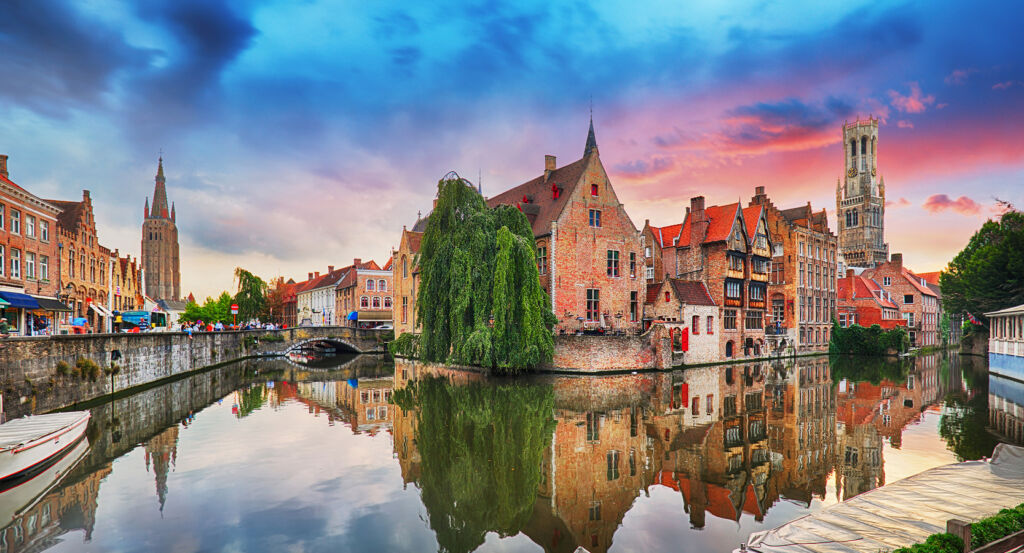
Brugge is a city many people feel they already know before arriving. Its canals, bridges, and stepped façades circulate endlessly in photographs, films, and travel lore, creating a sense of pre-familiarity that can flatten the experience once you're there. Hotel Bourgoensch Hof confronts that phenomenon head-on by situating you precisely where expectation and reality collide. Located at the edge of the Rozenhoedkaai, among the most photographed canal intersections in Europe, the hotel does not attempt to shield you from Brugge's visual density. Instead, it places you squarely within it, allowing the city's iconic imagery to unfold in real time, at human scale, from your own windows. Arrival is immediate and unmistakable. You are not eased into Brugge gradually or buffered by quiet streets. You step directly into the heart of its visual language, where water, stone, and light converge. Inside, the atmosphere is practical, warm, and grounded, a deliberate counterweight to the performance outside. Interiors favor comfort and clarity rather than theatricality, creating a sense of stability amid the constant visual stimulation beyond the glass. Public spaces are modest and functional, designed to support rest and orientation. There is a conscious restraint at work, an understanding that the environment outside already does the heavy lifting. Guest rooms define the experience. Many rooms offer direct canal views, placing you face-to-face with Brugge's most iconic perspectives. This proximity changes how the city registers. Instead of consuming these scenes briefly during a walk, you live alongside them, watching light shift across the water, crowds ebb and flow, and the city transition from morning activity to evening stillness. Beds are comfortable and positioned to support real rest despite the visual richness nearby. Lighting is warm and adjustable, allowing rooms to transition smoothly from day to night. Furnishings are simple and functional, intentionally understated so as not to compete with the views. Bathrooms are clean, efficient, and well-maintained, prioritizing practicality over indulgence. Sound behaves differently here. During the day, the surrounding area carries movement and presence, but the hotel's structure and glazing soften the impact, allowing the city to be observed. At night, when Brugge quiets dramatically, the environment transforms. The canals reflect lamplight, footsteps fade, and the city's visual drama becomes contemplative. Service at Hotel Bourgoensch Hof is friendly, direct, and supportive, focused on helping guests navigate a location that is both extraordinary and intense. Staff understand the rhythms of the area and offer guidance that helps guests engage with it at the right moments. The location defines everything. Stepping out places you instantly within Brugge's most celebrated views, yet returning inside offers a sense of grounding that keeps the experience from becoming overwhelming.
What you should know about Hotel Bourgoensch Hof.
Hotel Bourgoensch Hof occupies a site that has long functioned as a visual and logistical hinge within Brugge, shaping how the city has been seen, navigated, and remembered across centuries.
The area around the Rozenhoedkaai was historically significant not because it was ceremonial, but because it sat at the intersection of movement and commerce. Canals converged here, connecting different parts of the city and enabling trade, communication, and daily life to flow efficiently. Buildings in this zone were designed to be visible, accessible, and resilient. This context matters. Hotel Bourgoensch Hof's structure reflects a history of function intertwined with visibility. Its orientation toward the canal was practical before it was picturesque, allowing oversight of movement and connection. When tourism later transformed Brugge's economy, this same positioning became iconic, turning a once-utilitarian vantage point into a symbol of the city itself. One lesser-known aspect of the hotel is how consciously it avoids aesthetic competition with its surroundings. Rather than amplifying medieval themes or leaning into decorative nostalgia, the hotel maintains a restrained interior language. This allows the external environment to remain the focal point. The result is an experience where Brugge is not framed or interpreted for you; it is simply present, continuously and honestly. Another defining element is the hotel's relationship with time of day. Because of its location, the experience changes dramatically over a 24-hour cycle. Mornings bring quiet light and early movement along the canals. Midday introduces density, voices, and constant motion. Evenings soften into reflection as crowds disperse and the city's surfaces take on a different character. Guests staying here experience Brugge as a living system. The hotel's scale reinforces this perspective. By remaining relatively small and unassuming, it preserves the ability to function as a vantage point. Service culture aligns with this role. Staff engagement is practical and grounded, offering insight into timing, flow, and navigation. Over time, this has attracted travelers who value presence over immersion, people who want to understand how Brugge operates as much as how it appears. The hotel's name itself reflects historical continuity, referencing a period when Brugge's power and character were shaped through networks of trade and governance. In a city where history is often romanticized, Hotel Bourgoensch Hof preserves a more observational relationship with the past, one rooted in function, visibility, and connection.
How to fold Hotel Bourgoensch Hof into your trip.
Hotel Bourgoensch Hof works best when you allow it to shape your experience of Brugge through observation and timing.
Begin your mornings early. The area around the hotel is at its most revealing before the city fully awakens, when light is soft, water is still, and movement feels purposeful. Spend time simply watching the canal from your room or nearby bridges, allowing Brugge to present itself. Step out later in the morning with intention. Because you are already positioned at the city's visual core, there is no need to rush or chase highlights. Walk outward from the hotel rather than inward, letting the city's density dissipate gradually. Midday is the ideal time to retreat briefly. Returning to the hotel during peak hours allows you to step away from congestion. Use this pause to rest, observe, or recalibrate. In the afternoon, re-engage selectively. Visit nearby museums, churches, or quieter canals once crowds begin to thin. Because your base remains central, exploration feels flexible. Evenings are where the hotel truly distinguishes itself. As Brugge quiets and the canals reflect artificial light, the city takes on a different presence, one that is contemplative. Returning to your room during this transition allows you to experience Brugge's after-hours character. On longer stays, this rhythm becomes essential. Alternating between exposure and observation prevents physical overload and allows the city's layers to register clearly. Each day feels distinct not because the itinerary changes dramatically, but because the city itself shifts in response to time and movement. When departure day arrives, leaving Hotel Bourgoensch Hof feels like stepping out of a vantage point. The hotel does not ask you to disappear into Brugge or retreat from it. It offers a position inside the city's visual engine, allowing you to experience Brugge as it moves, gathers, and quiets, and to leave with an understanding shaped by proximity.
Where your story begins.
Foresyte Travel reveals places that feel extraordinary long before you arrive.
Experience premium editorial crafted for luxury travelers.