
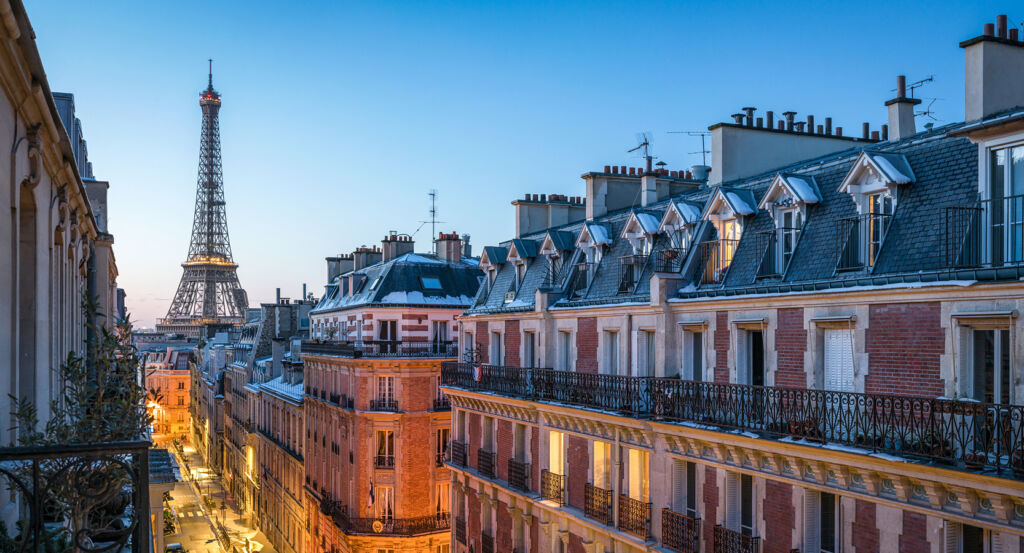
Why you should experience Hotel de Banville in Paris, France.
Hotel de Banville is a poetic four-star hotel where Plaine Monceau's literary inheritance, bourgeois elegance, artist-house culture and quiet residential refinement converge within a romantic interpretation of the Parisian country house.
Set along Boulevard Berthier near Avenue de Villiers and just steps from Square Sainte-Odile, the 38-room hotel inhabits a Haussmann-inspired building named for Théodore de Banville, the poet and playwright whose friendships with Victor Hugo, Charles Baudelaire and Théophile Gautier placed him within the creative circles that reshaped nineteenth-century French literature. The interiors carry that literary premise into a deliberately domestic style of vintage objects, moldings, patterned textiles and individually composed rooms, with upper-floor balconies and terraces opening across the rooftops toward the Eiffel Tower. A complete 2020 to 2021 redesign retained the building's established character while sharpening its shabby-chic aesthetic around brighter rooms, romantic detailing and carefully integrated vintage pieces. The result is a hotel where Théodore de Banville's pursuit of beauty, intimate interiors and rooftop perspectives give Plaine Monceau's cultivated character the atmosphere of a private Parisian house.
What you should know about Hotel de Banville.
Hotel de Banville is best known for taking its name from poet and playwright Théodore de Banville, the friend of Victor Hugo, Charles Baudelaire and Théophile Gautier whose devotion to formal beauty made him a precursor of the Parnassian movement and supplied the contemporary hotel with its governing literary identity. The property entered the Emeraude Hotels collection in 2019 before undergoing a complete redesign and technical overhaul between 2020 and 2021, when all 38 guestrooms were refurbished to harmonize the interiors while retaining the character of the Haussmann-inspired building. The renovation developed an existing shabby-chic style through natural light, romantic compositions and vintage pieces, while moldings, substantial headboards and individually differentiated furnishings preserve the impression of rooms accumulated within a residence instead of standardized across a conventional floor plan. Upper levels turn the building itself into part of the experience, with the seventh-floor Prestige accommodation facing the Eiffel Tower and the eighth-floor attic room extending onto a private terrace above the Parisian roofscape.
Emeraude Hotels gave the 2021 redesign a clear conceptual mandate around preservation and modernization, retaining the property's established architectural personality while rebuilding its interior language around a more coherent expression of the house. Théodore de Banville provides an unusually precise intellectual counterpart to that approach through his rejection of realist and commercially driven poetry in favor of beauty, formal purity and disciplined verse, principles that made his work influential in the emergence of Parnassus. Victor Hugo, Charles Baudelaire and Théophile Gautier place Banville within the broader literary network behind that aesthetic evolution, giving the hotel's name significance beyond a decorative reference to nineteenth-century Paris. Together, Emeraude Hotels, Théodore de Banville, Victor Hugo and Charles Baudelaire give Hotel de Banville a coherent character in which the 2021 renovation, romantic domesticity and literary namesake all return to the same premise: beauty pursued deliberately as a form of character.
How to fold Hotel de Banville into your trip.
Hotel de Banville works as the anchor for an afternoon tracing private artistic life, Second Empire collecting and Parisian performance culture through the cultivated institutions of Plaine Monceau and Ternes.
Begin at Musée national Jean-Jacques Henner, where Marie Henner selected painter Guillaume Dubufe's former artist-house in the early 1920s for a museum devoted to Jean-Jacques Henner, donated the founding collection to the French state in 1923 and saw the institution inaugurated by minister Léon Bérard on March 7, 1924, with later holdings expanding through Louvre and Musée d'Orsay deposits alongside Henner's furniture, correspondence and painter's materials. Continue to Citéco, where banker Émile Gaillard commissioned architect Jules Février to create an elaborate neo-Renaissance mansion between 1878 and 1882 for his collections, before Banque de France acquired the property in 1919, architect Alphonse Defrasse converted it into a branch bank and its later reinvention produced France's museum devoted to economic education. Conclude at Salle Wagram, whose ancestry reaches Jean-Antoine Dourlans's early nineteenth-century dance hall before Alphonse Fleuret created the present ballroom in 1865, a space later used for political gatherings, fashion events and recordings ranging from Pierre Monteux and Carl Schuricht to Maria Callas and Nicolai Gedda before becoming home to Orchestre Colonne in 2016. The progression moves from Henner's artistic legacy through Gaillard's collector residence into Wagram's remarkable afterlife as ballroom, recording space and orchestral home, revealing the art, patronage and performance culture surrounding Hotel de Banville.
Where your story begins.
Foresyte Travel reveals places that feel extraordinary long before you arrive.
Experience premium editorial crafted for luxury travelers.














































































































