
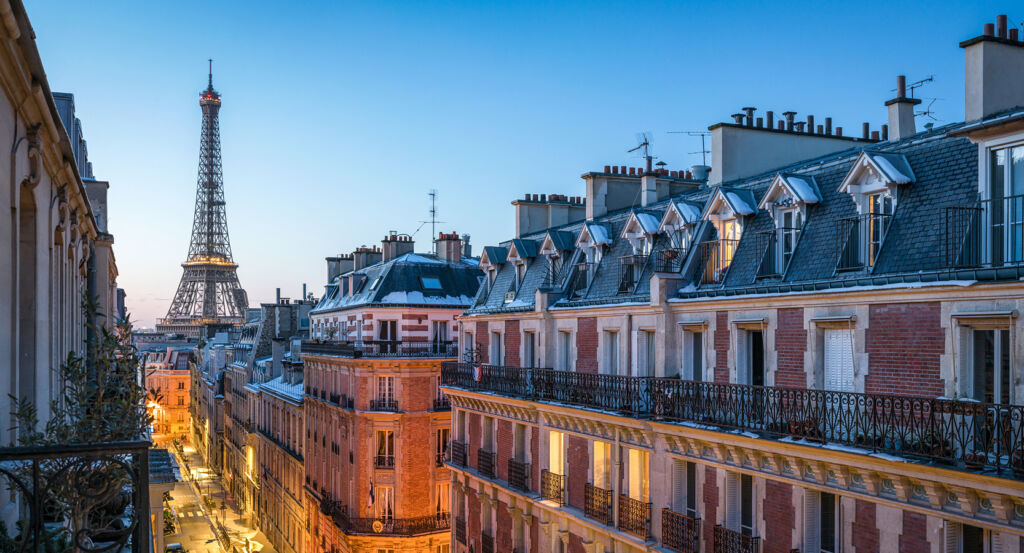
Why you should experience Hôtel Gustave in Paris, France.
Hôtel Gustave is a spirited four-star hotel where Grenelle's Belle Époque inheritance, engineering imagination, international exhibition culture and decorative craftsmanship converge through a design concept built around the creative optimism of late nineteenth-century Paris.
Set along Rue Viala near Rue des Entrepreneurs and just steps from Église Saint-Léon, the 32-room hotel channels the Expositions Universelles of 1889 and 1900 through a renovation by architect François Leblanc with decorators Patrice Henry and Marie-Agnès Louboutin, transforming the former Arley Eiffel Tower into a property named for Gustave Eiffel. Guestrooms extend the concept through imagery of structures erected for the two exhibitions, while textiles from Designers Guild, Lelièvre, Pierre Frey and Osborne & Little introduce four identifiable design houses into the decorative program. A Chinese-inspired salon recalls the 1889 exhibition's international pavilions, adding another strand of exposition history to interiors otherwise shaped by colorful photography, period references and industrial geometry. The result is a hotel where Leblanc, Henry and Louboutin turned the Expositions Universelles into an organizing design language, connecting contemporary hospitality with the engineering and decorative experimentation that reshaped this part of Paris.
What you should know about Hôtel Gustave.
Hôtel Gustave is best known for emerging from a comprehensive renovation of the former Arley Eiffel Tower, with the renewed property operating by 2015 and architect François Leblanc collaborating with decorators Patrice Henry and Marie-Agnès Louboutin on a 32-room concept centered specifically on the Belle Époque and the Expositions Universelles of 1889 and 1900. The hotel's new character explicitly honors Gustave Eiffel, while its guestrooms carry representations of structures erected for those two Paris exhibitions, establishing the fairs as a documented organizing principle. Designers Guild, Lelièvre, Pierre Frey and Osborne & Little supplied the textile style across the rooms, creating a design program involving four established decorative houses alongside original objects selected to differentiate individual interiors. A Chinese-inspired salon specifically references the Chinese pavilion associated with the 1889 exposition, extending the historical concept beyond Eiffel into the international exhibition culture that informed the renovation. The former Arley identity, Leblanc's architecture, Henry and Louboutin's decoration, four named textile houses and the two exposition years collectively give Hôtel Gustave a unusually traceable design genealogy.
The property's visual storytelling becomes more specific through the structures chosen to represent the exhibition era, with current hotel materials describing rooms conceived beneath imagery of buildings erected for the 1889 and 1900 fairs. Independent documentation identifies Eiffel Tower, Grand Palais and Petit Palais among the architectural references used across that room concept, allowing the interiors to move chronologically from the engineering ambitions of 1889 toward the exhibition architecture of 1900. The 2015 renovation joined François Leblanc's architectural intervention to Patrice Henry and Marie-Agnès Louboutin's decorative work while Designers Guild, Lelièvre, Pierre Frey and Osborne & Little supplied another identifiable layer of contemporary authorship. Hôtel Gustave consequently operates as a deliberately constructed interpretation of two Paris exhibitions, with its name, room imagery, Chinese salon, textile program and creative team all tracing back to the same historical premise.
How to fold Hôtel Gustave into your trip.
Hôtel Gustave works as the anchor for an afternoon tracing Franco-Japanese cultural exchange, literary preservation and sculptural authorship across the western Left Bank.
Begin at Maison de la culture du Japon à Paris, where a 1990 international competition selected Masayuki Yamanaka and Kenneth Armstrong, construction began in September 1994, and Jacques Chirac and Princess Sayako inaugurated the institution on May 13, 1997 before its public opening that September. Continue to Maison de Balzac, where Honoré de Balzac's former Passy residence became a literary museum under Louis Baudier de Royaumont in 1908, passed to the City of Paris in 1949 and reopened across the entire surviving pavilion in 1960. Conclude at Musée Bourdelle, where Antoine Bourdelle took his first studio in January 1885, remained for more than four decades, and inspired a museum opened in 1949 through donations by Cléopâtre Sévastos-Bourdelle and Rhodia before Henri Gautruche and Christian de Portzamparc added major architectural chapters in 1961 and 1992. The progression moves from Yamanaka and Armstrong's architecture of international exchange through Balzac's preserved literary world into Bourdelle's studios and their successive architectural expansions, revealing a western Left Bank shaped by cultural transmission, creative memory and artistic authorship.
Where your story begins.
Foresyte Travel reveals places that feel extraordinary long before you arrive.
Experience premium editorial crafted for luxury travelers.














































































































