Why you should experience Hotel Heritage - Relais & Chateaux in Brugge, Belgium.
Hotel Heritage - Relais & Chateaux is where Brugge's history becomes lived experience, a place that dissolves the distance between you and centuries of trade, culture, and craftsmanship.
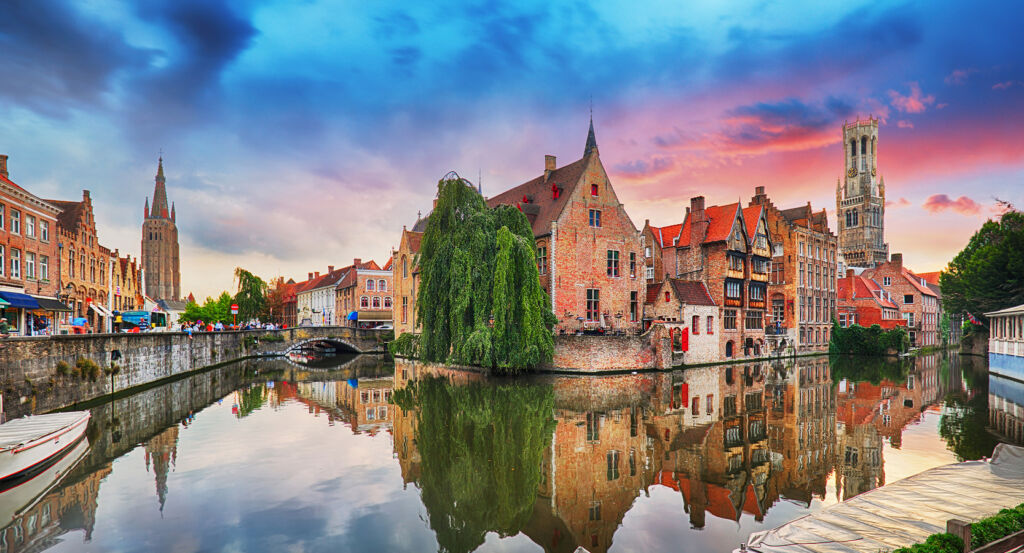
Brugge has a reputation for preserved façades and picture-perfect canals, but Hotel Heritage immerses you in the texture of that legacy. Housed in a row of historic buildings dating back to the 14th century, the property feels less like an overlay on the city and more like a continuation of it, centuries of Brugge's tangible past reframed through contemporary hospitality. From the moment you enter, you sense a lineage of space shaped by lived human purpose. The façade, corridors, and courtyards carry the patina of time, yet interiors are composed with restraint and exceptional craftsmanship that makes history feel relevant. The reception and public areas unfold with layers of material memory: stone, timber, exposed brick, and subtle textile accents that anchor the senses. These are not décor choices meant to evoke a bygone era; they are continuations of it, calibrated for comfort. Guest rooms, individually designed, carry this philosophy forward. This is not a one-template hotel. Each room responds to its spatial logic, often revealing unexpected architectural moments: vaulted ceilings, irregular angles, original beams, and stonework that tell of centuries. Furniture, fabrics, and finishes favor material quality and subtle texture rather than visual performance, enabling a sense of calm focus that becomes rare in travel. Beds are deeply comfortable and layered for restorative sleep, lighting is thoughtful and adjustable, and layouts prioritize spatial clarity. Large windows draw in Brugge's light, cool in winter, warm in summer, always reminding you that the city is an active participant in the room, not a backdrop. Bathrooms are composed with equal care: thoughtful proportions, premium fixtures, and materials that age well. Throughout the hotel, silence plays an active role. This is not the absence of sound; it is the control of sound that shapes the experience. Corridors, lounges, and rooms feel insulated from bustle without feeling shut off from place, creating an interior environment that supports both rest and reflection. Service at Hotel Heritage is similarly restrained and practiced, warm without intrusion, knowledgeable without performance, guided by an exceptional attention to detail that feels intuitive rather than instructive. Location amplifies the experience. Situated close to the Burg and Markt yet tucked within quieter lanes, the hotel places you moments from Brugge's cultural heart while preserving intervals of stillness that feel almost monastic in their calm. Hotel Heritage doesn't attempt to soften Brugge or flatten its complexity; it reflects the city's depth and invites you to live within it with nuance, poise, and layered understanding.
What you should know about Hotel Heritage - Relais & Chateaux.
Hotel Heritage - Relais & Chateaux occupies a site that is historically woven into Brugge's civic life, with origins that precede its hospitality character and extend into the city's longstanding traditions of trade, governance, and architectural craft.
Rather than being a historic shell repurposed superficially, the building complex preserves substantive structural narratives. These are spaces that once responded to the rhythms of everyday life in a medieval commercial capital, and their architectural DNA remains legible in proportions, spatial adjacencies, and material transitions. What makes the Heritage particularly distinctive is how its restoration team approached the project: not as a renovation that recreates history, but as a continuity of use. Spatial interventions were guided by an ethic of integrity, preserving what could be conserved, making room for contemporary function where necessary, and always foregrounding material honesty. Hallways and courtyards reveal this philosophy: original stone, timber, and masonry stand in discussion with new elements that are clearly of this century but carefully composed to respect what came before. This is not nostalgia; it is lineage. The property was later integrated into the Relais & Châteaux association, a global family of independent luxury hotels and restaurants defined by distinct character and cultural rootedness. That affiliation matters because it reflects the hotel's core character: individuality, locality, and craftsmanship over replication. One lesser-known detail about the hotel is how intentionally it supports extended stays. Rather than treating history as a static artifact, the property distributes it intelligently, rooms and common areas are paced so that guests repeatedly encounter moments of revelation rather than repetition. This design logic echoes Brugge's own city structure: quieter lanes give way to grand squares, modest façades open onto rich interior space, and intimacy coexists with civic scale. Over time, the hotel has become not just a place to sleep, but a locus of repeated return for travelers who value depth over novelty: artists, architects, scholars, and those who see travel as study. Its presence in Brugge is not incidental. It participates in the city's cultural ecology, hosting literary salons, local art exhibitions, and collaborations with makers whose work honors tradition. In a hospitality landscape often defined by trend cycles and visual noise, Hotel Heritage's endurance is tied to its insistence on discipline over decoration. It does not wear history like a costume; it inhabits it like a conviction.
How to fold Hotel Heritage - Relais & Chateaux into your trip.
Hotel Heritage works best when you let it shape your experience of Brugge from the inside out, not as a waypoint between landmarks, but as the architectural and resonant anchor of your stay.
Begin your mornings with quiet observation: watch light enter through tall windows, notice how stone surfaces change with the hour, and let the hotel's rhythm set your pace before stepping out. Walk toward the Burg and Markt at a deliberate pace rather than a checklist speed, allowing the city's concentric layers of history to unfold around you rather than overwhelm you. Midday returns to the hotel feel natural. Use this time for reading, reflection, or a slow lunch in the lounge before heading back out refreshed. The hotel's internal calm makes it easier to see nuance in Brugge's smaller museums, private palaces, and artisan workshops, places you might otherwise overlook. Afternoon light on the canals is different in tone than morning light over cobblestones; allow yourself to experience both without rush, using the Heritage's spatial logic as a way of holding the city in your mind rather than fragmenting it. Evenings at the hotel become a distinct chapter of the trip. Whether you choose to dine on site or explore nearby gastronomic venues, let the sequence of activity feel intentional: a meal followed by a walk through quiet lanes, returning to rooms where silence has shape and detail. On longer stays, this internal, external rhythm prevents physical overload, allowing the city's rich materiality to feel cumulative. When departure day arrives, leaving the Heritage does not feel like checking out of a hotel; it feels like stepping back into the world after a period of anchored presence. Hotel Heritage - Relais & Chateaux does not flatten Brugge into a postcard; it expands your capacity to live inside the city's history and complexity, making your stay feel both immediate and deeply placed.
Where your story begins.
Foresyte Travel reveals places that feel extraordinary long before you arrive.
Experience premium editorial crafted for luxury travelers.