
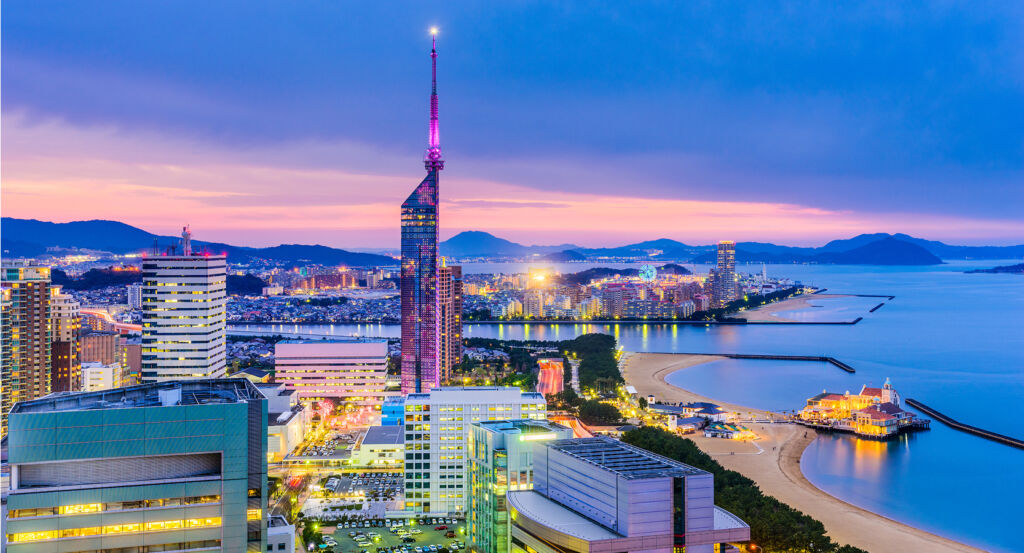
Why you should experience Hotel Il Palazzo in Fukuoka, Japan.
Hotel Il Palazzo is not a conventional luxury stay, it is an architectural statement that reframes Fukuoka as experimental, nocturnal, and intellectually charged, offering an experience where design, mood, and autonomy replace tradition, ceremony, and predictability.
Located in the Haruyoshi area near the Nakasu riverfront, Il Palazzo sits in a district where nightlife, dining, and urban grit intersect. Arrival feels intentionally cinematic. You do not ease into this hotel, you enter it. The transition from street to interior is abrupt and purposeful, like stepping into a different frequency. The building's postmodern pedigree is immediately apparent: bold geometry, controlled darkness, and a sense that space has been composed with intention rather than comfort as the primary driver. Public areas are dramatic yet disciplined, relying on contrast. Shadows matter here. Light is used sparingly, guiding movement and attention. The atmosphere feels curated, moody, and self-aware, a hotel that understands its own character and refuses dilution. Guest rooms extend this design-first philosophy into the private realm. Layouts are unconventional but deliberate, prioritizing atmosphere over standardization. Beds are substantial and inviting, positioned to anchor the room. The design language is unapologetically bold, dark tones, reflective surfaces, graphic lines, and intentional tension between openness and enclosure. This is not a space designed to disappear while you sleep; it is a space that invites awareness before rest. Windows frame the city selectively, often emphasizing glow, reflection, and movement. Bathrooms are modern and sharply executed, leaning into contrast and material clarity. Across the property, the experience feels fascinating, intentional, and distinctly non-neutral. Hotel Il Palazzo is ideal for travelers who want Fukuoka to feel avant-garde, expressive, and emotionally charged, a city encountered through design and atmosphere.
What you should know about Hotel Il Palazzo.
Hotel Il Palazzo is best known for architectural authorship and experiential control, the belief that a hotel can function as a total environment rather than a service container, and this philosophy defines how the property behaves at every level.
Designed by Aldo Rossi, among the most influential postmodern architects of the 20th century, the hotel was conceived as a complete aesthetic system. This authorship is not symbolic; it is operational. Circulation paths are deliberate, forcing awareness of transition and threshold. You do not drift through Il Palazzo; you move through it consciously. Public spaces resist casual sprawl. Seating is intentional. Corridors feel directional. Every movement feels chosen. Materials reinforce this sense of control. Stone, metal, glass, and lacquered surfaces are used to create contrast. Sound behaves differently here. Acoustics are tight and contained; voices feel close, footsteps deliberate. This creates intimacy without softness, a feeling of presence rather than relaxation. Lighting is the hotel's most defining feature. Darkness is not absence here; it is structure. Light appears where it is needed, shaping perception and mood. Daytime feels hushed and contemplative. Nighttime feels energized and purposeful. The hotel changes character with the hour, making time an active component of the stay. Service culture aligns with this autonomy-first character. Interactions are minimal, efficient, and respectful of independence. There is no performative warmth or scripted hospitality. Assistance is available but discreet, allowing guests to inhabit the space. This reinforces the hotel's character as a self-directed experience. Another understated strength of Hotel Il Palazzo is how it reframes luxury. Luxury here is not ease or abundance, it is intentionality. The feeling that nothing is accidental, nothing diluted for mass appeal. Over multiple nights, this becomes increasingly compelling. The hotel begins to feel less like accommodation and more like participation in a design philosophy. The surrounding neighborhood amplifies this effect. Haruyoshi and Nakasu are alive after dark, full of sound, light, and motion. Il Palazzo does not shield you from this energy; it contextualizes it. The hotel becomes a view through which the city's nocturnal character is sharpened.
How to fold Hotel Il Palazzo into your trip.
Hotel Il Palazzo works best when you treat it as an aesthetic anchor, a place that frames how you experience Fukuoka and temporally, not just logistically.
Begin your days slowly. Morning at Il Palazzo is quiet and introspective, shaped by subdued light and minimal noise. This is a moment to orient internally before stepping into the city. From here, river walks, cafés, and daytime exploration feel deliberate. Use the hotel's proximity to nightlife strategically. Spend afternoons exploring Tenjin, Hakata, or cultural sites, knowing that your base becomes more powerful as evening arrives. Midday returns feel different here than in conventional hotels. A short pause feels contemplative rather than restorative, a reset of perception rather than energy. As night falls, Il Palazzo comes alive. This is when the hotel's design logic aligns with the city's rhythm. Step out into Nakasu's glow, explore bars, music venues, and late-night dining, then return to a space that does not demand quiet but absorbs energy with control. The transition back into the hotel feels cinematic, a descent into darkness that encourages reflection. For longer stays, the hotel reshapes how you think about accommodation. You stop expecting the hotel to disappear and start allowing it to influence your pace, mood, and attention. Fukuoka begins to feel layered rather than linear, a city of light and shadow, intensity and pause. Business travelers who value neutrality may find Il Palazzo challenging; creative travelers, designers, architects, and night-oriented explorers will find it deeply rewarding. Anchoring your stay at Hotel Il Palazzo allows Fukuoka to be encountered as a contemporary cultural landscape, not just a functional city. The hotel does not compete with waterfront resorts, classic luxury towers, or heritage institutions. It occupies a singular position: architecture as experience. In doing so, it delivers a stay that feels bold, memorable, and uncompromising, where design leads, atmosphere holds, and the city reveals itself through contrast.
Where your story begins.
Foresyte Travel reveals places that feel extraordinary long before you arrive.
Experience premium editorial crafted for luxury travelers.

















































































































