
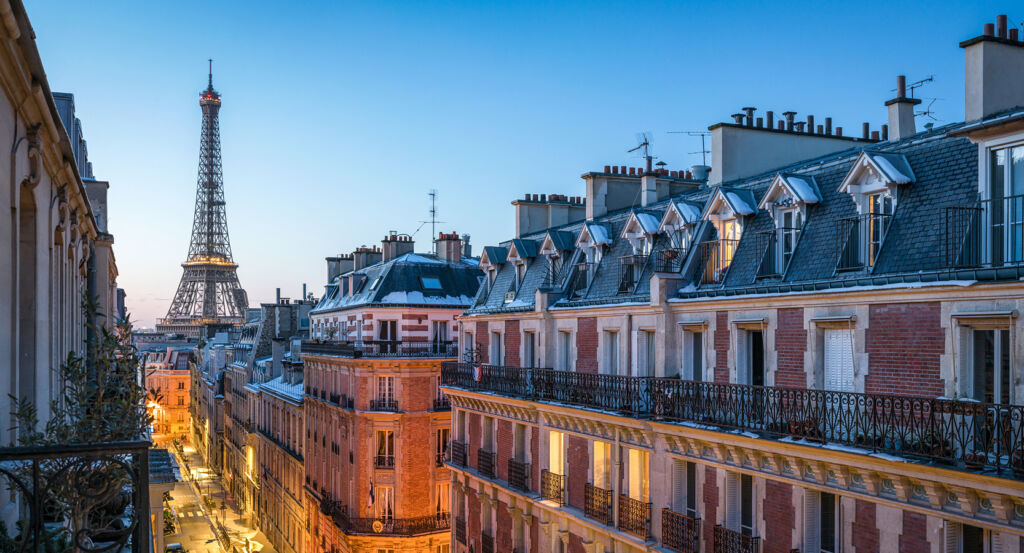
Why you should experience Hotel Keppler Paris Champs-Élysées in Paris, France.
Hotel Keppler Paris Champs-Élysées is a refined four-star hotel where Chaillot's architectural elegance, couture culture, decorative sophistication and cosmopolitan character converge within Pierre-Yves Rochon's intimate interpretation of French residential style.
Set along Rue Kepler near Avenue Kléber and just steps from Musée Yves Saint Laurent Paris, the hotel carries the unmistakable authorship of Pierre-Yves Rochon, whose black-and-white compositions, patterned textiles, sculptural furniture and carefully layered objects turn a compact Parisian property into an exercise in highly controlled interior design. Rochon built the aesthetic around permanence rather than fashion, combining classical references with graphic geometry and residential proportions while allowing individual rooms and suites to develop distinct decorative personalities. Suites overlooking the surrounding rooftops extend the composition vertically, while the recurring contrast of dark furnishings, pale walls, mirrors and richly patterned fabrics gives the property a visual character immediately recognizable as Rochon's work. The result is a hotel where one of France's defining hospitality designers translates the polished creative culture surrounding Chaillot into an unusually cohesive private-house experience.
What you should know about Hotel Keppler Paris Champs-Élysées.
Hotel Keppler Paris Champs-Élysées is best known for being conceived by Pierre-Yves Rochon, the internationally influential French interior designer whose hospitality portfolio spans major luxury properties across Europe, North America and Asia, with the Keppler representing his residentially scaled approach to Parisian hotel design. Rochon organized the interiors around a forceful black-and-white style softened through upholstered furniture, patterned fabrics, framed artwork, mirrors and carefully composed decorative objects, creating visual continuity. The hotel's accommodation program includes rooms and suites culminating in upper-level configurations with Eiffel Tower views, while Rochon's treatment extends from sleeping spaces into salons whose furniture groupings and decorative density deliberately evoke a private Parisian residence. Rochon articulates the philosophy behind the property through a rejection of short-lived stylistic fashion, arguing instead for simplicity, elegance and decorative appropriateness capable of becoming timeless, an unusually explicit statement of design intent from the project's principal creative author. Hotel Keppler consequently derives its character from a coherent body of interior authorship rather than an inventory of hospitality features, with Rochon's philosophy, monochromatic structure and residential composition supplying the factual foundation of the property.
Pierre-Yves Rochon's broader career gives that authorship additional weight because his practice has become closely associated with the modern interpretation of French luxury hospitality, particularly through projects where historical references are translated into contemporary interiors without abandoning ornament, craftsmanship or residential intimacy. Hotel Keppler operates at the smaller end of that design vocabulary, allowing Rochon's characteristic concern with proportion, furniture placement, textiles and decorative layering to register across comparatively intimate spaces. The black-and-white foundation also functions structurally across the project, giving patterned upholstery, metallic accents, mirrors and collected objects enough visual freedom to vary while preserving a consistent character throughout the house. Pierre-Yves Rochon and Hotel Keppler form an unusually concentrated designer-property relationship, with the hotel functioning as a compact expression of an interior philosophy developed across decades of internationally recognized hospitality work.
How to fold Hotel Keppler Paris Champs-Élysées into your trip.
Hotel Keppler Paris Champs-Élysées works as the anchor for an afternoon tracing haute couture authorship, interwar architectural ambition and the institutional development of modern art through the cultural landscape surrounding Chaillot.
Begin at Musée Yves Saint Laurent Paris, where the couture house moved into its Second Empire mansion in 1974, placing Saint Laurent's studio beside ateliers employing nearly 200 craftspeople before the building became Fondation Pierre Bergé - Yves Saint Laurent in 2004 and a museum in 2017. Continue to Palais de Tokyo, constructed for the 1937 Exposition internationale as a grand complex devoted to modern art, establishing the architectural structure from which separate state and municipal cultural institutions subsequently developed on opposite sides of the building. Conclude at Musée d'Art Moderne de Paris, inaugurated in 1961 after Maurice Girardin's 1953 bequest of more than 500 works helped establish a collection now exceeding 15,000 pieces, including major holdings by Matisse, Dufy, Picasso and Modigliani. The progression moves from Saint Laurent's working couture house through the architectural ambitions of the 1937 exposition into one of France's largest modern-art collections, revealing the concentration of fashion, architecture and artistic patronage surrounding Hotel Keppler Paris Champs-Élysées.
Where your story begins.
Foresyte Travel reveals places that feel extraordinary long before you arrive.
Experience premium editorial crafted for luxury travelers.














































































































