
Why you should experience Hôtel Louis II Paris in Paris, France.
Hôtel Louis II Paris is an intimate four-star hotel where Saint-Germain-des-Prés's literary intelligence, artistic independence, Left Bank salon culture and enduring fascination with collecting converge within a richly layered house approaching a century of hospitality.
Set along Rue Saint-Sulpice near Rue de Condé and just steps from Odéon, the 21-room hotel channels a district associated with Jean-Paul Sartre, Simone de Beauvoir and Pablo Picasso through interiors recently reworked by Christelle Bordais and Daphné Stervinou as a discussion between neoclassicism, contemporary art and rediscovered objects. Exposed beams, Toile de Jouy, velvet, marble and antique references distinguish accommodations whose seven categories carry individual names including Siena, Ninon, Athénaïs, Joséphine, Charlotte and Ambroise, creating the impression of rooms accumulated through generations. Mosaicist Alexandra Carron created the entrance mosaic, while artist Justin Fage contributes three Nymphes works made by applying pigments to supports derived from antique statuary, extending the decorative program through identifiable contemporary authorship. The result is a hotel where Bordais and Stervinou's collected interiors, Carron's mosaic and Fage's art give Saint-Germain-des-Prés's intellectual and creative inheritance a hospitality expression built around intimacy and individual character.
What you should know about Hôtel Louis II Paris.
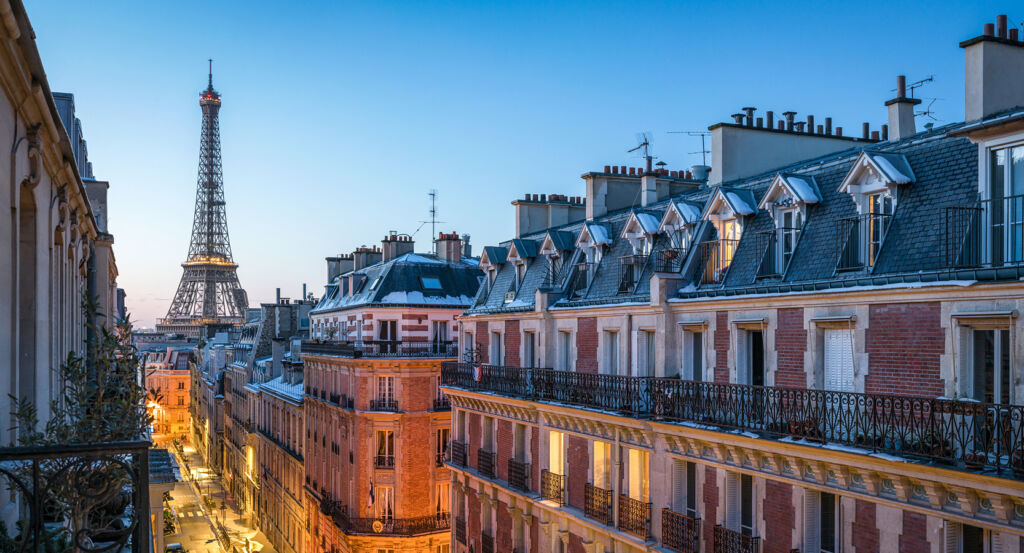
Hôtel Louis II Paris is best known for combining nearly a century of hospitality at 2 Rue Saint-Sulpice with a recently renovated 21-room property whose contemporary character was authored by Christelle Bordais and Daphné Stervinou through a deliberate mixture of antique objects, contemporary art, neoclassical references and conventional French decoration. The accommodation inventory comprises 18 guestrooms and three individually decorated suites arranged across seven categories, beginning with 10-square-meter Siena's Boudoir and Ninon's Classic rooms before progressing through 11-square-meter Athénaïs' Superior and Joséphine's Deluxe accommodations to the three upper categories. Charlotte's 17-square-meter Junior Suite occupies the sixth and highest floor with views across the Paris roofscape, Ambroise's 24-square-meter Suite adds a naturally illuminated black-marble bathroom, and the 27-square-meter Louis II Executive Suite combines exposed historic beams, a mythological wall hanging, a vermilion salon and another black-marble bathroom. Connecting Athénaïs and Ninon rooms create a 22-square-meter configuration for four occupants, while all 21 rooms face the street, giving a notably small hotel seven differentiated accommodation identities. Christelle Bordais and Daphné Stervinou's renovation, 18-room and three-suite composition, individually named categories and progression from 10 to 27 square meters establish Hôtel Louis II Paris as a highly personalized expression of independent Left Bank hospitality.
Daphné Stervinou develops the interiors through her work as both an antiques hunter and trend scout, deliberately placing old and new objects together so that contemporary interventions retain a relationship with the accumulated visual culture of Saint-Germain-des-Prés. Alexandra Carron gives the property a separate layer of artistic authorship through the entrance mosaic, while Justin Fage's three Nymphes introduce pigments applied to antique statuary supports, connecting classical form with contemporary color inside the hotel's compact communal spaces. Hôtel Louis II Paris extends the residential atmosphere into a lounge serving drinks and tapas, while a 24-hour reception supports an operation whose 21-room scale allows the decorative program to remain unusually individualized across guestrooms and public areas. Daphné Stervinou, Alexandra Carron and Justin Fage turn the recent renovation into a collaboration across interior composition, mosaic and contemporary art, reinforcing the collecting culture that has long shaped Saint-Germain-des-Prés.
How to fold Hôtel Louis II Paris into your trip.
Hôtel Louis II Paris works as the anchor for an afternoon tracing the revolutionary politics, collecting culture and artistic institutions that made the surrounding Left Bank one of Paris's most consequential intellectual environments.
Begin at Cour du Commerce-Saint-André, where Georges Danton lived at No. 20, Jean-Paul Marat temporarily operated the presses of L'Ami du Peuple at No. 8 and harpsichord maker Tobias Schmidt worked at No. 9, where he and Joseph-Ignace Guillotin developed the decapitation machine that became inseparable from the French Revolution. Continue to Musée du Luxembourg, whose institutional history began in 1750 as France's first public museum of antique art, displaying Rubens's 24-painting Marie de' Medici cycle alongside works by Leonardo da Vinci, Raphael, Titian, Poussin, Van Dyck and Rembrandt before Louis XVIII approved its reinvention in 1818 as a museum dedicated to living artists. Conclude in Jardin du Luxembourg, created beginning in 1612 around Marie de' Medici's palace and now extending across nearly 24 hectares, with an 1830 orangery housing more than 200 plant tubs and an orchard preserving 320 apple varieties and 210 pear varieties inherited from the Carthusian horticultural tradition. The progression moves from the political experimentation of Revolutionary Paris through an institution that helped define public engagement with historic and contemporary art into Marie de' Medici's centuries-old garden, revealing the intellectual, artistic and cultivated character surrounding Hôtel Louis II Paris.
Where your story begins.
Foresyte Travel reveals places that feel extraordinary long before you arrive.
Experience premium editorial crafted for luxury travelers.














































































































