
Why you should experience Hôtel Monge in Paris, France.
Hôtel Monge is a restored nineteenth-century townhouse where Quartier Latin's literary culture, Marie-Agnès Louboutin and Patrice Henry's interior authorship and Maison Deyrolle's natural-history imagery converge within a residence built in 1876.
Set along Rue Monge near Rue des Arènes and just steps from Arènes de Lutèce, the four-star property occupies the former home of a prosperous family known for receiving artists and writers from the Left Bank. Louboutin and Henry preserved the house's interconnected salons, mouldings, Hungarian-point parquet and Carrara marble fireplaces while introducing velvet, collected furniture, books, lithographs and travel objects into the renovated interiors. Maison Deyrolle tropical wallpapers bring the flora and fauna of nearby Jardin des Plantes into the decorative program, while literary references connect the 30 guestrooms with the Sorbonne and the intellectual history of the surrounding district. The result is a Quartier Latin hotel whose contemporary character remains anchored to the architecture, artistic associations and scholarly culture surrounding the original family residence.
What you should know about Hôtel Monge.
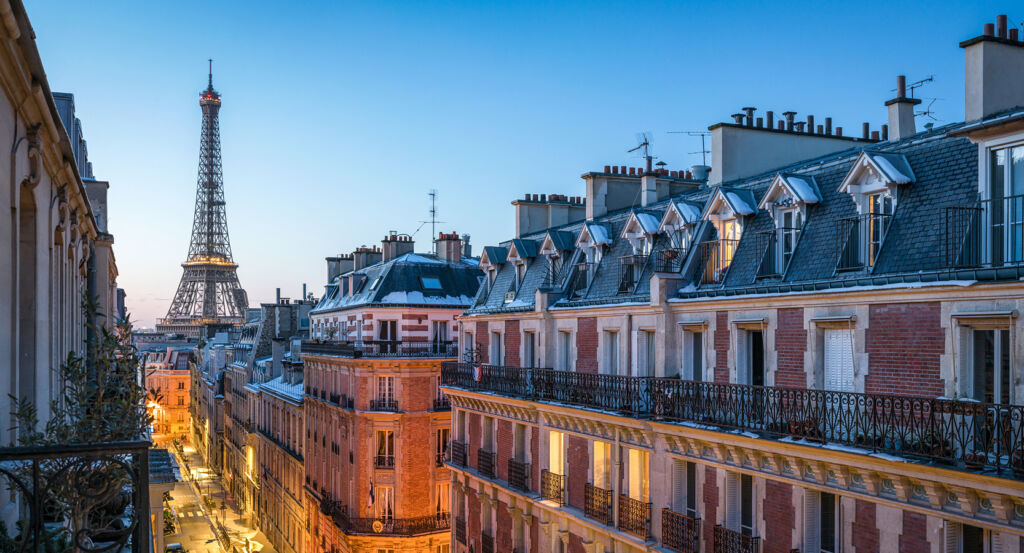
Hôtel Monge is best known for occupying an 1876 private residence that underwent years of renovation before reopening as a 30-room, four-star hotel with interiors by Marie-Agnès Louboutin and Patrice Henry, who retained original architectural elements including high moulded ceilings, Hungarian-point parquet and functioning marble fireplaces. Maison Deyrolle supplied tropical wallpapers rooted in the natural-history tradition of the Paris house founded by Jean-Baptiste Deyrolle in 1831, while Pierre Frey velvet introduces another historic French decorative house into the accommodation program. Louboutin and Henry developed the 30 rooms around two distinct intellectual references, the literary culture associated with the Sorbonne and Saint-Germain-des-Prés, and the botanical and zoological collections of Jardin des Plantes, expressed through books, lithographs, travel souvenirs and flora-and-fauna imagery. Current accommodation is divided across four categories, with Classic Double rooms measuring 15 square meters and Deluxe Triple rooms reaching 20 square meters, while selected rooms open directly toward Arènes de Lutèce and the rooftops of Paris. The 1876 construction, extensive reconstruction, 30-room scale, Louboutin and Henry authorship, Deyrolle commissions and Pierre Frey textiles establish Hôtel Monge through a documented intersection of preserved architecture and named French decorative houses.
Maison Deyrolle gives the interior program deeper historical continuity because Jean-Baptiste Deyrolle established the natural-history business in 1831, allowing the hotel's parrot and tropical patterns to reference a Parisian institution whose character long predates the 1876 residence itself. Pierre Frey develops the same decorative narrative through French-made velvet used on pillows and seating, pairing textile craftsmanship with the botanical imagery selected by Marie-Agnès Louboutin and Patrice Henry. L'Occitane en Provence extends that reliance on named French houses into the current guestrooms through its bath products, while the hotel's four accommodation categories maintain Louboutin and Henry's design language through velvet fabrics, tropical wall coverings and fiber-optic lighting. Together, Maison Deyrolle, Pierre Frey, L'Occitane en Provence and the Louboutin-Henry studio reveal a decorative program assembled through established French makers, connecting natural history, textiles and contemporary hospitality within the fabric of the nineteenth-century house.
How to fold Hôtel Monge into your trip.
Hôtel Monge works as the anchor for an afternoon tracing Roman Paris, scientific collecting and medieval scholarship through the Quartier Latin.
Begin at Musée de Cluny, where Roman baths and the medieval Hôtel des Abbés de Cluny frame collections spanning sculpture, stained glass, manuscripts and the Lady and the Unicorn tapestries. Continue to Panthéon, where Jacques-Germain Soufflot's eighteenth-century architecture developed from a church dedicated to Sainte-Geneviève into France's national mausoleum. Conclude at Grande Galerie de l'Évolution, where the Muséum national d'Histoire naturelle presents zoological collections inside the former Galerie de Zoologie, connecting directly with the natural-history imagery woven through Hôtel Monge. The progression moves from Cluny's archaeological record through Soufflot's Enlightenment architecture into the Muséum's scientific collections, placing Hôtel Monge within the intellectual and natural-history traditions that informed Louboutin and Henry's interiors.
Where your story begins.
Foresyte Travel reveals places that feel extraordinary long before you arrive.
Experience premium editorial crafted for luxury travelers.














































































































