
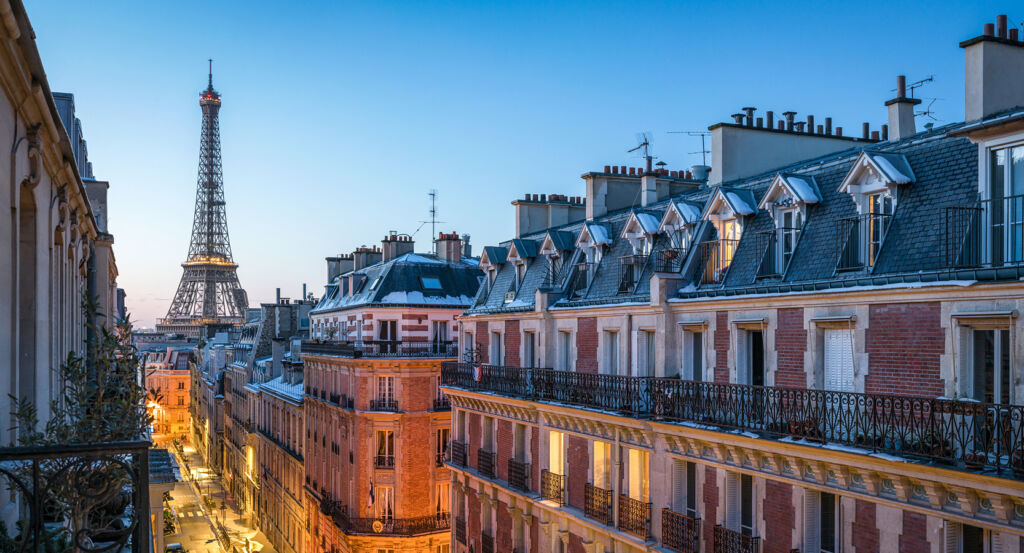
Why you should experience Hotel Peyris Opera in Paris, France.
Hotel Peyris Opera is a historic family-run hotel where Faubourg-Montmartre's performance culture, a century of independent hospitality and the architectural inheritance of late nineteenth-century Paris converge inside a Haussmannian building with unusually well-documented roots.
Set along Rue du Conservatoire near Rue Richer and just steps from Folies Bergère, the four-star property occupies land formerly connected with the Menus-Plaisirs, the royal administration responsible for preparing court ceremonies, festivals and performances before the Conservatoire de Musique established itself on the site in 1795. The present building arrived during the late nineteenth century with ashlar construction, Hungarian-point wooden floors and an open internal courtyard, while its original fifth floor was added later to accommodate hotel employees. Mr. Peyris introduced hospitality to the address in 1902 as Maison de Famille Peyris, beginning a family history that would eventually survive two world wars, multiple renovations and successive generations of ownership. The result is a Faubourg-Montmartre hotel whose character is inseparable from the performance institutions surrounding Rue du Conservatoire and more than a century of documented hospitality at the same address.
What you should know about Hotel Peyris Opera.
Hotel Peyris Opera is best known for beginning in 1902 when Mr. Peyris opened Maison de Famille Peyris inside a late nineteenth-century Haussmannian building whose site had previously formed part of the Menus-Plaisirs administration associated with royal ceremonies, festivals and performances under Louis XIV. The property initially combined accommodation with a hairdresser, butcher, pork butcher and specialist textile repairer on its first floor before the entire building became a boarding hotel in 1912, replacing those businesses with a large dining room for residents. Hotel Peyris underwent refurbishment during the First World War, received a glass-block ceiling over its former open courtyard in 1955 and added an elevator in 1963 before Mrs. Peyris, née Hustaix, eventually sold the family establishment. Parents of the current owner acquired Hotel Peyris in 1973, converting part of the former dining room into the independently accessible restaurant La Balancette, while televisions entered guestrooms during the 1980s and a younger generation assumed management in 1994. Subsequent renovations secured a three-star classification, air conditioning followed around the beginning of the twenty-first century, the property became Hotel Peyris Opera in 2010, and later work produced the present four-star, 50-room hotel documented by the property today.
Director Robert Guédiguian brought another chapter to the Rue du Conservatoire address in 2004 when Hotel Peyris provided a filming location for Le Promeneur du Champ-de-Mars, starring Michel Bouquet as François Mitterrand in a performance that earned Bouquet the 2006 César Award for Best Actor. Hotel Peyris also housed Le Jardinier until 2014, with the restaurant drawing actors and teachers associated with the nearby Conservatoire national supérieur d'art dramatique and reinforcing the property's longstanding relationship with the performing arts surrounding Rue du Conservatoire. Hotel Peyris Opera completed another renovation phase in 2014 under creative direction from its own management, introducing individually composed abstract paintings produced by the current operators alongside colorful guestrooms and public spaces that reinterpret Napoleon III styling. Together, Robert Guédiguian, Michel Bouquet, Le Jardinier and Conservatoire national supérieur d'art dramatique extend Hotel Peyris Opera's cultural record beyond its 1902 origins, connecting the family hotel with French cinema, acting and personally authored contemporary interiors.
How to fold Hotel Peyris Opera into your trip.
Hotel Peyris Opera works as the anchor for an afternoon tracing waxwork performance, auction culture and nineteenth-century theatrical entertainment through the Grands Boulevards.
Begin at Musée Grévin, founded in 1882 by journalist Arthur Meyer with caricaturist and sculptor Alfred Grévin, where elaborate historic interiors frame a collection rooted in the nineteenth-century fascination with celebrity and visual performance. Continue to Hôtel Drouot, whose auction rooms have shaped the Paris art market since the institution opened on Rue Drouot in 1852, connecting collectors, dealers and specialists with paintings, furniture, jewelry and decorative arts across generations of sales. Conclude at Grand Rex, opened in 1932 for producer Jacques Haïk and designed with architect Auguste Bluysen and engineer John Eberson, whose immense atmospheric auditorium translated American movie-palace architecture into one of Paris's defining entertainment spaces. The progression moves from Meyer and Grévin's nineteenth-century culture of celebrity through Hôtel Drouot's collecting tradition into Haïk, Bluysen and Eberson's cinematic performance, revealing the entertainment and arts district that has surrounded Hotel Peyris Opera throughout its history.
Where your story begins.
Foresyte Travel reveals places that feel extraordinary long before you arrive.
Experience premium editorial crafted for luxury travelers.














































































































