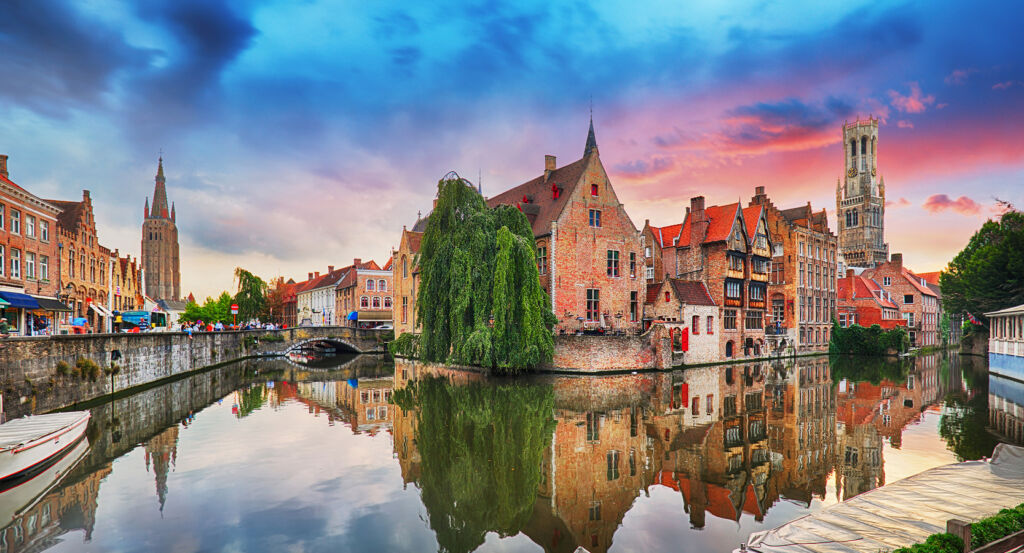
Why you should experience Hotel Portinari in Brugge, Belgium.
Hotel Portinari is where Brugge becomes immediate, human-scaled, and quietly sociable, a hotel that places you inside the city's energy without surrendering comfort, clarity, or resonant ease.
Brugge is often experienced through contrast. One moment you are surrounded by medieval stillness, the next you are swept into busy squares and narrow corridors dense with visitors. Hotel Portinari embraces this reality rather than resisting it, offering a stay that feels intentionally positioned within the city's pulse while maintaining an interior sense of order and warmth. Located directly on 't Zand Square, just outside the most compressed medieval lanes, the hotel occupies a threshold zone where Brugge opens up slightly, giving you room to breathe. Arrival feels straightforward and welcoming. There is no performative heritage or theatrical framing to decode, only the sense of entering a place designed to support movement, conversation, and rest in equal measure. Inside, interiors feel contemporary, warm, and approachable. The design favors comfort and legibility over narrative, allowing the hotel to function as a social anchor rather than a visual destination. Public spaces are open and inviting, encouraging guests to sit, linger, and interact. There is an ease to the layout that reduces friction, making it simple to orient yourself and settle in. Guest rooms continue this emphasis on clarity and livability. Spaces are well-proportioned and thoughtfully arranged, designed to feel functional. Beds are deeply comfortable and positioned to support real rest after days spent navigating Brugge on foot. Lighting is layered and adjustable, allowing rooms to shift easily between daytime activity and evening wind-down. Furnishings prioritize usability, offering sufficient storage, seating, and surfaces to unpack and settle rather than live out of a suitcase. Windows frame the square or surrounding streets, keeping the city visibly present while sound management ensures interior calm. Bathrooms are clean, modern, and efficient, emphasizing layout, water pressure, and ease over indulgent display. Throughout the hotel, sound is controlled effectively despite the lively surroundings. The result is an interior environment that feels buffered but not disconnected, allowing the city's energy to remain perceptible. Service at Hotel Portinari reflects this balanced tone. Staff interactions are friendly, responsive, and practical, shaped by attentiveness. Assistance feels genuine and immediate, whether you are arriving, departing, or navigating the city. The location reinforces the hotel's role as a connector. From here, Brugge's historic core is a short walk away, while transit hubs, cultural venues, and dining options sit just beyond the door. Returning to the hotel feels less like retreat and more like re-centering, a subtle but important distinction. Hotel Portinari does not attempt to reinterpret Brugge or elevate itself above it. It offers a stable, sociable base that allows the city to be experienced fluidly, making Brugge feel accessible, dynamic, and fully present.
What you should know about Hotel Portinari.
Hotel Portinari reflects Brugge's role as a city of movement and exchange, a legacy that continues to shape its character and positioning today.
Named after the influential Portinari family, whose ties to trade and finance connected Brugge to the broader currents of Renaissance Europe, the hotel's character is subtly aligned with the city's history as a crossroads. Brugge was never meant to be static. Its prosperity emerged from openness, circulation, and interaction, qualities that are echoed in the hotel's placement and operational philosophy. t Zand Square, where the hotel is located, has long functioned as a space of gathering and transition. Historically used for markets, public events, and civic life, the square represents Brugge at its most outward-facing. Hotel Portinari's position here situates it within that lineage, making it a natural choice for travelers who want to engage with the city as it moves rather than as it is frozen in time. One lesser-known aspect of the hotel is how deliberately it balances accessibility with restraint. While the surroundings are active, the interior environment is designed to absorb. This is achieved through thoughtful spatial planning, sound insulation, and material choices that favor warmth and absorption. The effect is psychological as much as physical, allowing guests to feel connected to the city. Another defining element is the hotel's adaptability. Brugge attracts a wide spectrum of visitors, from short-stay tourists and cultural explorers to business travelers and repeat guests. Hotel Portinari's layout and service model are calibrated to accommodate this diversity. Rooms support both rest and productivity, public spaces flex between social and quiet modes, and staff interactions adjust naturally to guest needs. Over time, this adaptability has made the hotel a reliable choice for travelers who value consistency over novelty. Rather than reinventing itself to chase trends, Hotel Portinari has evolved through incremental refinement, updating amenities and interiors while preserving its core identity. This continuity mirrors Brugge's own challenge: remaining relevant. The service culture reinforces this stability. Staff members are trained to provide clear, locally informed guidance, helping guests navigate the city efficiently while avoiding unnecessary complexity. In a destination where timing and route choice can dramatically shape experience, this practical support becomes invaluable. Hotel Portinari's strength lies not in performance or storytelling, but in its alignment with Brugge's lived reality as a city that still functions, gathers, and moves.
How to fold Hotel Portinari into your trip.
Hotel Portinari works as a connective hub, allowing your experience of Brugge to flow outward and inward with minimal friction.
Begin your mornings with intention. From the hotel, you can enter the historic center quickly, but consider pacing your approach. Walk toward the Markt through side streets, letting the city's scale build gradually. Visit major landmarks when crowds are lighter, then return to the hotel midday as part of your rhythm. This pause is essential. A short reset in your room or a quiet moment in a shared space allows the density of Brugge's history to settle, making afternoon exploration more perceptive. In the afternoon, explore Brugge's broader footprint. Walk toward neighborhoods beyond the core, visit cultural venues near 't Zand, or use the hotel's proximity to transit to plan short excursions outside the city. Knowing that your base is central and accessible reduces pressure to overconsume Brugge in a single sweep. Evenings benefit from flexibility. Choose dinner nearby or venture deeper into the old town, then return. The square's open character makes nighttime returns feel calm. On longer stays, this central positioning becomes especially valuable. Alternating immersion with ease prevents fatigue and allows Brugge's layers to accumulate meaningfully. Each day can emphasize a different dimension of the city. When departure day arrives, Hotel Portinari's location simplifies logistics, allowing you to leave. The hotel does not attempt to define your experience of Brugge or compete with its beauty. It provides access, clarity, and continuity, enabling you to engage the city as a living place. In doing so, Hotel Portinari supports a way of traveling that feels fluid, grounded, and sustainable, allowing Brugge's character to remain vivid and present long after you leave.
Where your story begins.
Foresyte Travel reveals places that feel extraordinary long before you arrive.
Experience premium editorial crafted for luxury travelers.