Why you should experience Hotel Ter Brughe in Brugge, Belgium.
Hotel Ter Brughe is where Brugge feels elemental and unguarded, a canal-side refuge that replaces polish with authenticity and invites you to experience the city as a living environment.
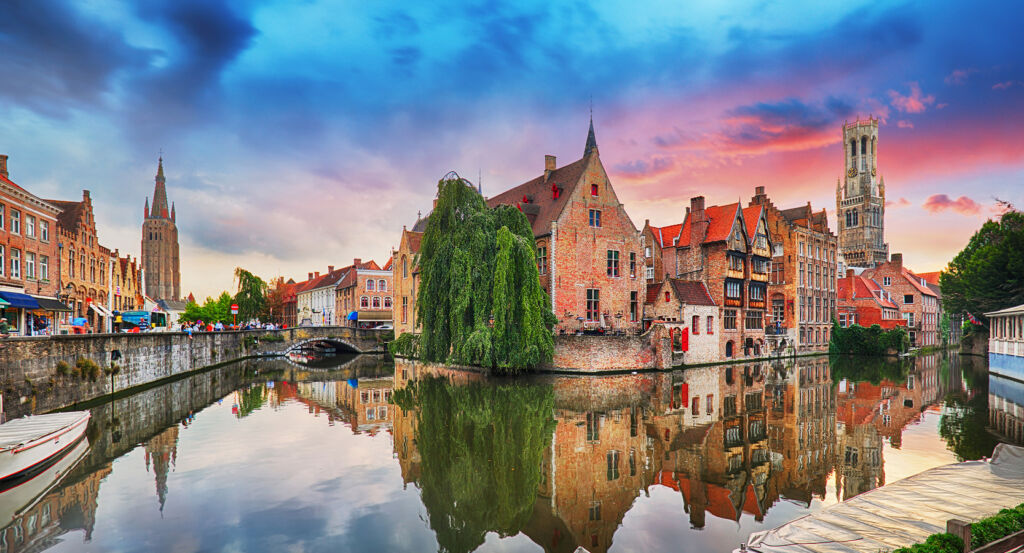
Brugge is often filtered through refinement. Lace, symmetry, preservation, and perfection dominate its image, sometimes to the point where the city can feel overly composed, even distant. Hotel Ter Brughe offers a necessary counterbalance. Set directly along a quiet canal near the Augustijnenrei, the hotel feels rooted in Brugge's working past. Arrival is modest and almost deliberately understated. There is no sense of ceremony or performance, only the impression of a place that has been standing long before tourism learned how to frame it. The exterior blends naturally into the canal edge, stone and brick softened by age and water, giving the sense that the building belongs exactly where it is. Inside, the atmosphere is intimate, slightly imperfect, and deeply human. Low ceilings, exposed beams, uneven stone floors, and narrow passages establish a tactile connection to Brugge's medieval domestic life. This is not a hotel that tries to smooth away irregularity. Instead, it allows the building's age to remain visible, creating a sense of continuity that feels honest. Public spaces unfold quietly, with small lounges, breakfast rooms, and canal-facing corners that feel more like private interiors than shared amenities. Movement through the hotel is slow by necessity, encouraging awareness. Guest rooms extend this lived-in quality. Each room feels distinct, shaped by the constraints and character of the historic structure. Sloped ceilings, timber beams, and deep-set windows give the spaces a sense of specificity that anchors you firmly in place. Beds are comfortable and inviting, prioritizing rest over statement. Lighting is warm and gentle, designed to complement the building's age. Furnishings are simple and functional, chosen to support inhabitation. Many rooms look directly onto the canal, where reflections, passing light, and quiet water movement become part of the room's atmosphere. Bathrooms are straightforward and practical, emphasizing warmth, cleanliness, and ease. Throughout the hotel, sound behaves differently than in larger properties. The canal absorbs much of the city's noise, and the building's thick walls and inward-facing layout further soften external sound. What remains is a gentle acoustic environment where footsteps, water, and distant bells coexist. Service at Hotel Ter Brughe matches the setting. Staff interactions are warm, informal, and personal, guided more by attentiveness than protocol. Assistance feels genuine rather than procedural, and recommendations often reflect lived familiarity with the neighborhood rather than rehearsed highlights. The location reinforces the hotel's grounded character. While within walking distance of Brugge's major landmarks, the surrounding area feels residential and calm, allowing you to approach the city selectively.
What you should know about Hotel Ter Brughe.
Hotel Ter Brughe occupies a building shaped by Brugge's medieval working life, a lineage that continues to influence its character, layout, and atmosphere today.
The structure dates back several centuries and was originally part of Brugge's dense network of canal-side dwellings that supported trade, craft, and daily domestic activity. Unlike grand residences or civic buildings designed to project power, these canal houses were built for function and endurance. Proximity to water was essential, not decorative, allowing goods, people, and information to move efficiently through the city. This origin matters. The building's proportions, materials, and inward focus reflect a time when Brugge was a working city first and a destination second. Narrow staircases, irregular room shapes, and thick masonry were practical responses to medieval construction methods and urban density. When Hotel Ter Brughe emerged as a place of hospitality, the guiding principle was preservation through acceptance. Instead of standardizing the structure or masking its age, restorations focused on maintaining its lived character. Original beams, stone walls, and uneven surfaces were retained, allowing the building's history to remain legible and tactile. One lesser-known aspect of the hotel is how intentionally it resists homogenization. In an era when many historic hotels smooth away irregularities to meet modern expectations, Hotel Ter Brughe embraces asymmetry and variation. Rooms differ not only in size and layout but in mood and relationship to light, creating an experience that feels personal. This architectural honesty has a psychological effect. Guests often describe feeling less like visitors and more like temporary residents, attuned to the rhythms of the canal and the neighborhood. The canal itself plays a central role. Historically, these waterways were Brugge's lifeblood, and their presence continues to shape the hotel's atmosphere. Reflections on the water, subtle sounds, and changing light patterns give the building a sense of gentle movement. Another defining element is the hotel's relationship with repetition. Because the experience resists novelty and performance, return visits feel natural. Guests often come back not for something new, but for something familiar that remains steady. The service culture reinforces this sense of continuity. Staff engage with guests conversationally rather than formally, offering guidance that feels grounded in lived knowledge rather than scripted tourism. In a city where history is often curated and framed for consumption, Hotel Ter Brughe preserves history as environment. It does not explain itself through signage or narrative. It allows the building's age, texture, and quiet to communicate what centuries of use have already established.
How to fold Hotel Ter Brughe into your trip.
Hotel Ter Brughe works best when you allow it to become your quiet constant in Brugge, shaping your days through rhythm and return.
Begin your mornings slowly. The canal's presence makes early hours especially atmospheric, with soft light reflecting off the water and the city still largely at rest. Take time over breakfast, observe the subtle movement outside, and let the day start. From the hotel, explore Brugge on foot, but resist the instinct to head immediately toward the busiest landmarks. Instead, follow the canals, cross smaller bridges, and let the city reveal itself incrementally. Use the hotel intentionally as a midpoint. Midday returns are not interruptions but essential resets. A brief pause in your room or a quiet moment by the canal allows the density of Brugge's history to settle, making afternoon exploration feel deeper and less exhausting. In the afternoon, focus on experiences that reward patience. Visit smaller museums, walk neighborhoods away from the main routes, or sit along a canal. Knowing that you can retreat easily encourages a more relaxed, observant approach to the city. Evenings benefit from restraint. Choose a nearby restaurant rather than crossing the city, then walk back as crowds thin and Brugge softens into quiet. Returning to Hotel Ter Brughe at night feels like stepping into a familiar interior rather than concluding the day. On longer stays, this rhythm becomes essential. Alternating outward engagement with inward calm prevents fatigue and allows each day to feel distinct. Brugge reveals itself most fully through repetition and subtle variation, not accumulation, and the hotel's character supports this. When departure day arrives, leaving Hotel Ter Brughe feels reflective rather than abrupt, as though you are stepping back into motion from a place that has held you gently rather than impressed you loudly. The hotel does not ask you to consume Brugge or decode it quickly. It provides the conditions to experience the city through texture, patience, and proximity, allowing Brugge's deeper character to remain with you long after you leave.
Where your story begins.
Foresyte Travel reveals places that feel extraordinary long before you arrive.
Experience premium editorial crafted for luxury travelers.