
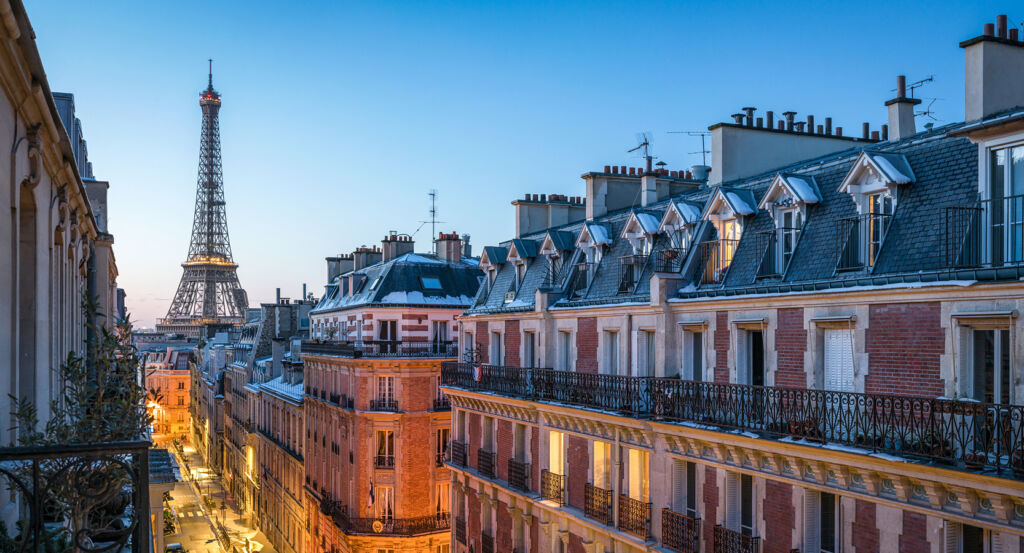
Why you should experience Hôtel Yllen Eiffel in Paris, France.
Hôtel Yllen Eiffel is a craftsmanship-inspired boutique hotel where Necker's residential character, nineteenth-century Parisian architecture, Enlightenment-era decorative traditions and contemporary French hospitality converge behind a historic façade on Rue de Vaugirard.
Set along Rue de Vaugirard near Rue des Volontaires and directly opposite Volontaires Métro, the four-star hotel has operated from its nineteenth-century building for more than 30 years before a comprehensive renovation expanded and modernized the property. The contemporary house contains 38 rooms conceived around three French métiers, crystalware, jewelry and haute couture, translating those traditions through natural materials, golden accents, saturated colors and individually differentiated decorative schemes. Accommodation ranges from 11-square-meter Cosy rooms through 13-square-meter Classic rooms and 17-square-meter Privilege and Deluxe categories to a 21-square-meter Junior Suite with a furnished balcony overlooking the Paris rooftops. A wood-paneled fitness room, light-filled dining room, bar, lounges and modular meeting salon complete a compact hotel whose design connects French craftsmanship with the domestic scale of the surrounding 15th Arrondissement.
What you should know about Hôtel Yllen Eiffel.
Hôtel Yllen Eiffel is best known for transforming a property that has operated for more than 30 years behind a nineteenth-century Rue de Vaugirard façade into a completely renovated four-star hotel whose 38 guestrooms interpret the Paris of the Enlightenment through crystalware, jewelry and haute couture. The Yllen Eiffel accommodation program now encompasses seven principal formats, beginning with 11-square-meter Cosy rooms and 13-square-meter Classic Double and Classic Twin rooms before expanding through 17-square-meter Privilege and Deluxe accommodation, 25-square-meter Quadruple rooms and a 21-square-meter Junior Suite accommodating as many as four people. L'Occitane supplies French bath products across the guestrooms, while Nespresso coffee machines and Kusmi Tea hospitality trays extend the property's emphasis on recognizable French and European brands into the in-room program. Volontaires Métro places the hotel directly on Line 12, connecting the Rue de Vaugirard address with Porte de Versailles, Montparnasse and Central Paris, while the surrounding Necker quarter preserves the residential streets, neighborhood commerce and long urban axis that distinguish this section of the 15th Arrondissement. Hôtel Yllen Eiffel consequently builds its character from a tightly defined combination of nineteenth-century architecture, a 38-room scale, French decorative métiers and the urban geography of one of Paris's longest historic streets.
L'Occitane gives Hôtel Yllen Eiffel's craftsmanship narrative a Provençal dimension through the bath products supplied across the 38 guestrooms, connecting the hotel's decorative celebration of French savoir-faire with a cosmetics house founded by Olivier Baussan in Provence. Kusmi Tea develops the French cultural program through tea served in the accommodation hospitality trays, placing the historic Paris tea house alongside the crystalware, jewelry and haute couture references shaping the room interiors. Nespresso adds a Swiss design and coffee component through machines installed throughout the accommodation categories, giving the compact guestrooms a consistent beverage program from the 11-square-meter Cosy room through the 21-square-meter Junior Suite. Hôtel Yllen Eiffel carries those brand relationships into a broader residential program through its wood-paneled fitness room, dining room, bar and modular lounge, allowing L'Occitane, Kusmi Tea and Nespresso to operate within the same French-lifestyle narrative established by the hotel's crystalware, jewelry and haute couture interiors.
How to fold Hôtel Yllen Eiffel into your trip.
Hôtel Yllen Eiffel works as the anchor for an afternoon tracing sculpture, artistic studios and twentieth-century public landscape through the southern Left Bank.
Begin at Musée Bourdelle, where sculptor Antoine Bourdelle lived and worked from 1885 until his death in 1929, leaving studios filled with plaster casts, bronzes, drawings and personal objects that preserve the working environment behind his development from Rodin's assistant into an influential teacher and sculptor. Continue to Musée de La Poste, where architect André Chatelin designed the building inaugurated in 1973 and sculptor Robert Juvin developed its molded-concrete façade, connecting the history of French postal communication with postwar architecture, graphic culture and industrial design. Conclude at Parc Georges-Brassens, opened in 1984 across 7.74 hectares formerly occupied by the Vaugirard horse market and slaughterhouses, where surviving market structures preserve the industrial history of a district later associated with singer and poet Georges Brassens. The progression moves from Bourdelle's working studios through Chatelin and Juvin's architecture into a former industrial landscape carrying Brassens's name, creating an artistic and cultural sequence grounded in the same southern Paris territory surrounding Hôtel Yllen Eiffel.
Where your story begins.
Foresyte Travel reveals places that feel extraordinary long before you arrive.
Experience premium editorial crafted for luxury travelers.














































































































