
Why Senso-ji Hozomon Gate matters.
Senso-ji Hozomon Gate is a commanding Buddhist gateway where Asakusa's temple-town character meets expansive guardian sculpture, postwar reconstruction and the ceremonial threshold to Tokyo's oldest temple precinct.
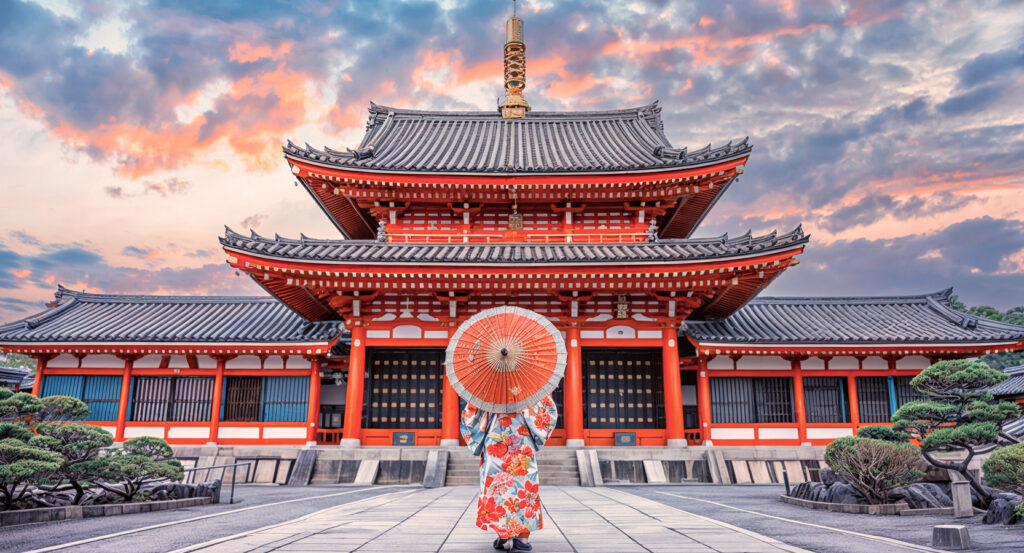
Set along Senso-ji's central approach near Nakamise-dori and just steps from the Main Hall, the vermilion two-storey gate terminates the long commercial axis from Kaminarimon with a scale that suddenly compresses the surrounding crowds beneath its deep tiled roof. Five bays divide the lower level, with three central passages framed by immense Nio guardians occupying the outer bays and a central lantern measuring 3.75 meters high, 2.7 meters wide and 450 kilograms. Passing beneath the structure changes the architectural field immediately, replacing Nakamise's narrow storefront corridor with an open precinct framed by the Main Hall, Five-Storied Pagoda and incense rising around the central approach. On the reverse elevation, enormous waraji straw sandals hang against the gate, magnifying the protective presence of the Nio through objects deliberately scaled far beyond ordinary human use. The result is a threshold whose architecture, sculpture and ceremonial position transform the final meters toward Senso-ji from a commercial approach into an unmistakably sacred precinct.
What defines Senso-ji Hozomon Gate.
Senso-ji Hozomon Gate is best known for carrying a gateway tradition attributed to Taira no Kinmasa in 942 through Tokugawa patronage, wartime destruction and the reconstruction of Senso-ji during Japan's postwar recovery. Kinmasa became governor of Musashi Province and rebuilt parts of the temple complex in gratitude for the fulfillment of his prayers, establishing the gate then known as Niomon for the guardian figures installed within it. Repeated fires forced successive rebuilding before Tokugawa Iemitsu sponsored another major reconstruction of Senso-ji, culminating in completion of a new Niomon and Main Hall in 1649. That gate endured for nearly three centuries, surviving the enormous physical transformation of Asakusa around it until the March 10, 1945 Tokyo air raid destroyed it together with the Main Hall, Five-Storied Pagoda and sutra repository. Senso-ji began rebuilding its principal structures during the following decade, completing the present Main Hall in 1958 and Kaminarimon in 1960. Yonetaro Otani, founder of Otani Heavy Industries and Hotel New Otani, and his wife then financed reconstruction of Niomon as a reinforced-concrete structure with a traditional tiled roof. The new gate was completed on April 1, 1964, immediately before Tokyo's first Summer Olympics, and its upper storey assumed the additional role of a protected repository for temple treasures. That function produced the name Hozomon, or Treasure House Gate, giving the reconstructed building a purpose extending beyond its ancient role as the guarded entrance to Senso-ji's inner precinct.
The collection housed above the passage gives that postwar name exceptional historical substance through the Yuan Edition of the Buddhist Canon, a nationally designated Important Cultural Property with a survival history extending far beyond Asakusa. The scriptures had previously belonged to Tsurugaoka Hachimangu in Kamakura, where the Meiji government's separation of Shinto and Buddhism placed Buddhist objects at risk during the upheaval surrounding haibutsu kishaku. Buddhist nun Teiun purchased the canon when it faced destruction and donated it to Senso-ji, transferring the collection from Kamakura into the custody of the Asakusa temple. Shinmon Tatsugoro, the influential head of Edo's Number Ten firefighting brigade, assisted in transporting the scriptures to Asakusa and had already developed a close connection with Senso-ji through his service at a gate within the precinct. Tatsugoro subsequently financed a sutra repository during the Ansei era of 1854 to 1860, giving the canon a purpose-built home long before the destruction of 1945. Reconstruction in 1964 folded that custodial function directly into the new gate, uniting a medieval Buddhist collection, a Meiji-era rescue and an Edo firefighter's patronage within the building itself. Hozomon protects Senso-ji on two levels at once: the Nio defend the approach below, and the upper storey safeguards scriptures whose preservation connects Kamakura Buddhism, Edo civic culture and the religious disruptions of the Meiji Restoration.
How Senso-ji Hozomon Gate fits.
Senso-ji Hozomon Gate works as the anchor for an Asakusa route through three precinct sites that trace the temple from Tokugawa religious patronage through elite landscape design and into a surviving architectural fragment of the early Edo complex.
Begin at Senso-ji Main Hall, where the temple's history reaches back to the foundational tradition of 628, when fishermen Hinokuma Hamanari and Takenari retrieved an image of Sho Kannon from the Sumida River and village leader Haji no Nakatomo converted his residence into a place of worship for it. Priest Shokai erected a hall in 645 and, following a revelatory dream, established the Kannon as a hidden image, creating the devotional center around which the later complex developed. Fires, earthquakes and rebuilding repeatedly altered the structure, with close to 20 reconstructions across its history. Tokugawa Iemitsu sponsored the 1649 hall that survived longer than any predecessor before the March 1945 air raid destroyed it, and the present building arose between 1951 and 1958 through a reconstruction supported by worshippers and an imperial contribution. That sequence makes the Main Hall the essential continuation beyond Hozomon, moving from the gate's protective architecture to the sacred focus that generated the entire precinct. Continue to Demboin and Its Garden, the head priest's residential complex, where Senso-ji's religious administration intersects with one of the precinct's most significant surviving designed landscapes. The compound includes reception rooms, large and small shoin, residential quarters and spaces used for memorial rites and ascetic practice, forming an institutional world distinct from the public devotional axis outside. Its pond-centered strolling garden is associated with Kobori Enshu, the early Edo tea master, garden designer and daimyo whose work connected architecture, tea culture and landscape under the Tokugawa order. Senso-ji's chronology places his activity here around the 1635 reconstruction period, and the garden later received national designation as a Place of Scenic Beauty in 2011. Six Demboin buildings gained Important Cultural Property status in 2015, preserving a substantial architectural counterpart to the temple structures reconstructed after the war. Conclude at Niten-mon Gate, where an actual seventeenth-century structure survives the destruction that eliminated Hozomon's Tokugawa predecessor. Its origins connect with the Toshogu shrine erected inside Senso-ji in 1618 under Tokugawa Hidetada, and the present gate was built in 1649 as the temple's eastern entrance after fires repeatedly damaged the precinct. The Meiji separation of Shinto and Buddhism removed its original guardian figures to Asakusa Shrine in 1884, prompting the installation of Buddhist protectors transferred from Tsurugaoka Hachimangu in Kamakura and the adoption of the Niten-mon name. Those figures were later lost during wartime repairs, and the present Jikokuten and Zochoten came from the mausoleum of fourth Tokugawa shogun Ietsuna at Kanei-ji in 1957. A major restoration completed in 2010 recovered the gate's early Edo appearance, leaving an Important Cultural Property that physically bridges Senso-ji's Tokugawa construction campaign, Meiji religious reorganization and postwar preservation. The progression moves from the Main Hall's ancient Kannon tradition through Demboin's Tokugawa-era landscape culture into Niten-mon Gate's surviving seventeenth-century fabric, revealing the religious, architectural and political layers surrounding Senso-ji Hozomon Gate across more than a millennium of Asakusa history.
Where your story begins.
Foresyte Travel reveals places that feel extraordinary long before you arrive.
Enjoy editorial crafted for luxury travelers.
Foresyte may earn a commission when you book.

















































































































