Why InterContinental Adelaide matters.
InterContinental Adelaide is a riverfront hotel where North Terrace's cultural boulevard meets Adelaide's late twentieth-century redevelopment, South Australia's festival economy and the River Torrens parklands. Its importance comes from occupying one of the city's most consequential constructed sites, where railway infrastructure, convention facilities, public entertainment and luxury accommodation were assembled into a single urban complex.
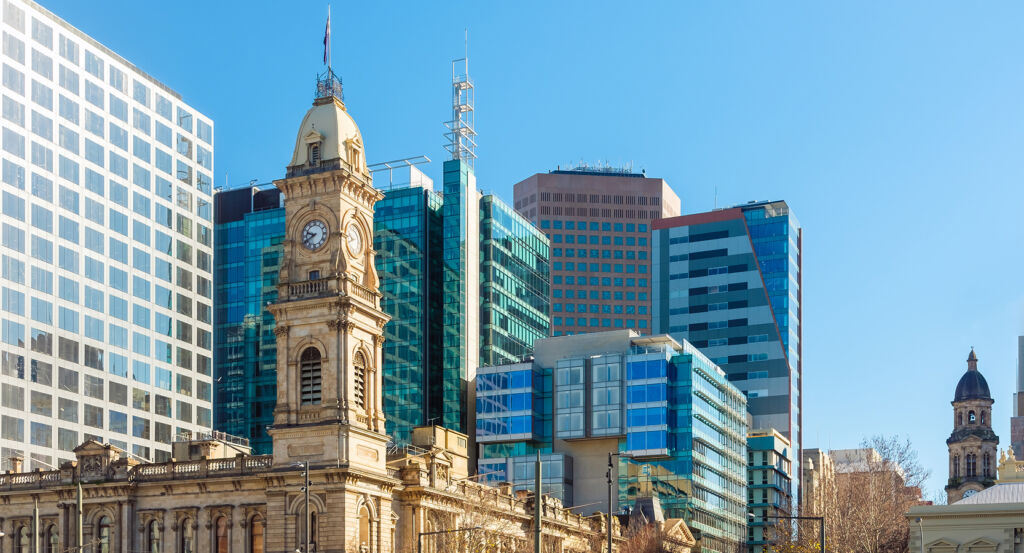
Standing on North Terrace beside the River Torrens and Adelaide Railway Station, InterContinental Adelaide occupies the western edge of the central business district between King William Road, the Adelaide Convention Centre, Adelaide Festival Centre and Adelaide Oval. The hotel rises above the Riverbank precinct, with Elder Park and the Torrens shoreline extending westward while Parliament House, museums and the commercial grid continue east along North Terrace. Railway platforms and transport infrastructure operate beneath and beside the surrounding development, creating a layered relationship between civic movement, waterfront recreation and high-rise accommodation. The result is a hotel that functions as a vertical gateway between Adelaide's city centre, cultural institutions, sporting grounds and river landscape.
What defines InterContinental Adelaide.
InterContinental Adelaide originated in the Adelaide Station and Environs Redevelopment, an ambitious urban transformation undertaken during the government of South Australian Premier John Bannon to establish a major commercial, convention and entertainment precinct above the city's railway infrastructure. The project brought together international hotel accommodation, a purpose-built convention centre, a casino, commercial offices and new pedestrian connections through a coordinated development that transformed the western end of North Terrace. Architect John Andrews, whose international career included major institutional projects in Australia and North America, directed the redevelopment's architectural vision through John Andrews International in association with Woodhead Australia. Construction company Sabemo South Australia delivered the hotel, with Hong Kong-based Hirsch Bedner Associates responsible for its original interiors. The development's substantial engineering requirements arose from the integration of major commercial buildings above active railway corridors, creating a new urban platform between the established city centre and the River Torrens. Hyatt Regency Adelaide officially opened on June 28, 1988, welcoming Federal Tourism Minister Graham Richardson as its first guest. Hyatt International president Bernd Chorengel regarded the development as one of Adelaide's most important building projects, reflecting its significance to the city's international convention and tourism ambitions. The hotel joined the Adelaide Casino, which had opened inside the historic railway station in 1985, and the Adelaide Convention Centre, inaugurated in 1987 as Australia's first purpose-built convention facility. Its completion established an international luxury hotel within a precinct conceived to attract major conferences, corporate investment and interstate visitors to South Australia. The development also generated controversy over the commercial occupation of Adelaide's Park Lands, introducing a lasting debate about the relationship between public open space and metropolitan redevelopment. A major ownership and management transition followed in September 2009, when Thai conglomerate TCC, founded by businessman Charoen Sirivadhanabhakdi, entered an agreement with InterContinental Hotels Group to convert four properties across the Asia-Pacific region. Hyatt Regency Adelaide became InterContinental Adelaide under the arrangement, introducing the international luxury brand to one of South Australia's most prominent established hotel buildings. TCC Land International subsequently advanced a comprehensive refurbishment strategy intended to renew the property's original hospitality infrastructure. In May 2021, the company and IHG announced a proposed A$32 million renovation encompassing accommodations, restaurants, public interiors, meeting facilities and the Club InterContinental offering. The investment represented the first major redevelopment program proposed for the hotel since its original construction, extending the property's architectural and commercial evolution beyond its Hyatt origins. InterContinental Adelaide occupies a distinctive position in Australian hospitality history through its relationship with state-sponsored urban development, international architectural collaboration, private investment and the emergence of Adelaide as a major convention destination.
Chef Kenny Trinh's leadership at Shiki gives InterContinental Adelaide its most distinctive culinary character through the Japanese philosophy of seasonal cooking and the precise theatrical discipline of teppanyaki. The restaurant takes its name from the Japanese word for four seasons, establishing a culinary structure in which ingredient selection, preparation and presentation respond to the changing agricultural and maritime calendar. Trinh and his team work with premium Australian and Japanese produce, bringing the natural richness of seafood, carefully selected Wagyu and seasonal vegetables into a cooking tradition centered on direct contact with a heated iron surface. Teppanyaki requires exact control of temperature, timing and movement, allowing the chef to develop caramelization and concentrated savory flavors while preserving the tenderness and individual character of each ingredient. The counter arrangement gives these techniques a social dimension, placing guests directly before the cooking surface as the chef coordinates successive preparations through controlled movements and attentive service. Japanese culinary principles of balance and restraint shape the relationship between the richness of grilled ingredients, delicate seasoning and the refreshing qualities of accompanying flavors. Shiki's sake selection extends that philosophy through beverages whose aromatic profiles, acidity and texture complement the changing intensity of the meal. The restaurant's commitment to seasonal variation also connects Japanese culinary discipline with South Australia's agricultural abundance, creating a distinctive expression of international gastronomy grounded in the region's produce. Riverside Restaurant develops the property's Australia character through a complementary emphasis on local sourcing, seasonal ingredients and the generous traditions of metropolitan hotel dining. Its breakfast service incorporates freshly prepared specialties alongside an extensive selection of continental and Australian offerings, reflecting the property's longstanding role in international business hospitality. Weekend high tea introduces a more ceremonial rhythm through delicate pastries, savory preparations and carefully selected teas, extending the social traditions of grand hotels into Adelaide's contemporary dining culture. The Atrium Lounge brings South Australia's established wine culture into the hotel's public hospitality program through regional and international selections, composed cocktails and informal dining. Live musical performances on Friday and Saturday evenings introduce a further social dimension, connecting the lounge's intimate seating arrangements with the traditions of metropolitan hotel bars. Club InterContinental develops the property's personalized service philosophy through dedicated lounge hospitality, afternoon tea, evening refreshments and attentive concierge assistance. Together, these culinary and service traditions establish InterContinental Adelaide's hospitality character through the relationship between Japanese technical craftsmanship, South Australian food and wine culture, and the formal social conventions of an established international hotel.
How InterContinental Adelaide fits.
InterContinental Adelaide works as a base for reading Adelaide through its riverfront sporting culture, performing-arts institutions and North Terrace's long concentration of museums and public collections. The surrounding district moves from contemporary stadium architecture to festival infrastructure and then into the educational and scientific institutions that define the city's cultural boulevard. The route also shows how Adelaide's centre places recreation, performance and scholarship within a compact walkable landscape. Each stop adds a different dimension to the hotel's position beside the River Torrens and the city's western civic edge.
Begin at Adelaide Oval, the stadium complex across the River Torrens from the hotel and one of South Australia's most important sporting grounds. Cricket has been played on the site since the nineteenth century, and the oval became the home ground of South Australian cricket while later accommodating Australian rules football, rugby and major concerts. The modern stadium redevelopment connected the northern and southern sides of the city through new pedestrian routes and a footbridge across the river. Historic scoreboard structures and established trees remain part of the ground's visual character beside contemporary grandstands and hospitality facilities. Continue to Adelaide Festival Centre, the performing-arts precinct beside King William Road and Elder Park. The centre opened in 1973 as Australia's first purpose-built arts centre, giving Adelaide a permanent venue for theatre, opera, ballet, music and festival programming. Its theatres and public terraces occupy the riverfront beside the Festival Plaza, where large-scale cultural events extend beyond the formal auditorium spaces. The centre's relationship with the annual Adelaide Festival helped establish the city's international reputation as a place where performance, public space and civic celebration operate together. Conclude at the South Australian Museum on North Terrace, whose collections connect Adelaide to Aboriginal culture, natural history and scientific research. The museum's Aboriginal collections include material from across Australia and provide one of the country's major public settings for interpreting Indigenous histories and cultures. Its galleries also contain zoological, geological and palaeontological material, giving the institution a broad relationship with the natural systems of South Australia and the wider continent. The building sits within the North Terrace cultural sequence near the Art Gallery of South Australia, State Library of South Australia and University of Adelaide. The progression moves from Adelaide Oval's sporting and architectural transformation through Adelaide Festival Centre's performance culture to the South Australian Museum's scientific and Aboriginal collections, placing InterContinental Adelaide within the city's connected riverfront and cultural infrastructure.
Where your story begins.
Foresyte Travel reveals places that feel extraordinary long before you arrive.
Enjoy editorial crafted for luxury travelers.
Foresyte may earn a commission when you book.