
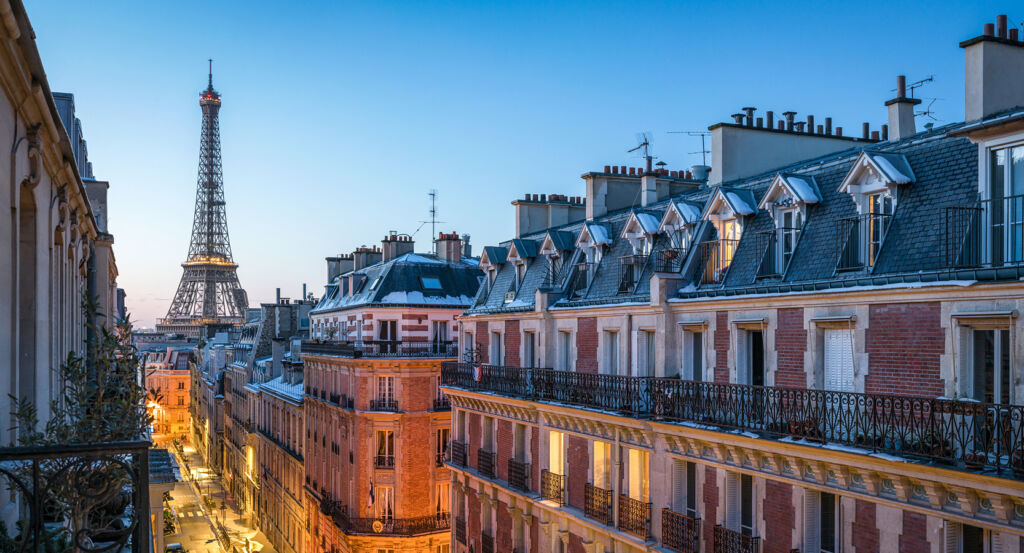
Why you should experience InterContinental Paris Le Grand in Paris, France.
InterContinental Paris Le Grand is a grand Second Empire hotel where Gaillon's operatic character, Napoleon III's vision for modern Paris, Haussmannian urbanism and more than 160 years of cultural history converge directly opposite Palais Garnier.
Set along Rue Scribe near Boulevard des Capucines and just steps from Place de l'Opéra, the hotel was conceived during the early 1860s as part of Napoleon III and Baron Haussmann's campaign to establish Paris as a modern cultural capital ahead of the 1867 Exposition Universelle. Empress Eugénie inaugurated Le Grand Hôtel on May 5, 1862 after construction lasting barely a year, revealing a vast establishment with 800 rooms, 45 salons and façades opening toward three perspectives across the newly reorganized Opéra district. Salon Opéra formed the ceremonial centerpiece beneath a 14-meter dome surrounded by gilding, arcades and candelabras, while Café de la Paix immediately developed into one of the capital's defining artistic and social meeting places. Architect and designer Pierre-Yves Rochon later directed extensive renovations of both the hotel and Café de la Paix, preserving their Second Empire style while translating the nineteenth-century institution into contemporary luxury hospitality.
What you should know about InterContinental Paris Le Grand.
InterContinental Paris Le Grand is best known for being inaugurated by Empress Eugénie on May 5, 1862 as an 800-room, 45-salon expression of Napoleon III and Baron Haussmann's reconstruction of Paris, with the project completed in barely a year as the surrounding Opéra district was being remade into one of the ceremonial centers of the Second Empire. Salon Opéra established the architectural scale of the original hotel beneath a 14-meter dome, while Café de la Paix opened at street level and rapidly became a meeting place for Parisian artistic, literary and political society. Palais Garnier subsequently opened opposite the hotel in 1875 after 15 years of construction, completing the urban composition that connected the Grand Hôtel with Charles Garnier's new opera house and Haussmann's surrounding boulevards. Georges Clemenceau watched the victorious French troops parade from the hotel balcony in 1918, and negotiations preceding the North Atlantic Treaty took place in the hotel's mezzanine salons in 1948, adding twentieth-century diplomatic history to an address already associated with Victor Hugo, Émile Zola, Marlène Dietrich, Joséphine Baker, René Goscinny and Jean-Jacques Sempé. Pierre-Yves Rochon later undertook comprehensive renovations of InterContinental Paris Le Grand and Café de la Paix, preserving the Second Empire architecture, gilded reception rooms and historic decorative style while reorganizing the institution for contemporary hotel operations.
Laurent André carries the culinary history of InterContinental Paris Le Grand forward as Executive Chef, having taken command of the hotel and Café de la Paix kitchens in October 2016 after training under Alain Chapel, working within Alain Ducasse's culinary world and spending seven years at Le Royal Monceau Raffles Paris. Café de la Paix develops André's French repertoire through onion soup, sole meunière, oysters, shellfish, caramelized millefeuille and opera cake, connecting the chef's contemporary kitchen with a dining room operating beside Place de l'Opéra since the nineteenth century. Algotherm extends the property's contemporary program through Dermo Ocean Spa, where the French marine-cosmetics specialist operates four individual treatment cabins, one double cabin, a hammam, sauna and relaxation area on the first floor of InterContinental Paris Le Grand. Technogym completes the wellness program through a 24-hour fitness center, allowing Laurent André, Café de la Paix, Algotherm and Technogym to sustain distinct culinary and wellness identities inside the Second Empire institution.
How to fold InterContinental Paris Le Grand into your trip.
InterContinental Paris Le Grand works as the anchor for an afternoon tracing opera, perfume and decorative arts through the cultural institutions surrounding the Grands Boulevards.
Begin at Palais Garnier, where Charles Garnier won the architectural competition launched under Napoleon III in 1861 and spent more than a decade developing the opera house that opened in 1875 directly opposite the hotel, completing the ceremonial urban ensemble envisioned for the surrounding district. Continue to Musée du Parfum Fragonard, where the Grasse perfume house founded by Eugène Fuchs in 1926 presents historic fragrance vessels, distillation equipment and manufacturing traditions inside the former Éden-Théâtre complex near Square de l'Opéra-Louis-Jouvet. Conclude at Musée des Arts Décoratifs, where collections occupying the Louvre's Marsan wing encompass furniture, fashion, jewelry, ceramics, glass, textiles and graphic design, placing the craftsmanship of the Second Empire within a much broader history of French decorative production. The progression moves from Charles Garnier's operatic architecture through Fragonard's perfume culture into the decorative collections of the Louvre complex, creating a tightly connected study of architecture, craftsmanship and performance around InterContinental Paris Le Grand.
Where your story begins.
Foresyte Travel reveals places that feel extraordinary long before you arrive.
Experience premium editorial crafted for luxury travelers.














































































































