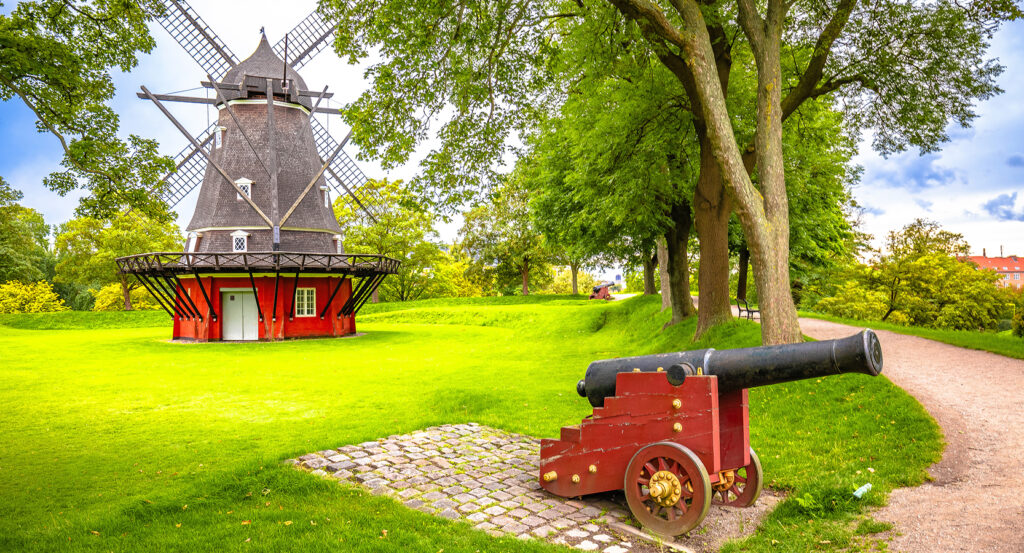
Why Kastellet matters.
Kastellet in Copenhagen is one of Europe's best-preserved star fortresses, a serene and striking blend of military history, geometric perfection, and Scandinavian calm.
Shaped like a five-pointed star and encircled by emerald-green moats, Kastellet feels less like a fortress and more like a living canvas where nature and history coexist in quiet harmony. Built in the 17th century by King Christian IV to defend the city, it stands today not as a relic of war but as a peaceful public park, a space where joggers trace the outlines of old ramparts and the Danish flag flutters proudly above red brick barracks. The fortress's symmetry is unique from above, crisp lines of earthwork bastions, grassy slopes rising to windmills and cannons that now serve as sculptural reminders of Copenhagen's resilience. Within the walls, ochre and crimson buildings line cobbled paths, their sharp roofs gleaming in the soft northern light. It's a place where time folds neatly, where the echoes of soldiers' drills have faded into birdsong and the hum of bicycles. Kastellet isn't just a landmark; it's a sanctuary that captures Denmark's rare balance of discipline, beauty, and peace.
What defines Kastellet.
Though Kastellet's quiet charm suggests a tranquil past, its foundations were laid during one of the most turbulent eras in Danish history.
Commissioned in 1626 by King Christian IV and later completed by King Frederik III after the Swedish siege of Copenhagen, the fortress was designed following the Dutch star fort model, an architectural innovation that maximized defensive strength through geometric precision. Its pentagonal layout with bastions at every corner allowed defenders to cover all angles of approach, making it nearly impregnable for centuries. Even after Denmark's military focus shifted, Kastellet remained an active garrison, playing a role in the Napoleonic Wars and World War II. During the German occupation, it served as barracks for Nazi forces, a shadowed chapter that ended with liberation in 1945, when the Danish resistance raised the national flag over its ramparts once again. In the postwar years, the fortress underwent careful restoration, preserving its historical integrity while opening it to the public. Today, it still houses military offices but also functions as a cherished green lung in the heart of the city. Few realize that its design directly influenced later European and American fortifications, serving as a prototype for the star forts that dot the Atlantic coastlines of the United States. Beneath its serene surface lies a story of adaptation, from stronghold to symbol, from weapon of defense to emblem of peace.
How Kastellet fits.
Visiting Kastellet in Copenhagen offers one of the city's most rewarding walks, a graceful loop through history, architecture, and nature.
Enter through the King's Gate, where the fortress's distinctive ramparts unfold before you in sweeping lines of green. The path atop the earthworks offers panoramic views of the city skyline and the sparkling Øresund Strait, with the windmill at the northern bastion standing as a gentle sentinel to centuries past. Wander through the fortress grounds to discover the energetic red barracks, the small white church that still holds services, and the statue of King Frederik III watching over the parade grounds. Pause at the northeast corner for one of Copenhagen's most moving moments, the view of the nearby Little Mermaid statue across the water, a reminder of Denmark's poetic soul just beyond its martial heart. If you visit in autumn, the moats glow with reflections of golden trees, while spring brings a sea of tulips that soften the fortress's edges. Kastellet connects easily with other nearby icons, it's just steps from Amalienborg Palace, the Gefion Fountain, and St. Alban's Church, making it a perfect anchor point for a day's exploration. For the best experience, visit at sunset, when the fading light gilds the ramparts and the city hum quiets to a hush. Standing atop Kastellet's bastions, looking out toward the harbor, you feel the pulse of Copenhagen's history, steady, dignified, and enduring.
Where your story begins.
Foresyte Travel reveals places that feel extraordinary long before you arrive.
Enjoy editorial crafted for luxury travelers.
Foresyte may earn a commission when you book.