Why you should experience Kimball Natural History Museum in San Francisco, California.
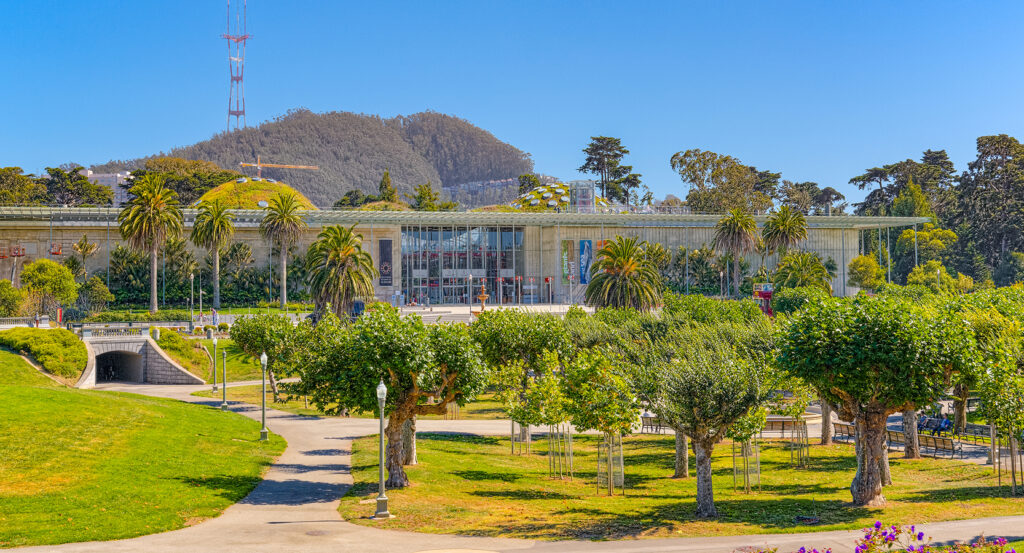
The Kimball Natural History Museum at the California Academy of Sciences in San Francisco brings the story of life on Earth vividly to life, weaving the past and present of our planet into one breathtaking continuum.
Spread across multiple levels of the Academy, the museum immerses you in a world where fossils, dioramas, and digital projections fuse science and wonder. Towering dinosaur skeletons stretch toward the skylights while glimmering gemstone walls sparkle under ambient light. Every exhibit feels alive, whether it's the preserved wings of a butterfly or the fossilized bones of a Triceratops frozen in time. You walk not just through displays, but through epochs: from the dawn of life in the ocean's depths to the rise of mammals and humanity's imprint on Earth. The museum doesn't just educate; it invites you to see yourself as part of an ongoing natural story, a single heartbeat in the immense rhythm of evolution.
What you didn't know about Kimball Natural History Museum.
The Kimball Natural History Museum is one of the Academy's core galleries, and it's named for the Kimball family, whose philanthropy helped transform the museum into a leading voice for environmental science.
Its collections date back more than 150 years, encompassing over 46 million specimens that form the foundation for research and conservation worldwide. Among its most striking exhibits are a complete T. rex skull, an African Hall with preserved wildlife in astonishing realism, and the “Islands of Evolution” gallery that showcases how isolation shapes biodiversity. One of its most innovative features is its seamless integration of real-time data from field scientists, climate models, migration maps, and seismic readings update live, reminding visitors that natural history is still being written. The museum also houses specimens collected by the Academy's early expeditions, including rare birds, insects, and minerals gathered during 19th-century voyages across the Pacific. It's both a time capsule and a laboratory, a place where discovery never really stops.
How to fold Kimball Natural History Museum into your trip.
Plan to visit the Kimball Natural History Museum midway through your time at the California Academy of Sciences, when your curiosity is fully sparked but your mind still fresh.
Start in the “Life Through Time” section, where fossils and reconstructed skeletons trace the lineage of life from primordial oceans to the modern biosphere. Continue to the “Islands of Evolution” exhibit to explore how adaptation fuels diversity, then pause in the African Hall to experience one of the Academy's oldest and most beloved spaces, its dioramas are museum legends. Take your time with the interactive stations, especially the seismic monitors and environmental data visualizations, which bring abstract science into vivid, tactile reality. Before leaving, stop at the central atrium where the museum's message resonates most clearly: that humanity's story is inextricably linked to the health of the planet. Whether you're drawn by the drama of dinosaurs or the quiet poetry of natural systems, the Kimball Natural History Museum reminds you that science is not just something to study, it's something to feel.
Hear it from the Foresyte community.
Just enough life around you not to be overwhelming. Right pace.
Where your story begins.
Start your planning journey with Foresyte Travel.
Experience immersive stories crafted for luxury travelers.