Why you should experience Koko Crater Railway Trail in Hawaii.
Koko Crater Railway Trail in Honolulu is for those who crave a challenge wrapped in beauty, where every step upward is a battle with gravity and a communion with the island itself.
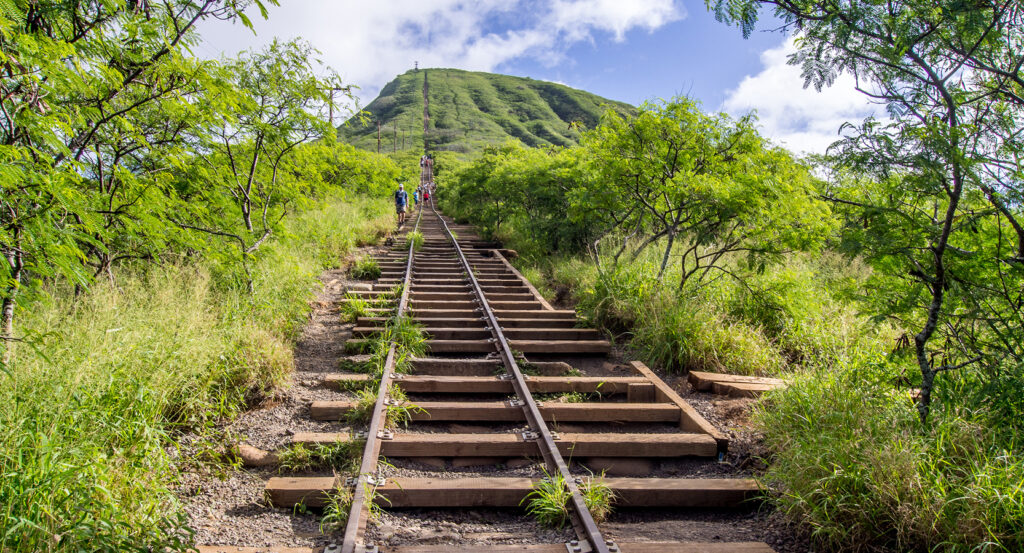
Known locally as “Koko Head Stairs,” this steep, 1,048-step climb follows the remnants of a World War II railway track that once carried military supplies to lookout bunkers perched high above Honolulu's southeastern coastline. Today, those same wooden ties form one of Hawaii's most iconic, and humbling, hikes. From the first step, you feel the burn; by the halfway point, you're questioning your life choices; and at the top, you're rewarded with a view so vast and transcendent it silences the struggle that came before. The Pacific spreads endlessly in all directions, Diamond Head gleams in the distance, and the turquoise bays of Hanauma and Maunalua shimmer below like jewels. Trade winds whip across the ridge, carrying the scent of sea salt and ironwood, cooling your skin and clearing your mind. It's not just a trail, it's a rite of passage, a test of will that turns exhaustion into euphoria and leaves every climber with the same wide-eyed realization: nothing this beautiful comes easy.
What you should know about Koko Crater Railway Trail.
The story of Koko Crater Railway Trail is one of transformation, from military infrastructure to a beloved symbol of perseverance.
During World War II, the U.S. military built a railway up the side of Koko Crater to transport cargo, troops, and equipment to the summit's bunkers, which served as lookout stations for potential naval threats. The narrow-gauge track climbed more than 1,000 feet in less than a mile, a feat of engineering meant for machines, not humans. After the war, the track was abandoned, left to the elements until local hikers rediscovered it and began using it as a trail. The original railway ties remain in place today, serving as makeshift steps, each one uneven, sun-worn, and brutally steep. Midway through the climb, hikers cross a section known as “the bridge”, a short stretch of open beams that hangs over a small ravine, testing both balance and nerves. Despite its intensity, the trail has become a local favorite, drawing everyone from fitness enthusiasts to first-timers chasing that post-hike high. What many don't realize is that the crater itself, part of the larger Koko Head volcanic complex, was formed tens of thousands of years ago by explosive eruptions that left behind a massive, bowl-shaped depression. The summit, once a site of war and surveillance, has since become a sanctuary for reflection, offering panoramic views that extend from the Kaiwi Channel to the Windward Coast. The contrast of its military past and its spiritual present gives the climb an almost mythic weight, a transformation from purpose-built vigilance to pure human endurance.
How to fold Koko Crater Railway Trail into your trip.
To conquer Koko Crater Railway Trail is to embrace both discipline and awe, a challenge best met at sunrise, when the world feels softer and the light gentler.
Arrive early, parking fills quickly, and the Hawaiian sun grows relentless by midmorning. The trail begins at Koko Head District Park, where grassy fields give way to the steep, unmistakable line of wooden steps slicing up the crater's face. Start slow, find your rhythm, and pace yourself, even seasoned hikers stop to rest on the side platforms that overlook the valley. Bring plenty of water, sturdy shoes, and determination; this isn't a leisurely stroll but an ascent that demands respect. About two-thirds of the way up, the “bridge” section offers an adrenaline spike, though you can sidestep it along a dirt path if you prefer solid ground. As you near the summit, every muscle protests, but the view pulls you onward. At the top, take your time. From here, you can see Hanauma Bay's coral lagoon, Sandy Beach Park, and the rolling spine of the Koʻolau Range fading into mist. The city of Honolulu glimmers to the west, and if you stay long enough, you might catch para-gliders drifting lazily in the breeze. The descent is easier, but your legs will tremble with earned fatigue. Afterward, refuel at nearby Koko Marina or cool off with a swim at Hanauma Bay. The trail may take less than two hours, but the feeling it leaves, the fusion of accomplishment, humility, and awe, lingers long after. Koko Crater Railway Trail isn't just a hike; it's a metaphor made real, a climb through pain into perspective, where every step upward feels like rediscovering your own strength.
Where your story begins.
Foresyte Travel reveals places that feel extraordinary long before you arrive.
Experience premium editorial crafted for luxury travelers.