
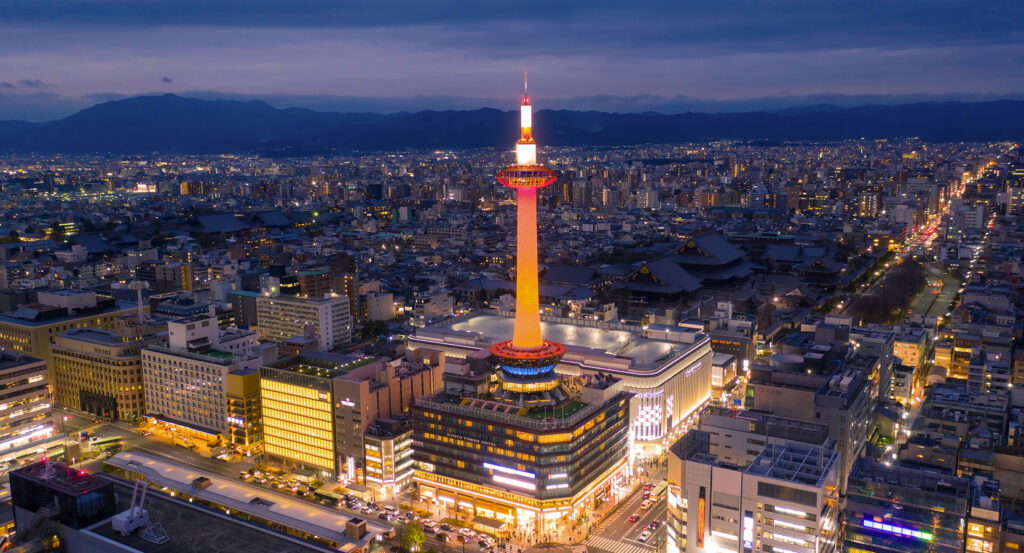
Why Nidec Kyoto Tower matters.
Nidec Kyoto Tower is a soaring observation tower where Shimogyō's transportation hub, postwar optimism, engineering ingenuity, and Kyoto's modern character announce the city's gateway through an elegant silhouette unlike any other on its skyline.
Set along Karasuma-dori near Shiokoji-dori and just steps from Kyoto Station, this slender observation tower rises above the station district through panoramic viewing decks, contemporary exhibition spaces, illuminated interiors, and a gracefully engineered structure where uninterrupted views stretch from the Higashiyama mountains to Arashiyama and across the ordered grid of Japan's ancient capital. Its smooth white profile recalls a lighthouse guiding travelers inland, transforming a modern engineering achievement into the symbolic arrival point for Kyoto. Precision, restraint, and perspective define every level of the ascent.
What defines Nidec Kyoto Tower.
Nidec Kyoto Tower is best known for opening on 28 December 1964 alongside the inauguration of the Tōkaidō Shinkansen after architect Mamoru Yamada designed a 131-meter observation tower employing Japan's first large-scale monocoque structural system, creating Kyoto's tallest structure while demonstrating advanced engineering within one of the nation's most historically protected urban landscapes. Completed in only one year and ten months, the 800-ton tower was constructed directly above a nine-story commercial building, eliminating the need for a conventional lattice structure through a welded cylindrical steel shell that efficiently distributes structural loads while providing exceptional resistance to earthquakes and typhoon-force winds. Structural engineer Makoto Tanahashi of Kyoto University refined the pioneering monocoque design, allowing the tower to achieve a remarkably slender profile. Positioned 100 meters above ground, the observation deck offers uninterrupted views across the Kyoto Basin toward Mount Hiei, Higashiyama, Arashiyama, and countless temple precincts that reveal the city's unique relationship between natural topography and urban planning. Conceived during Japan's era of rapid economic growth, the tower intentionally avoided overwhelming Kyoto's historic skyline, instead serving as a contemporary counterpart to the city's centuries-old architectural heritage. In April 2024, the structure was renamed Nidec Kyoto Tower following a naming-rights agreement while continuing to welcome millions of rail passengers arriving through Kyoto Station each year. Ongoing structural monitoring, façade conservation, lighting modernization, and seismic assessment preserve one of Japan's most influential achievements in postwar structural engineering.
The pioneering monocoque steel shell solved an engineering challenge unique to Kyoto: introducing a prominent vertical structure without disrupting the city's long-established visual character. Instead of relying on exposed lattice construction, the welded cylindrical exterior carries structural loads through its own skin, allowing the tower to remain exceptionally slender while maintaining resilience against seismic activity and powerful seasonal winds. Its lighthouse-inspired profile acknowledges Kyoto's role as a destination reached by travelers rather than a city defined by height, giving the tower a civic purpose that extends beyond its observation deck. More than six decades after completion, the structure continues representing the confidence of Japan's postwar engineering while respecting the architectural rhythm that has long distinguished Kyoto from every other major city in the country.
How Nidec Kyoto Tower fits.
Nidec Kyoto Tower works as the centerpiece of an exploration through Shimogyō's transportation and cultural corridor.
Begin at Kyoto Station, where one of Japan's busiest transportation hubs establishes the modern character of the district before ascending Nidec Kyoto Tower. Continue to Higashi Hongan-ji, whose expansive temple grounds deepen appreciation for Kyoto's religious heritage within walking distance of the tower. Conclude at Kyoto Railway Museum, where historic locomotives and railway innovation provide a memorable finale celebrating another defining chapter of the city's modern development. The progression moves naturally from contemporary infrastructure to panoramic discovery before concluding through Japan's railway history, revealing why Shimogyō remains one of Kyoto's most dynamic districts.
Where your story begins.
Foresyte Travel reveals places that feel extraordinary long before you arrive.
Enjoy editorial crafted for luxury travelers.
Foresyte may earn a commission when you book.

















































































































