Why Madison Street matters.
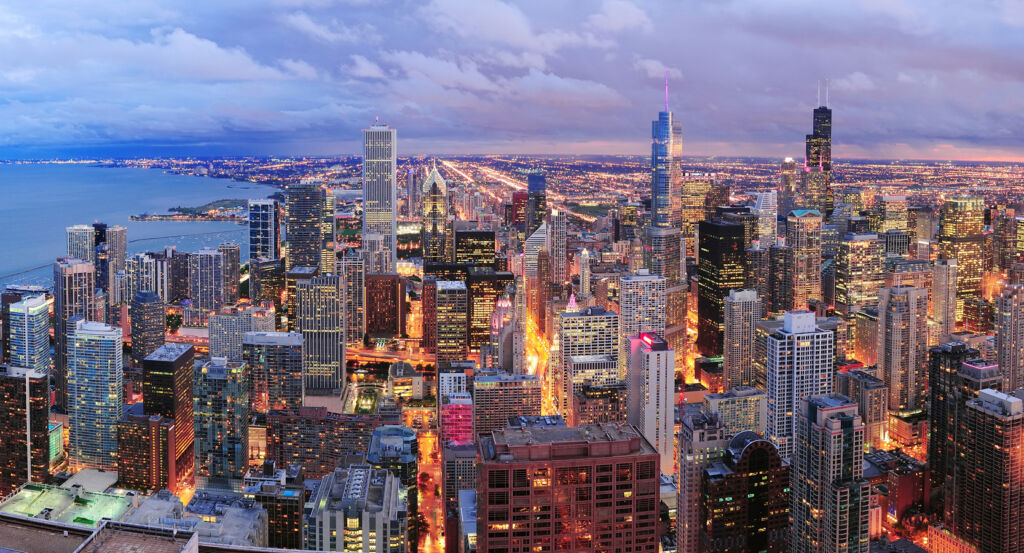
Madison Street is a dynamic corridor where the Loop's commercial ambition, architectural innovation, civic legacy, and Chicago's evolution as a global metropolis have shaped one of the city's most consequential thoroughfares.
Running through the Loop between the West Loop and Grant Park, Madison Street connects landmark office towers, historic theaters, financial institutions, university campuses, public plazas, and celebrated civic spaces that collectively reflect more than 150 years of downtown development. The corridor reveals how commerce, transportation, entertainment, and institutional investment transformed Chicago's central business district into one of North America's defining urban centers. Historic skyscrapers and contemporary architecture remain seamlessly interwoven throughout the streetscape, preserving successive eras of growth while accommodating continual reinvention. The result is a corridor distinguished by architectural achievement, economic significance, and an enduring role at the heart of Chicago.
What defines Madison Street.
Madison Street is best known for serving as Chicago's official east-west baseline, from which all street addresses throughout the city are measured, establishing the corridor as one of the most important reference lines in Chicago's urban grid. Reconstruction following the Great Chicago Fire of 1871 transformed the surrounding district into a showcase for the emerging Chicago School of architecture as steel-frame office buildings, department stores, hotels, and commercial headquarters rapidly replaced the destroyed downtown. Construction of the Union Loop elevated railway between 1895 and 1897, followed by the opening of the State Street Subway in 1943, reinforced Madison Street's importance as one of downtown's principal transportation corridors serving Chicago's expanding commercial core. Continued redevelopment throughout the twentieth and twenty-first centuries has preserved many of the corridor's historic commercial buildings while supporting major investment in office space, higher education, hospitality, and entertainment.
Completion of the Reliance Building in 1895 by architects Burnham & Root and Charles B. Atwood introduced one of the world's earliest steel-frame curtain-wall skyscrapers, establishing architectural innovations that profoundly influenced commercial construction throughout the twentieth century. Creation of the Loop Retail Historic District, later listed on the National Register of Historic Places, recognized an exceptional concentration of late nineteenth- and early twentieth-century commercial buildings immediately surrounding Madison Street that document Chicago's emergence as a national retail capital. Expansion of Roosevelt University after its founding in 1945 strengthened the corridor's institutional presence through academic facilities, performance venues, and continuing educational investment within the Loop. Together, the Reliance Building, Burnham & Root, Charles B. Atwood, the Loop Retail Historic District, the National Register of Historic Places, and Roosevelt University demonstrate how architectural innovation, historic preservation, and higher education have collectively reinforced Madison Street's enduring significance within Downtown.
How Madison Street fits.
Madison Street works as an exploration of Chicago's architectural heritage, cultural institutions, and civic identity.
Begin at The Art Institute of Chicago, where internationally renowned collections establish the artistic foundation of the Loop before following Madison Street westward through downtown. Continue to Chicago Cultural Center, whose extraordinary interiors and civic history deepen the story of Chicago's architectural ambition while complementing the surrounding streetscape. Conclude at Millennium Park, where celebrated public art, innovative landscape design, and sweeping skyline views provide a fitting finale celebrating Chicago's continuing evolution as one of the world's great urban centers. The progression moves naturally from artistic achievement to civic architecture before concluding within the city's foremost public gathering space, revealing why Madison Street remains inseparable from Chicago's enduring identity.
Where your story begins.
Foresyte Travel reveals places that feel extraordinary long before you arrive.
Enjoy editorial crafted for luxury travelers.
Foresyte may earn a commission when you book.