
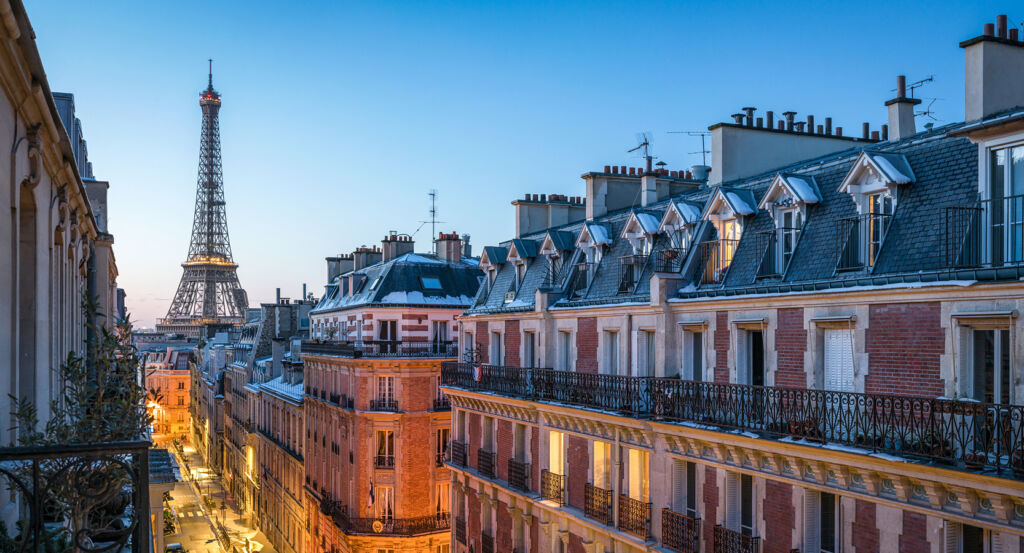
Why you should experience Maison Nabis in Paris, France.
Maison Nabis is a sensual boutique hotel where Nouvelle Athènes's artistic character, fin-de-siècle experimentation, Pigalle's fascinating cultural inheritance and the decorative imagination of the Nabis converge inside Oscar Lucien's richly layered interpretation of late nineteenth-century Paris.
Set along Rue de Parme near Rue de Clichy and just steps from Place de Clichy, the hotel emerged on July 1, 2017 after a year-long renovation transformed the former Pavillon de Paris into a 30-room four-star property designed by Oscar Lucien, founder of Maison Numéro 20. Lucien conceived six floors around precious-stone palettes of mother-of-pearl, yellow opal, amethyst, emerald, ruby and black diamond, connecting them through a royal-blue-and-gold spiral staircase and guestrooms defined by patterned headboards. Custom furniture, marble, gold leaf, aged mirrors, retro fittings and textiles from Dedar, Elitis and Rubelli deepen the decorative style without separating it from the artistic premise. The result is a hotel where color, textiles, furniture and late nineteenth-century art history form a coherent contemporary interpretation of the creative culture surrounding Pigalle and Nouvelle Athènes.
What you should know about Maison Nabis.
Maison Nabis is best known for reopening on July 1, 2017 after one year of renovation transformed the former Pavillon de Paris into a 30-room boutique hotel under Oscar Lucien and his Paris design studio Maison Numéro 20. Honotel had taken over the property in 2008, while the 2017 reinvention replaced its previous character with a concept inspired by the Nabis, the Post-Impressionist avant-garde whose members included Pierre Bonnard, Édouard Vuillard, Maurice Denis and Paul Sérusier and whose experiments with decorative surfaces, flattened perspective and patterned interiors helped dissolve distinctions between painting and decoration. Lucien translated that connection materially through bespoke furniture, passementerie, marble, gold leaf, aged mirrors, pleated lampshades, retro-style fittings and fabrics from Dedar, Elitis and Rubelli, while vegetal and graphic headboards across all 30 guestrooms echo the painted screens adopted as supports by the original Nabis artists. Six guest floors received individual gemstone identities of mother-of-pearl, yellow opal, amethyst, emerald, ruby and black diamond, with the central staircase continuing the chromatic composition in royal blue and gold. Current accommodation preserves the intimate scale through 12-to-15-square-meter Classic rooms, Classic Balcony rooms of the same range, 17-to-20-square-meter Deluxe rooms and 18-square-meter Deluxe Balcony rooms, while Honotel continues operating the property within the HappyCulture network.
Oscar Lucien developed the interiors as a deliberate discussion between the Nabis and the more fascinating history of the surrounding 9th Arrondissement, with Maison Numéro 20 drawing upon the artists, nightlife and maisons closes that once shaped the streets between Pigalle and Nouvelle Athènes. Collinet extended Lucien's decorative program through custom hotel furniture including bedside tables with integrated lamps, desks, minibars, occasional tables and benches, allowing the furniture program to reinforce the same authored style as the fabrics and wall treatments. Dedar, Elitis and Rubelli supplied another material layer through embroidered and patterned textiles, while the Empire-influenced circular banquette, royal-blue upholstery, gilding and mirrors of the principal salon translate the theatricality of the guestrooms into the hotel's central gathering space. Together, Oscar Lucien, Maison Numéro 20, Collinet, Dedar, Elitis and Rubelli establish Maison Nabis as a tightly composed design project in which the 2017 reinvention extends from artistic theory into furniture, fabric, color and spatial composition.
How to fold Maison Nabis into your trip.
Maison Nabis works as the anchor for an afternoon tracing the painters, studios and private artistic worlds that established Nouvelle Athènes as one of nineteenth-century Paris's great creative districts.
Begin at Musée de la Vie Romantique, where painter Ary Scheffer settled in 1830 and established north-facing studios that hosted figures including Eugène Delacroix, Frédéric Chopin, Franz Liszt, George Sand, Charles Dickens and Pauline Viardot during the celebrated Friday gatherings on Rue Chaptal. Continue to Musée Gustave Moreau, where Moreau commissioned architect Albert Lafon in 1895 to convert his family residence into the museum he envisioned for his own work, creating vast north-lit studios connected by a spiral staircase above rooms arranged around the artist's personal memories. Conclude at Musée national Jean-Jacques Henner, where the preserved atmosphere of a nineteenth-century artist's residence extends the afternoon into the private world of another painter associated with the cultural society of western Paris. The progression moves from Scheffer's Romantic salon through Moreau's self-created artistic museum into Henner's intimate setting, revealing the concentration of painterly culture that gives Maison Nabis's own decorative references their geographic depth.
Where your story begins.
Foresyte Travel reveals places that feel extraordinary long before you arrive.
Experience premium editorial crafted for luxury travelers.














































































































